Home/Blog/What Gets Cited by AI Overviews? How Search Fans Out, Why...
Technical Guides2026.10.28
What Gets Cited by AI Overviews? How Search Fans Out, Why Original Information Matters, and How to Measure Visibility
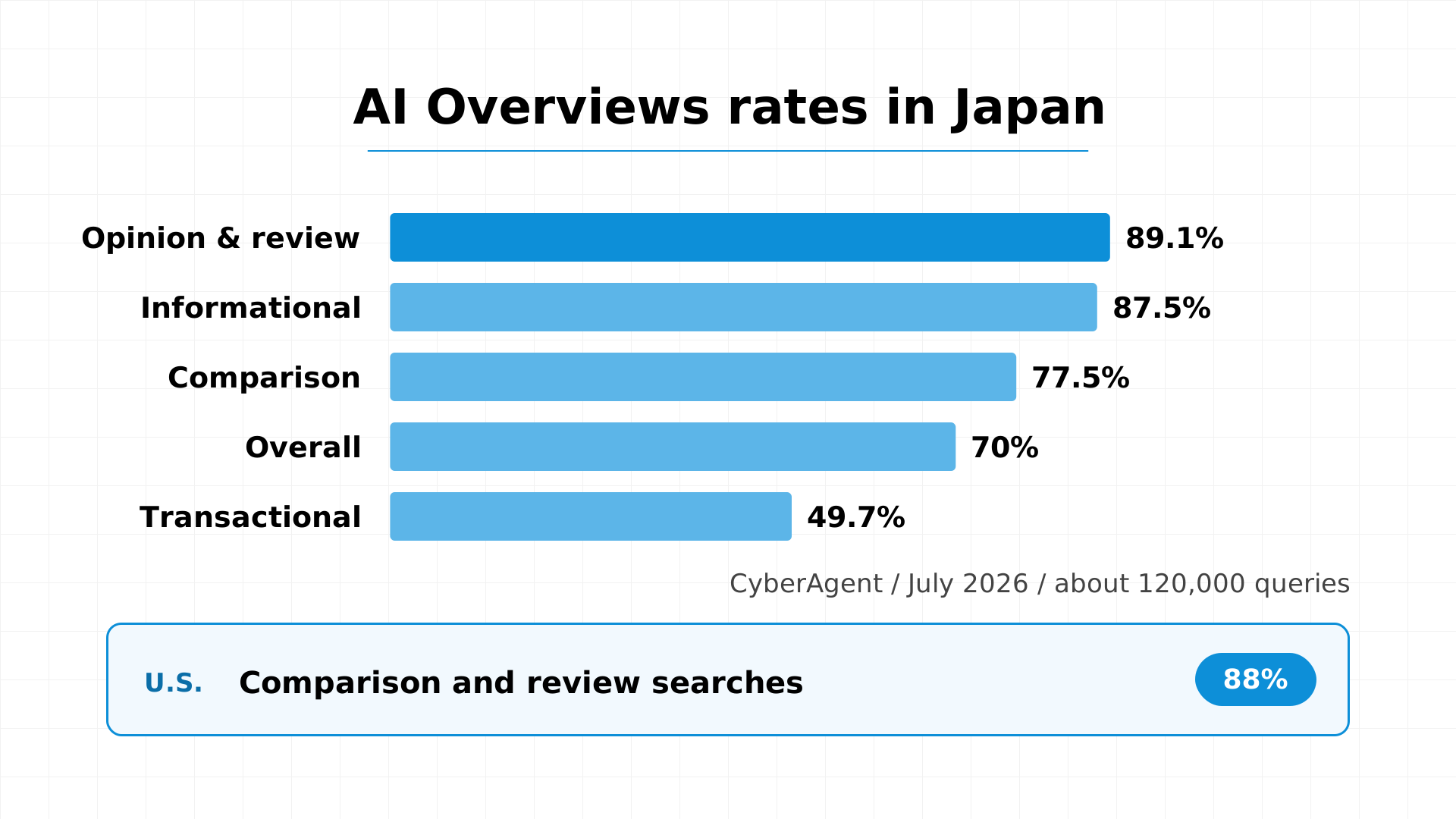
AI Overviews are no longer unusual in Google Search in Japan either. When CyberAgent examined about 120,000 search queries in July 2026, AI Overviews appeared for about 70% of them overall, and for 87.5% of searches looking for information. The first thing searchers read is becoming the AI summary rather than the links in the search results.
87.5%Share of informational searches in Japan that showed AI Overviews (CyberAgent, July 2026, about 120,000 queries)
37.9%Share of AI Overviews sources that ranked in the top 10 for the same query (Ahrefs, March 2026)
~1 hourTime for the AI Overviews answer to change after Feature Upvote fixed old posts and requested indexing
So which pages do AI Overviews choose as sources? Google explains that AI Overviews run on the same ranking systems as regular search. Yet research also shows that just under 40% of cited pages ranked in the top 10 for the same query. This gap is explained by the fact that Google expands the original question into multiple related searches to gather information.
Traditional search optimization
Optimizing for AI Overviews
Scope
Ranking for one query
The whole topic, including related searches
What to write
Answers that match the query
Information, experience, and data other pages lack
What to measure
Rankings and clicks
Citations, brand mentions, and their consistency
This article explains which searches trigger AI Overviews and how sources are chosen, then covers how to write content that gets cited, a case where a wrong answer was fixed, and how to measure visibility. It also shows how to keep tracking AI Overviews answers with Dr.AISEO.
Comparison and Review Searches Show AI Overviews 80–90% of the Time, in Japan Too
AI Overviews are more likely to appear for research, comparison, and reputation searches, and less likely for searches made to complete a purchase or visit a store. For comparison and review searches, the appearance rate in Japan is at roughly the same level as in the U.S. Google explains that it shows AI Overviews when its systems determine that a searcher wants to quickly understand information from a range of sources (Search Engine Land).
Japan: 89.1% for Review Searches, 77.5% for Comparison Searches
In CyberAgent's study (July 2026, about 120,000 queries), AI Overviews appeared for about 70% of queries overall. Broken down by search purpose, the rate was 87.5% for informational searches looking for knowledge, methods, or reputation, and 49.7% for transactional searches such as purchase consideration, applications, reservations, and finding nearby stores (Web Tantou-sha Forum, Japanese).
The same study reports appearance rates for each combination of 26 categories and 10 search purposes. Taking the simple average across categories, opinion and review searches (part of the informational group) came to 89.1%, and purchase consideration and comparison searches (part of the transactional group) came to 77.5%. What pulls the transactional average down is searches to buy a product directly by name and searches for nearby stores. For searches that compare products and services or check their reputation, AI Overviews already appear 80–90% of the time in Japan.
U.S.: 88% for Comparison and Review Searches
In the U.S. too, AI Overviews have grown rapidly on searches at the comparison and consideration stage. When Semrush tracked 400 queries in banking, software, and e-commerce containing "alternatives," "[brand] vs [brand]," "best," "pricing," and "reviews" for 12 months, the appearance rate rose from 45.75% in September 2025 to 88% in August 2026. Weighted by search volume, it was 97.08% (Semrush).
Seer Interactive's analysis of 5.47 million queries in April 2026 likewise found AI Overviews on 95.4% of comparison queries and 85.9% of question-format queries (Search Engine Land). The figures cannot be compared directly because the methods differ, but the 80–90% level for comparison and review searches is not very different between Japan and the U.S.
Look at the Work a Query Asks Google to Do, Not the Query Type
To judge which searches will show AI Overviews, it is more useful to look at what work a search asks Google to do than at how the query is classified. Searches that need several pieces of information combined to answer, such as explanations, comparisons, and recommendations, are the ones AI is most likely to summarize. Searches where your products or services are compared also reach people close to a purchase decision, so they are worth checking first.
How Does Google Gather Information and Choose Sources?
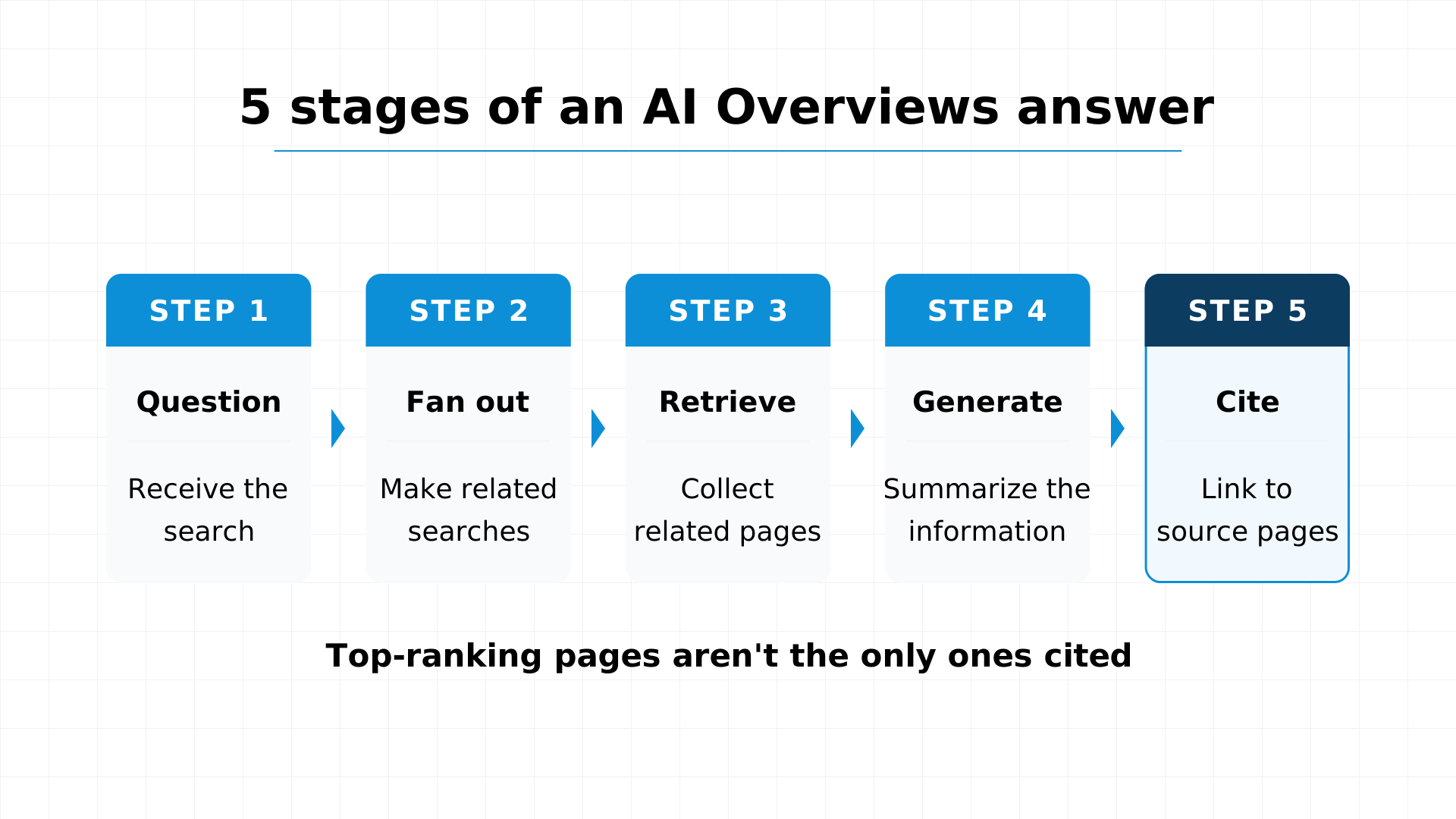
AI Overviews expand the original question into multiple related searches, gather information from pages in the search index, and build an answer. As a result, pages that rank high for the original query are not the only ones cited.
Built on Search, Expanding the Question to Investigate
In its optimization guide for generative AI features published in May 2026, Google stated that generative AI features such as AI Overviews are rooted in its core Search ranking and quality systems (Google Search Central). To build an answer, they retrieve relevant pages from the search index and generate a response based on their content. This method is called RAG (retrieval-augmented generation), also known as grounding.
The other key feature is a mechanism that creates several related searches from the original question and runs them at the same time (query fan-out). Using the question "how to fix a lawn that's full of weeds" as an example, the guide explains that related searches are created about herbicides, removing weeds without chemicals, and more. To appear in AI Overviews, a page must be indexed and eligible to be shown in search results with a snippet.
60% of Sources Come from Outside the Top 10
In an analysis Ahrefs published in March 2026 (863,000 search results and about 4 million AI Overviews citation URLs), 37.9% of cited pages ranked in the top 10 for the same query. 31.2% ranked 11th to 100th, and 31.0% ranked below 100th (Ahrefs).
This result is easier to understand alongside the fan-out mechanism. When Surfer analyzed 10,000 queries and 173,902 URLs in November 2025, pages ranking for both the original query and related searches were 161% more likely to be cited than pages ranking only for the original query (Search Engine Land). This is a correlation, and it does not prove that ranking for related searches causes citations. The related searches generated for the same question also change on every run; only about 27% stayed the same.
The target query is just a starting point. Preparing information that covers the points readers will want to know next, around that query, widens your chances of being cited.
Five Ways to Write Content That Gets Cited
There is no set formula for getting cited. The basic approach is to write the information readers need to make decisions more specifically and clearly than other pages. The agency author who wrote for Search Engine Land looked back on two and a half years of testing and noted that some techniques that spread as ways to write for AI Overviews turned out to be unfounded folklore (Search Engine Land).
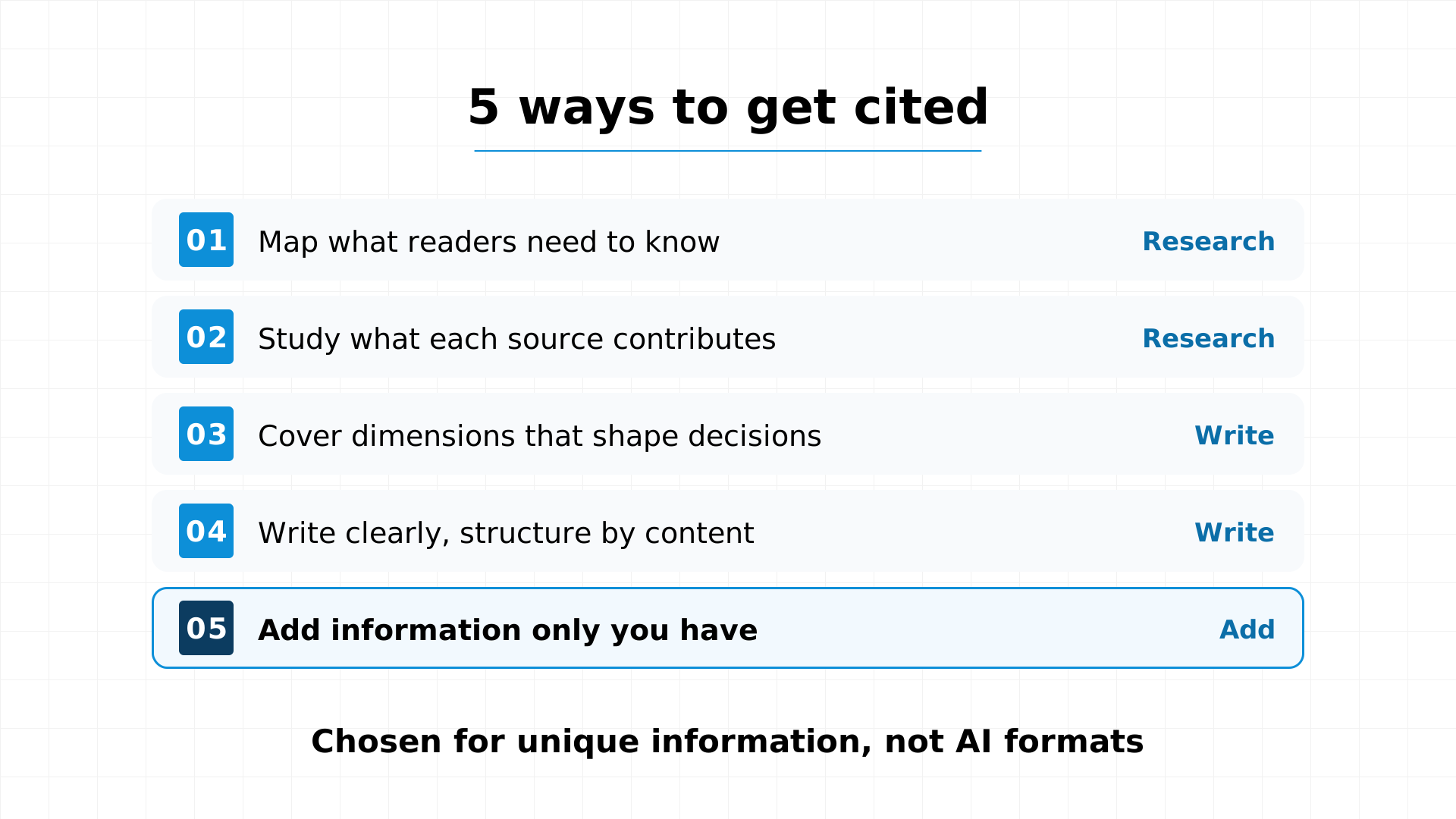
Map what readers need to know: Rather than looking only at the query, write down what the searcher wants to understand and decide. Sorting out what needs explaining, what they might compare, and what questions will follow defines the scope of the article.
Study what the currently cited pages contribute to the answer: Beyond checking the top-ranking pages, check which part of the answer each page cited in AI Overviews supports. Points that are vague, that assume too much prior knowledge, or that lack evidence are where your page can step in.
Cover the dimensions that shape decisions: Address the factors that influence a reader's decision, such as cost, process, benefits, comparisons, risks, and requirements. These dimensions vary by industry: implementation effort and integrations for software, or specifications and processes for manufacturing. That said, there is no need to add loosely related topics just to widen the scope.
Write clearly and structure the content to fit it: Give a straightforward answer to a straightforward question, state definitions explicitly, and if the answer depends on three conditions, name all three. Decide headings and structure based on the nature of the information, such as numbered steps for processes and tables for comparisons.
Add information only you have: Commodity information such as basic definitions and familiar tips can be produced endlessly with AI. Information other pages cannot copy, such as your own data, customer outcomes, test results, implementation experience, and expert insight, is what earns citations.
You Don't Need to Write "for AI"
In early AI Overviews optimization, conversational writing, numbered steps, and short, finely divided paragraphs were said to work. The author now believes it was not the format itself that worked, but clear answers and the cost, conditions, and exceptions surfaced within the steps.
Google's guide also says there is no need to write in a specific way for generative AI search, and that AI can understand synonyms and the intent of a search. It also says there is no need to break content into small pieces for AI to understand it. On mass-producing pages for each related search, the guide states that doing so to manipulate rankings or AI answers violates its spam policy on scaled content abuse (Google Search Central).
The Most Valuable Is "Unique Evidence and Experience"
The author of the Search Engine Land article views the value of information in four stages. From lowest to highest: a commodity answer, a clear explanation, an understanding that covers the relevant dimensions, and, most valuable of all, unique evidence and experience (Search Engine Land). The higher the stage, the more specific and worth retrieving the information is for Google, and the harder it is for readers to find elsewhere. Google's guide also recommends first-hand information such as unique viewpoints and reviews based on personal experience. Why original information gets chosen by AI is also explained in "What Is “Net Information Value”? The Only Way to Stand Out in a Sea of AI-Generated Content."
Case Study: How Feature Upvote Fixed a Wrong Answer
Even if AI Overviews give a wrong answer about your company, the answer can change once you fix the source page and have Google crawl it again. This is the case of Feature Upvote, which provides a feature-request voting tool, as reported by Semrush (Semrush).
Old Blog Posts Were the Source
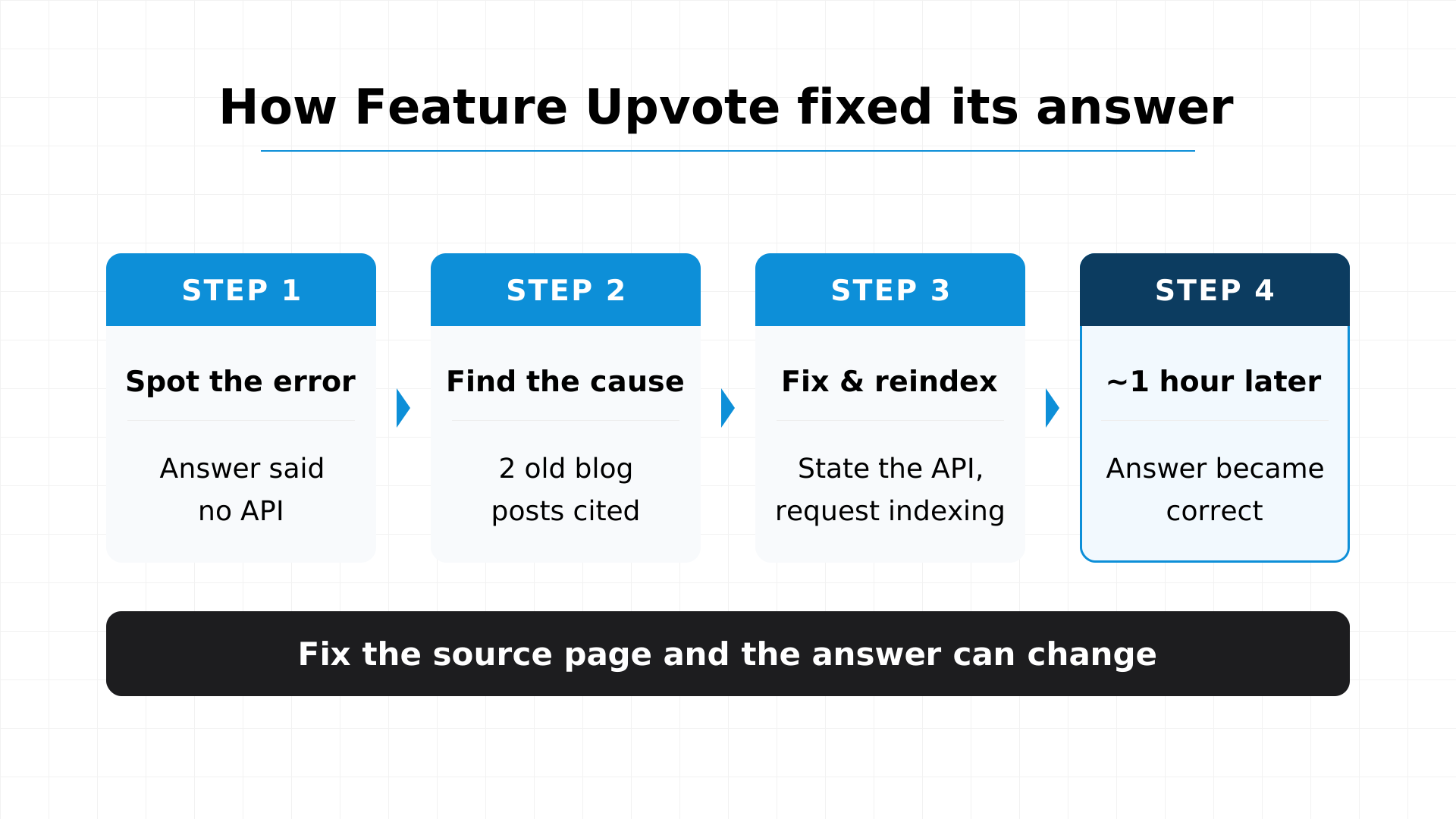
In July 2026, Feature Upvote's founder searched for the company name and "API" to find the documentation for its API (a way to connect with external systems), which had been published about a week earlier. AI Overviews answered that the company had no API. The sources were two old company blog posts written before the API existed. The new documentation, with "Public REST API" as its heading, was not cited.
Fixing the Old Posts and Requesting Indexing
The company fixed the old posts cited by AI Overviews to state that an API exists, and asked Google to index the updated pages. Along the way, it also found that the blog post announcing the API had not been indexed. Getting industry media to cover the API was also considered, but not carried out.
The Answer Changed in About an Hour, but Wobbled for Days
On July 28, about an hour after the indexing request, the AI Overviews answer changed to say the API exists. The next day, the founder searched three times while logged out to confirm it was not a fluke. However, depending on how the question was phrased, wrong answers kept appearing for several more days. As of September 10, the answer was still correct, but the sources had shifted from the announcement post to a product page and an article on using the API.
Semrush concludes that fixes can take weeks or months, that there is no guarantee a correct answer will last, and that answers need to be rechecked regularly. When you find a wrong answer, it recommends not judging from a single search, but recording the full answer, date and time, and sources for three to five phrasings. How to check what appears when people search your brand name is explained in detail in "AI Overviews Now Appear on 80% of Branded Searches. When People Search Your Name, What Do They Read First?"
How Should You Measure Visibility in AI Overviews?
Visibility in AI Overviews cannot be measured by whether you were cited alone. Look at how prominent the citation is, whether your brand appears in the answer text, and how consistent you are across related searches, then connect it all to search performance and business outcomes.
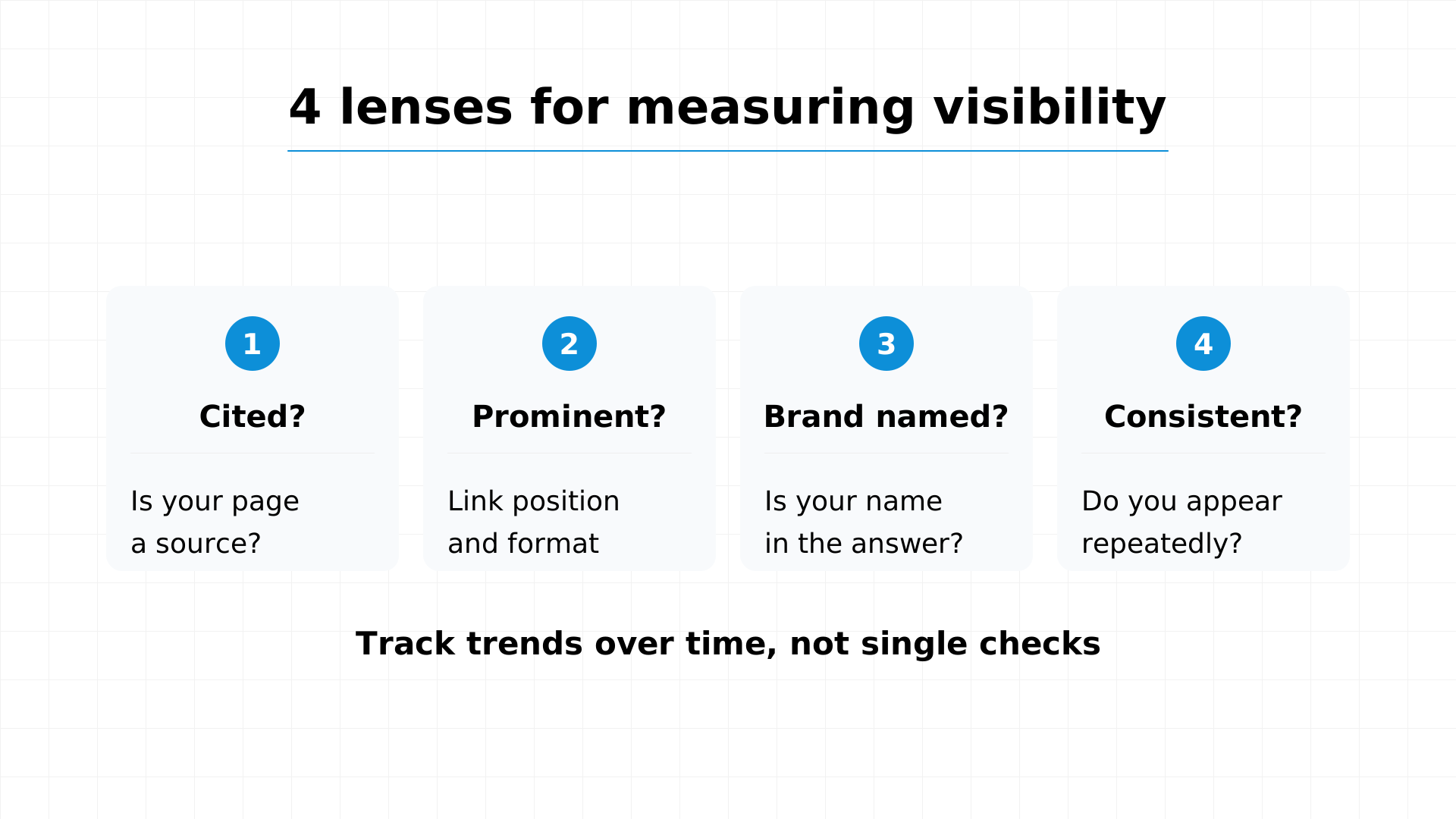
Look Through Four Lenses
The Search Engine Land author views visibility in AI Overviews through the following four lenses. This captures reality better than asking "where do we rank in AI Overviews?"
Are you cited?: Whether your page is among the sources.
Is the citation prominent?: Where in the answer the citation link appears, and in what form. In October 2026, Google announced a change that shows inline links within answers more often and higher up, so the same citation can vary in prominence (Google).
Is your brand named?: Whether your company name appears in the answer text. Google may use information from a page without making the source or brand prominent.
Do you appear consistently?: Whether you show up the same way across important searches and related ones when checked repeatedly.
The fourth lens, consistency, matters most, because AI answers change every time you ask, even for the same question. In November–December 2025, SparkToro worked with about 600 volunteers to send the same questions repeatedly to ChatGPT, Claude, and Google's AI (AI Overviews, or AI Mode when AI Overviews did not appear). For Google's AI, even when the same question was asked 100 times, the chance of getting the exact same set of recommended brands in two or more responses was less than 1%. In other words, the combination of brands named differs almost every time, even for the same question (SparkToro). Rather than judging from a single check whether you appeared, check repeatedly and look at how often you appear.
Use Search Console's Generative AI Report as the Foundation
In June 2026, Google added performance reports for generative AI features to Search Console. You can see how often your pages were shown in AI Overviews, AI Mode, and generative AI features in Discover, by page, country, device, and date (Google Search Central). It is also available in Japan, and as data Google itself provides, it serves as the foundation for measurement (Web Tantou-sha Forum, Japanese).
However, this report shows impressions only, without clicks or queries (as of October 2026). It does not tell you which searches you were cited for, what the answer said, or how competitors appear, so for important searches you need to supplement it with separate measurement that records the answers themselves.
Connect to Search Performance and Business Outcomes
Being cited does not necessarily increase clicks. In Seer Interactive's data, pages cited in AI Overviews earned 120% more clicks per impression than pages on results with AI Overviews that were not cited, but 38% fewer than searches with no AI Overviews at all (Search Engine Land).
A survey of users in Japan also found that 63.2% sometimes or often end their search with the information in AI Overviews alone. At the same time, 54.2% sometimes or often click links within AI Overviews (CyberAgent, Japanese). The order of measurement is "visibility in AI → search performance (impressions, click-through rate) → business outcomes (inquiries, growth in branded searches, and so on)." Looking at citations and clicks side by side lets you judge how changes in visibility translate into results.
Keep Tracking AI Overviews Answers with Dr.AISEO
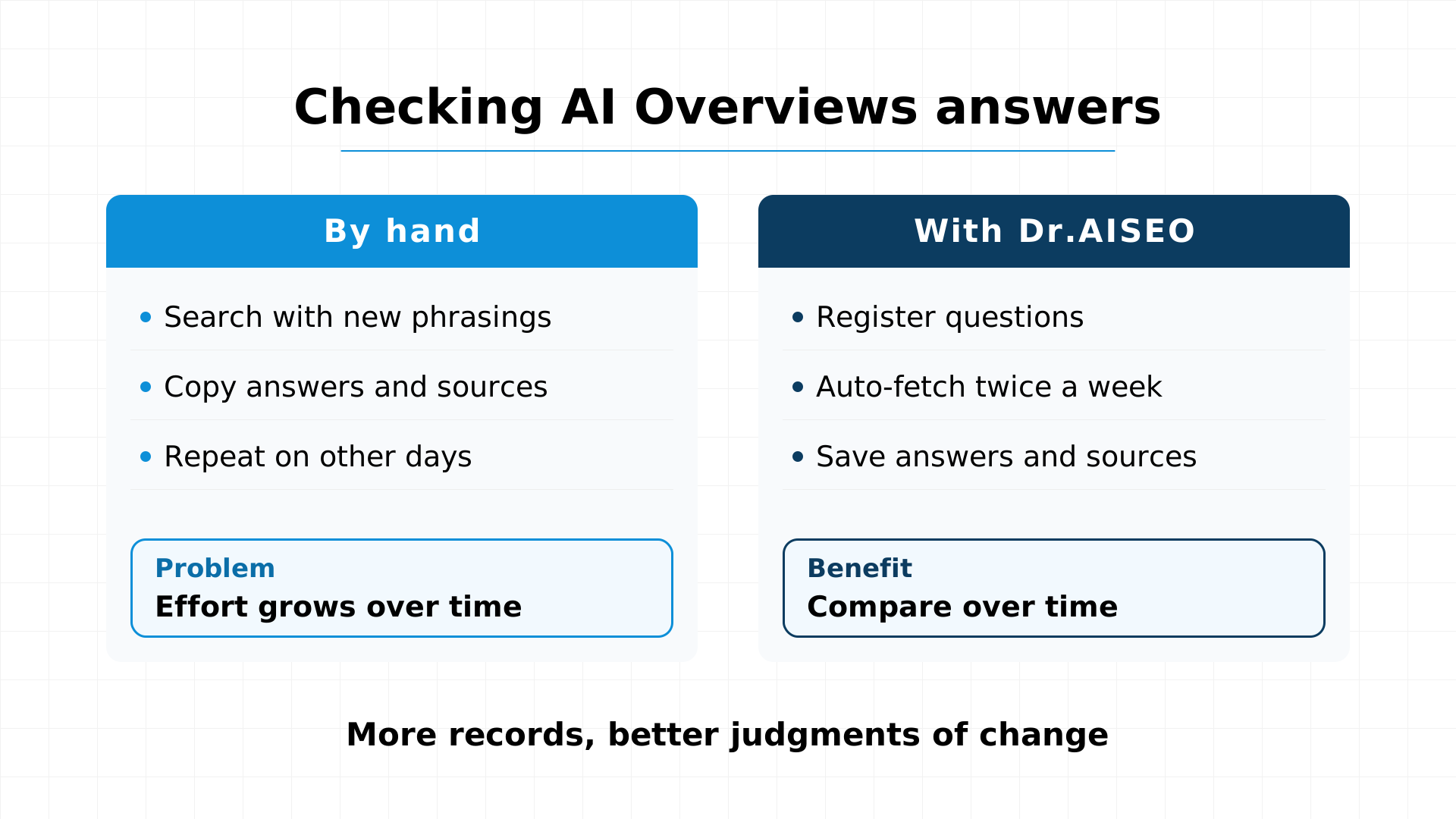
In both the Feature Upvote case and the Search Engine Land author's measurement, the key is "checking the same question repeatedly with different phrasings, and recording the answers and sources." Done by hand, the effort grows with the number of queries, and past answers are not kept. Dr.AISEO builds up this record automatically.
Fetched from Japanese Search Results in Japanese
Dr.AISEO fetches Google AI Overviews from the search results page, with the region set to Japan and the language set to Japanese (as of October 2026). Registered questions run automatically twice a week (Sunday and Thursday), and you can also run them manually when needed. Runs where AI Overviews did not appear are recorded too, so you can track changes in whether they appear at all. The details of how data is fetched are disclosed in "Should You Measure AI Search via the UI or the API? Why the Same ChatGPT Gives Non-Overlapping Results."
Trace Back to the Answer Text and Source URLs
Measurement results let you check not only aggregated figures but also the underlying AI Overviews answer text and source URLs. In addition to whether your pages are cited, AI judges from context whether your company name appears in the answer text. Generic nouns with the same spelling and different companies with the same name are not counted. When a wrong answer appears, you can trace which pages are the sources and identify the page to fix, as Feature Upvote did.
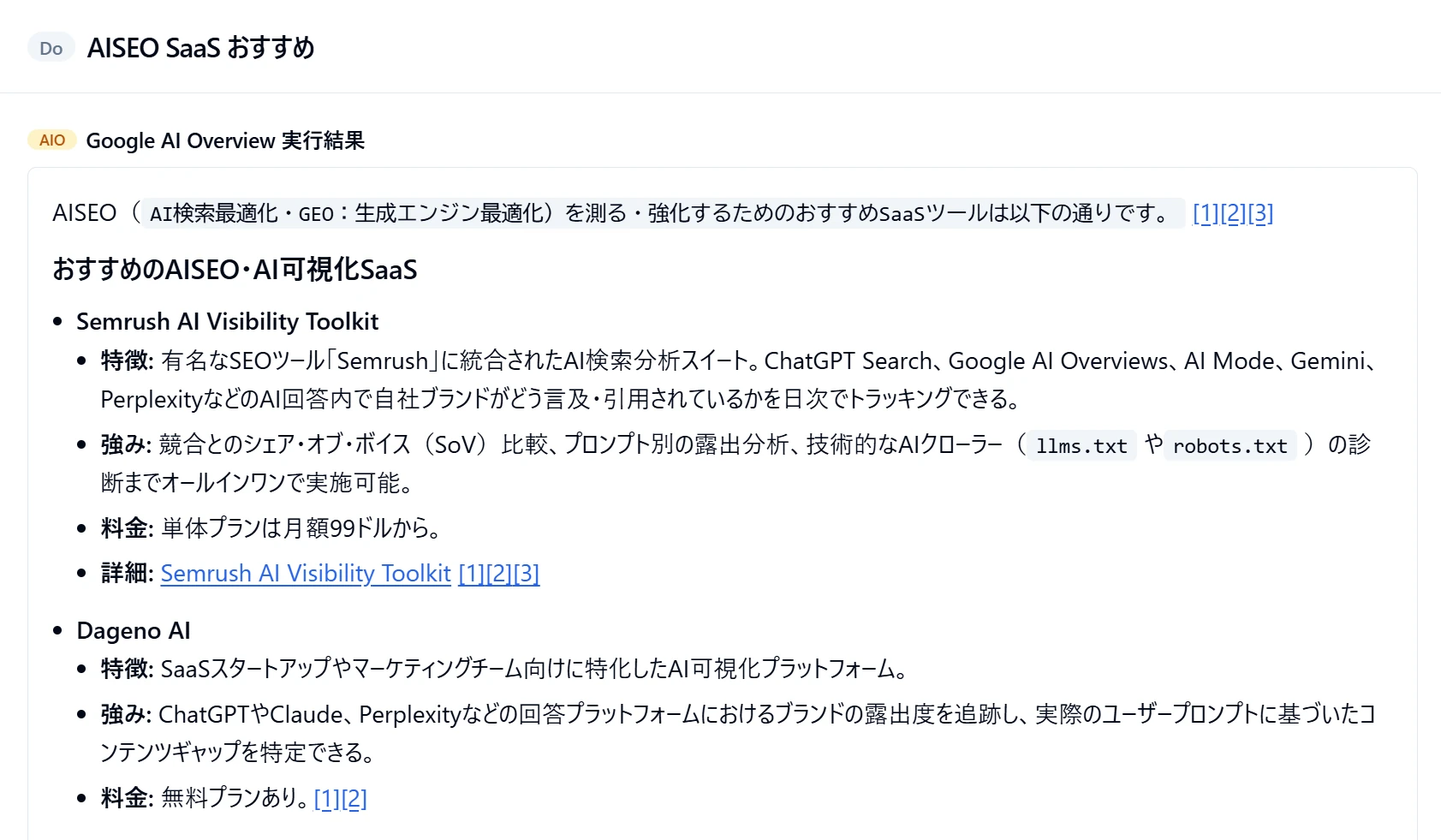
Dr.AISEO's AI Overviews result screen. You can see the answer to a registered question and the links to its sources as they are.
Register Different Phrasings to Check Consistency
By registering several differently phrased questions on one topic, you can check over time whether you appear consistently across related searches. Registering competitor brands also lets you compare who appears in the same answer. As records build up, you can judge the before-and-after of page fixes, and changes in the appearance rate itself, with your own data.
Summary: Add Information Only You Can Provide, Rather Than Copying Formats
AI Overviews now appear for nearly 90% of informational searches in Japan too. Sources are chosen on the same systems as regular search, with the original question expanded into multiple related searches. That is why many pages outside the top 10 are cited.
You do not need a special way of writing for AI to get cited. Covering the dimensions readers need for decisions, writing clearly, and adding information other pages cannot copy, such as your own data and experience, is the approach that keeps working. Even when a wrong answer appears, fixing the source page can change it.
Check visibility over time through four lenses: whether you are cited, how prominent the citation is, whether your brand is named, and how consistently you appear. Use the Search Console report as the foundation and supplement it with records of the answers themselves. Dr.AISEO offers a free plan, so you can check how AI Overviews answer questions about your business, down to the answer text and sources.
[[2026 Update] How Does AI Search Work? GEO for Getting Websites "Recommended" by AI (Web Tantou-sha Forum, Japanese)](https://webtan.impress.co.jp/e/2026/10/09/53334)