What Gets Cited by Gemini? How It Rewrites Queries, Where It Quotes From, and What It Reads in Japan
In an August 2026 survey of 9,278 people aged 15 to 69 across Japan by CyberAgent's GEO Lab, 23.2% said they use Gemini as a way to search, ranking third after ChatGPT (30.6%) and AI Mode (28.4%) (CyberAgent). To get your brand named by Gemini, you need to know what Gemini searches for, and which part of which page it cites.
80%Share of Gemini's cited passages that start in the first half of the body text (RESONEO)
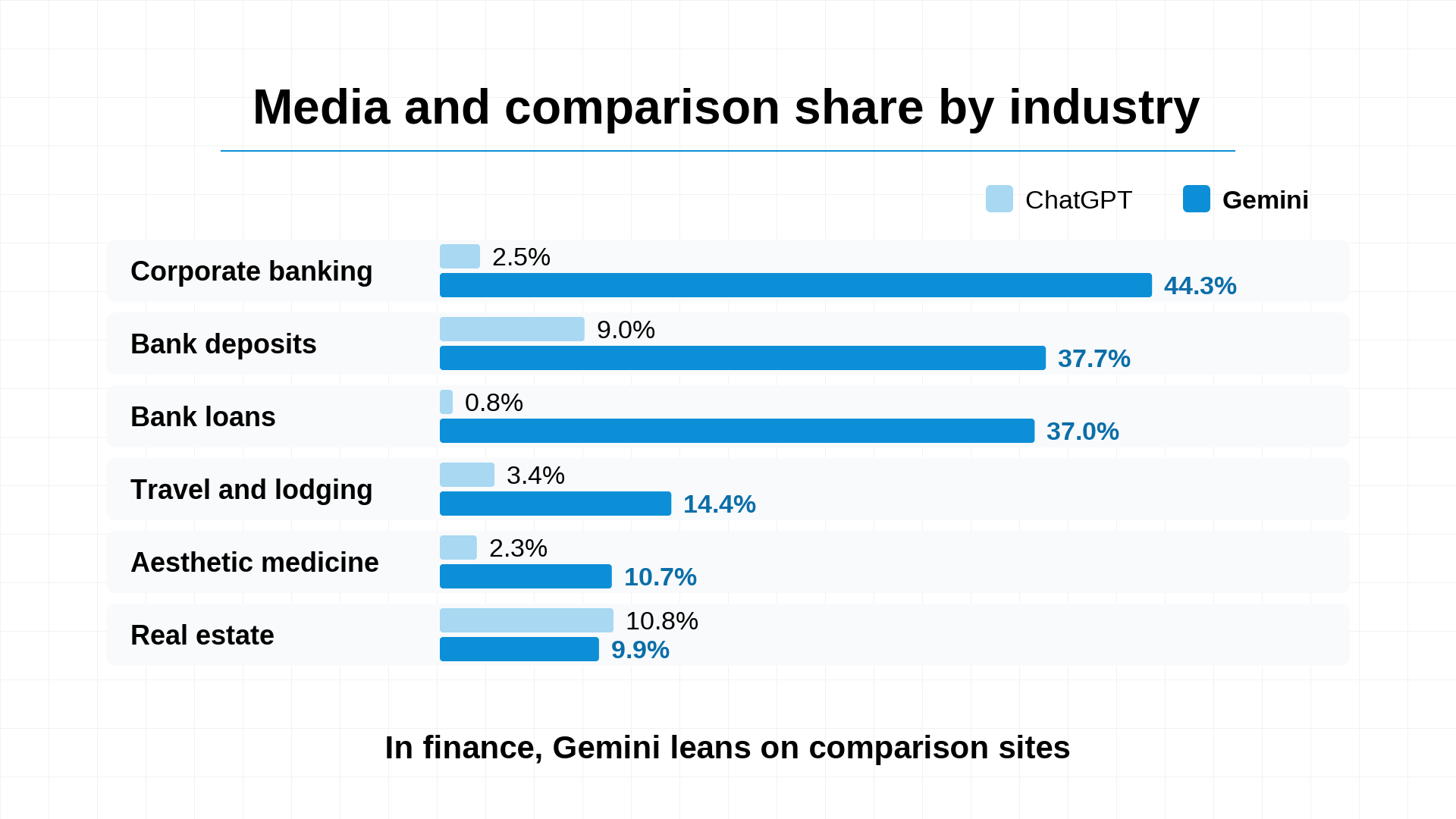
44.3%Share of media and comparison articles Gemini consulted for corporate banking questions (ChatGPT: 2.5%)
23.2%Share of people in Japan who use Gemini as a way to search (ChatGPT: 30.6%)
In October 2026, the French SEO agency RESONEO analyzed 76,450 publicly shared Gemini conversations and the 222,753 Google searches behind them. It found that Gemini rewrites questions into keyword strings before searching, cites only about 30% of the pages it consults, and takes most cited passages from the first half of a page. Meanwhile, a joint study by Dr.AISEO and Bakuri Inc. found that in Japan, Gemini consults comparison and ranking articles far more often than ChatGPT does.
Question
What we now know
What to do
How does it search?
It turns questions into keywords and adds years and English terms
Write years, proper nouns, and figures in the body text
What does it cite?
About 30% of consulted pages; 80% of cited passages start in the first half
Put the conclusion and supporting facts early on the page
What does it read in Japan?
More comparison and ranking articles than ChatGPT
Be accurately covered by industry comparison sites and media
This article uses published research to explain how Gemini gathers and cites information, what it reads in Japan, which tactics work now, and how to check Gemini's answers with Dr.AISEO.
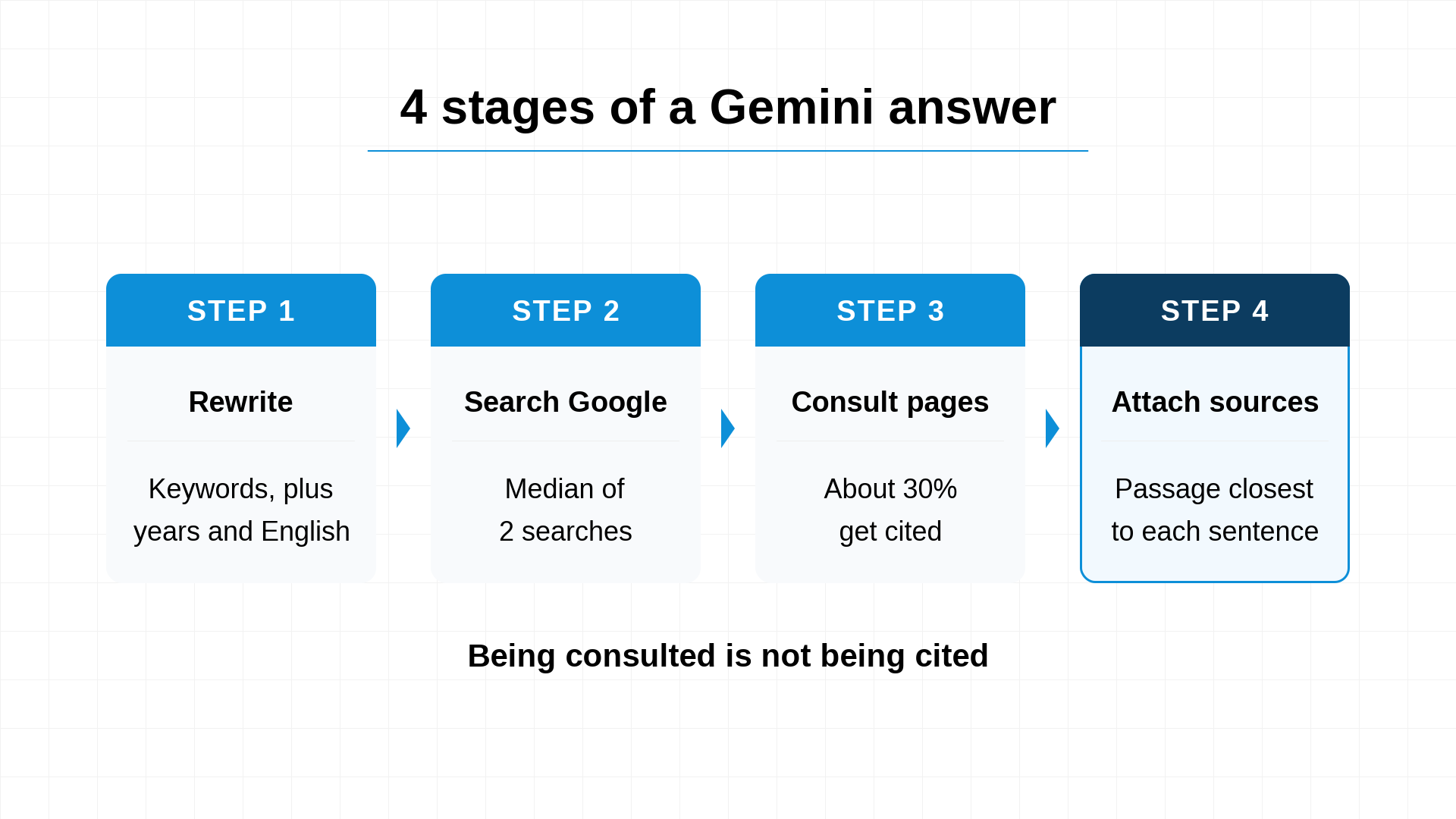
When Gemini receives a question, it gathers information through Google Search, writes an answer while consulting the pages it found, and attaches the passage from a page that is closest to each sentence of its answer as the source. Because the foundation is Google Search, a page that Google cannot find is unlikely to become material for Gemini's answers either.
RESONEO's analysis covers Gemini conversations shared publicly between November 2024 and October 2026 (RESONEO). The shared conversations record the Google searches Gemini ran, the pages it consulted, and the passages it cited, which makes it possible to read what happens behind an answer. Google has not officially explained this mechanism, so these findings should be read as external observation.
Gemini is searching less often. According to the same analysis, the median number of searches per answer was 4 from January to April 2026, 3 in May, and 2 from June onward. With fewer searches per answer, it matters more than ever to be found in the first search.
Gemini's models change frequently. Google added Gemini 3.8 Flash in September 2026 and Gemini 4 Argon in October 2026 as selectable models in AI Mode (Search Engine Journal). When the model changes, the way it searches and the pages it cites change too. Read the figures in this article as observations as of October 2026.
Questions Are Rewritten Before They Are Searched
Gemini does not search the user's question as typed. It rewrites the question into search-friendly terms first. Knowing the rewrite patterns shows what to write on a page so it gets picked up.
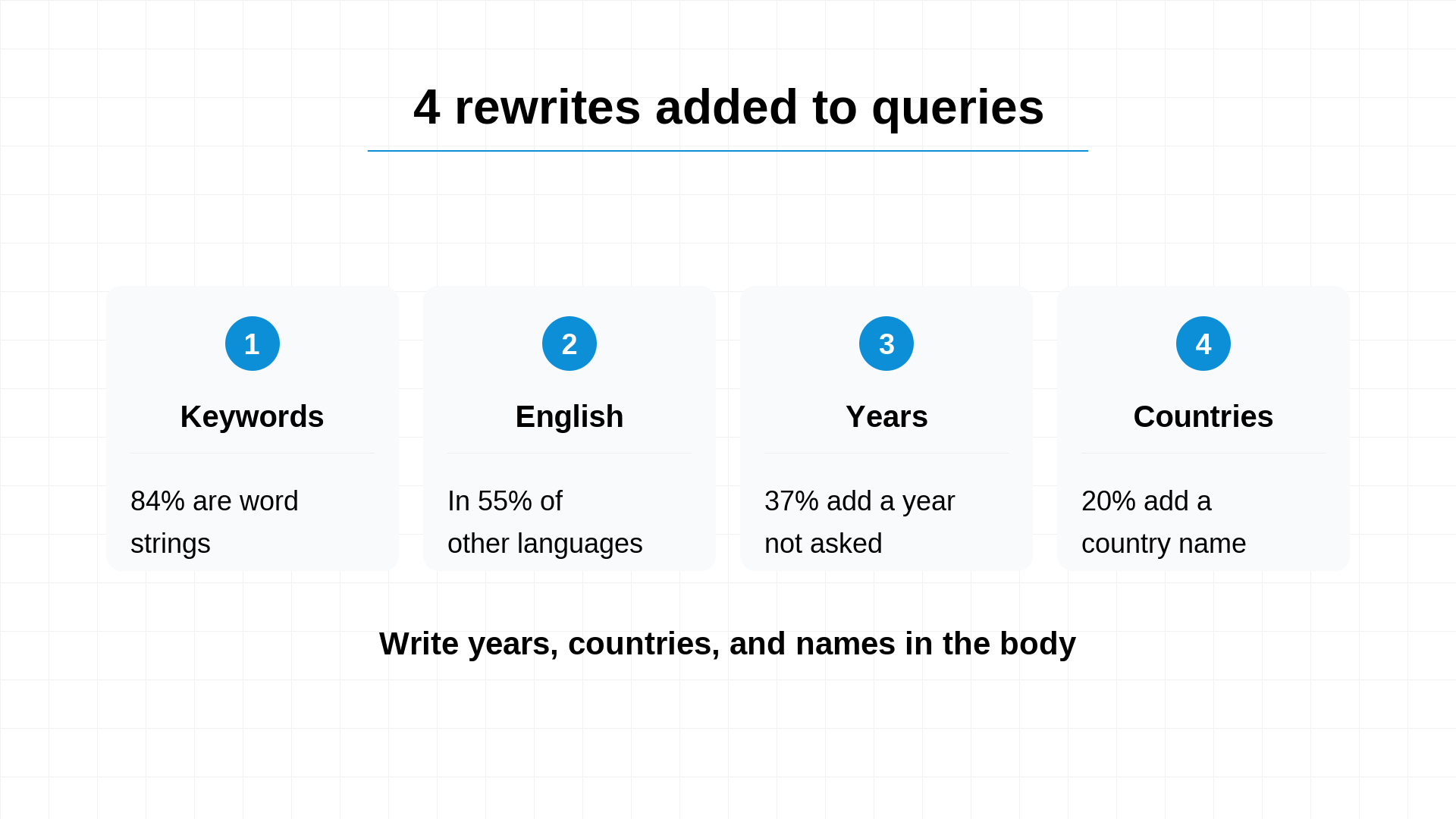
Keyword strings: 84% of queries were strings of keywords rather than questions.
English: Even when the question was asked in another language, 55% of searches included an English query.
Added years: 37% of queries added a year (such as "2026") that was not in the question.
Added countries: 20% of searches added a country name, rising to 31.5% for questions in French.
In addition, about a quarter of searches added proper nouns such as brand names, product names, or people's names. Comparison queries ("A vs B") accounted for 12% overall but fell below 3% from June 2026 onward.
For companies, years and proper nouns are what matter most. If Gemini adds words such as "2026," "pricing," or a company name before searching, pages that contain those words are more likely to be picked up. Write the point in time in the body text, as in "pricing as of October 2026," not only in the updated date, and spell out company names, product names, and figures.
The English rewrite needs a caveat. The share of English queries fell from 65% in January 2026 to 26% in October. Much of the analysis focuses on English answers, so the same pattern may not hold for questions asked in Japanese.
Being Consulted Is Not Being Cited: Only About 30% Are
On average, only about 30% of the pages Gemini consults for an answer are cited as sources. Getting picked up in search and being shown as a source in the answer are two separate stages.
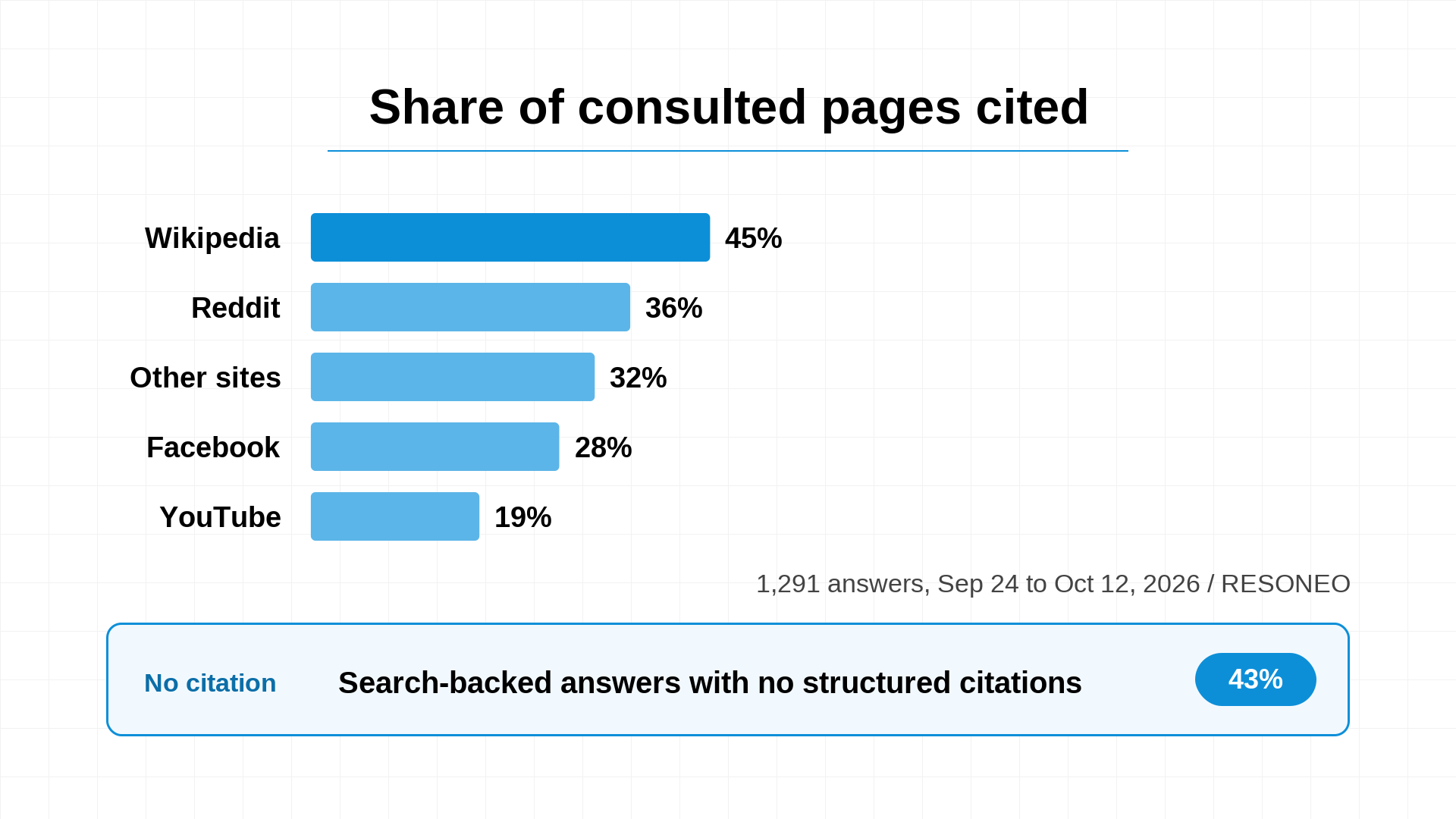
When RESONEO examined 1,291 answers from September 24 to October 12, 2026, the share of consulted pages that were cited was 45% for Wikipedia, 36% for Reddit, 32% for other sites, 28% for Facebook, and 19% for YouTube (RESONEO). YouTube was consulted in 18% of answers but cited in only 5%.
Many answers show no sources even after searching. In the same analysis, 43% of the 7,277 search-backed answers from May 11 to October 12, 2026 displayed no structured citations. The share has fallen from 79% in January 2026, but citation counts alone cannot tell you whether Gemini read your page.
Citations are not limited to major sites, either. In the same analysis, 51% of answers with citations cited at least one site ranked below 1,000,000th in a global ranking based on Chrome usage data, or not ranked at all. Even a small site can be cited if it states facts that fit the question exactly.
Three Traits of Passages That Get Cited
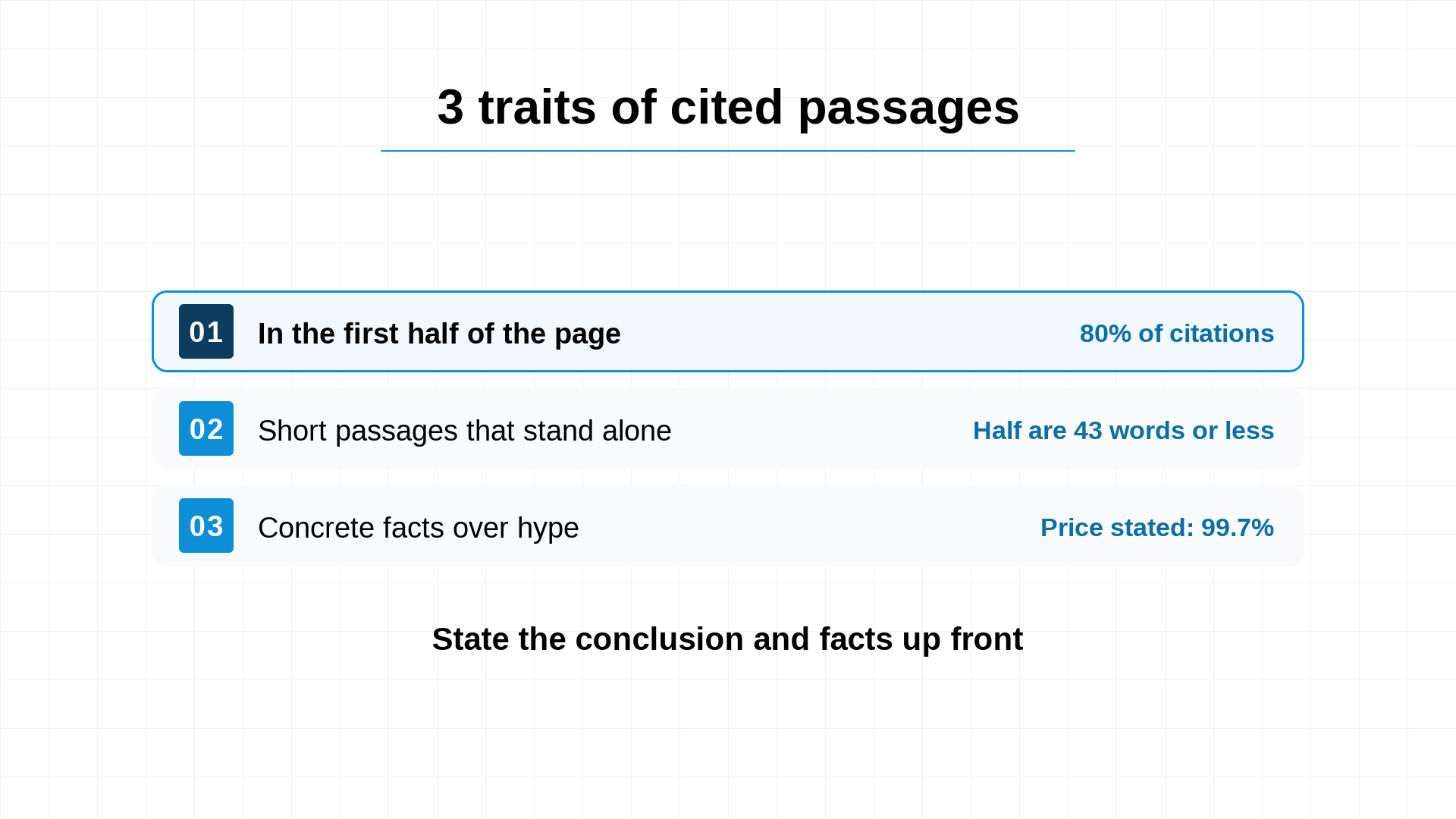
Gemini tends to cite the passage closest to a sentence in its answer, and it takes that passage from the first half of a page. The passages most likely to be cited sit in the first half of the page, make sense on their own, and state concrete facts.
Placed in the first half of the page: When RESONEO examined 1,454 cited passages, 33% began in the first 10% of the body text and 80% began in the first half (RESONEO). Put the conclusion and its supporting facts at the top of the page.
Short passages that stand alone: Half of the cited passages were 43 words or fewer. In 54% of cases, the cited passage was the one on the page closest to the answer sentence. RESONEO infers that Gemini writes its answer first and then attaches the closest passage as the source. Writing that states one fact per paragraph, without relying on earlier paragraphs, is easier to link as a source.
Concrete facts over hype: dejan.ai ran 5,381 tests in October 2026 in which Gemini 4 Argon chose which of two pages, differing in only one feature, to use as a source. Pages that stated a price were chosen 99.7% of the time, while pages using exclamation marks or all-caps emphasis were almost never chosen (dejan.ai).
Note that dejan.ai's experiment used pages created for the test, not observations of real citations in search. The company also sells analytics tools. RESONEO itself cautions that 43 words is not an optimal length. Stating the conclusion and facts up front matters more than hitting a word count.
Cited passages are not reused word for word. In the same RESONEO analysis, 70% of answer sentences shared no four-word sequence with their source. Because Gemini paraphrases its sources, clear factual sentences whose meaning survives paraphrasing are an advantage.
Sites Gemini Cites: News and Reddit Abroad, Comparison Articles in Japan
The sites Gemini cites vary widely by country and industry. Outside Japan, citations of news sites and Reddit are rising, while in Japan, Gemini consults comparison and ranking articles far more often than ChatGPT does.
Outside Japan: More News and Reddit, Fewer Research Sites
When RESONEO compared mostly English answers with citations in 2025 and 2026, citations of news sites rose from 41 to 55 per 100 answers (RESONEO). Wikipedia appeared in about a third of answers with citations, rising from 28.8% in 2025 to 32.1% in 2026. Reddit was not cited at all in 2025, but appeared in 5.2% of answers from February 2026 onward. By contrast, citations of research and health sites fell, with the U.S. National Institutes of Health (nih.gov) dropping from 8.1% to 2.0%.
Surfer's tally of about 3.83 million citations shown in the Gemini interface in September 2026 also found that Reddit accounted for 25.04% of the citations to the top 50 domains. Twelve review and comparison domains, including Clutch and Gartner, accounted for 20.1%, showing that opinions and comparisons are cited frequently (Surfer).
In Japan: More Comparison and Ranking Articles Than ChatGPT
In Japan, comparison and ranking articles carry more weight in Gemini than in ChatGPT. In the industry-by-industry "AIO / AISEO Domain Research" that Dr.AISEO conducts jointly with Bakuri Inc., we ran industry-specific questions in ChatGPT and Gemini between July and October 2026 and classified the sites each answer consulted.
Comparing the share of "media and comparison articles" among consulted sites, Gemini exceeded ChatGPT in five of six industries.
Industry (measurement date)
ChatGPT
Gemini
Corporate banking (October 21, 2026)
2.5%
44.3%
Bank deposits (October 15, 2026)
9.0%
37.7%
Bank loans (October 9, 2026)
0.8%
37.0%
Travel and lodging (August 31, 2026)
3.4%
14.4%
Aesthetic medicine (October 2, 2026)
2.3%
10.7%
Real estate (July 24 and 28, 2026)
10.8%
9.9%
The gap is largest in finance. In the bank loan edition, 88.9% of the sites ChatGPT consulted were financial institutions' official sites, while for Gemini official sites made up only 47.4%, and price comparison and mortgage comparison sites made up 37.0%. Even for questions where ChatGPT goes to official sites and public institutions to confirm answers, Gemini relies on reputation in comparison sites. In the travel and lodging edition, Gemini consulted major booking sites 70.1% of the time (ChatGPT: 41.0%), a clear tendency to read third-party sites rather than the businesses' own sites.
Japan-wide data points the same way. In Ahrefs' September 2026 ranking of domains cited for questions in Japan, the top 10 domains cited by Gemini included mybest (6th) and Kakaku.com (10th).
Keep the measurement method in mind when reading these figures. ChatGPT answers were collected from the same screen users see, while Gemini answers were collected through Google's API with grounding (answering after researching on Google Search) enabled, using the gemini-2.5-flash model. These are not the exact answers shown in the Gemini app. In addition, in the three banking editions, sites that could not be classified were counted as "media and comparison articles."
Tactics That Work Now, and Tactics Whose Effect Has Changed
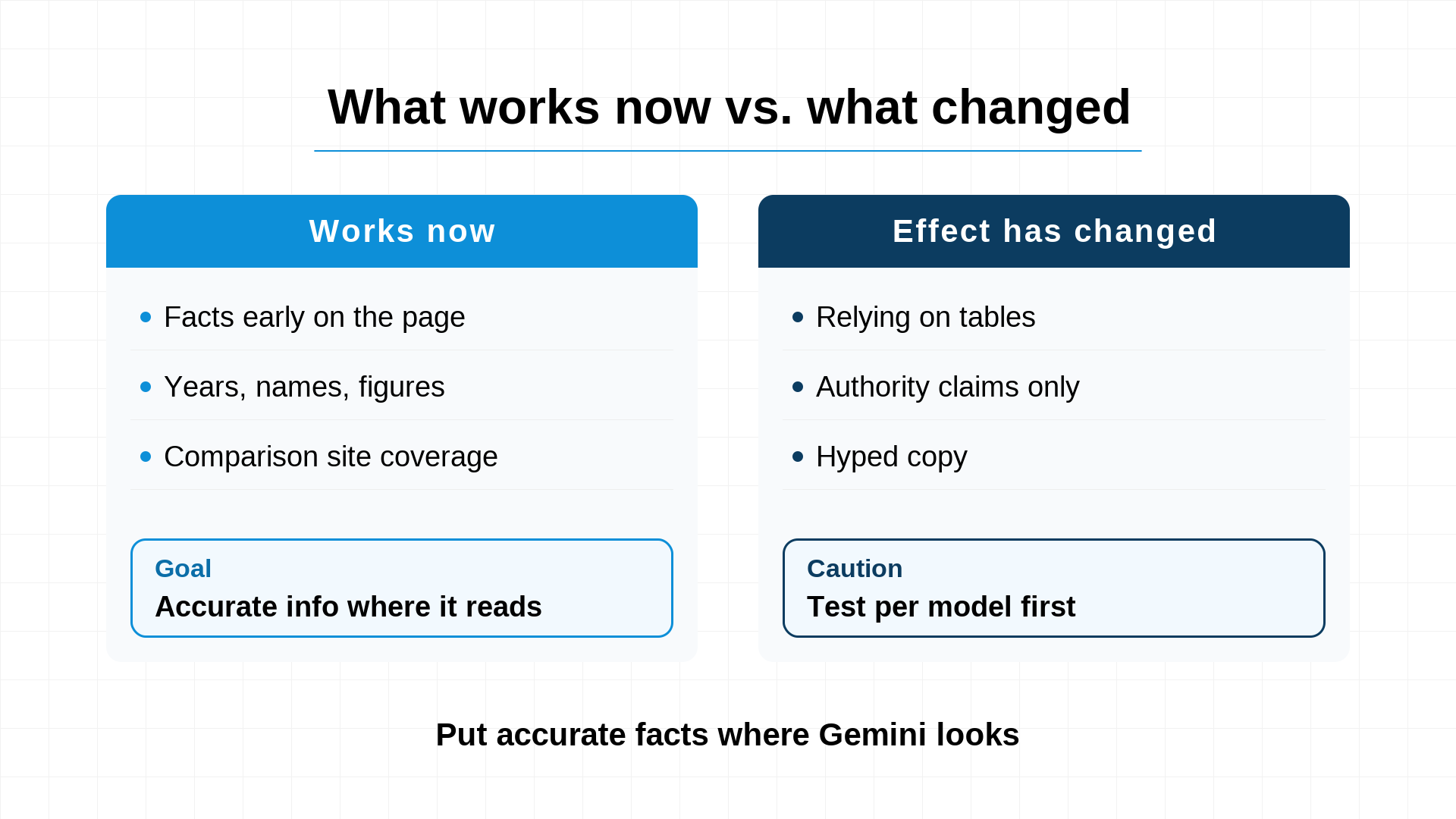
What works with Gemini now is writing the conclusion and facts in the first half of the page and being accurately covered by the third-party sites Gemini consults. Long-recommended tactics such as adding tables or signaling authority no longer work the way they used to.
Tactics That Work Now
Write conclusions and facts early: 80% of Gemini's citations start in the first half of the body text. State the answer to the question and the supporting figures and conditions at the top of the page. Long preambles or company introductions use up the positions most likely to be cited.
Write years, company names, and figures in the body: Gemini adds years and proper nouns to its queries. Pages that spell out the point in time and proper nouns, such as "as of October 2026" or "Dr.AISEO's free plan," are easier to pick up with rewritten queries. Verifiable facts like prices and specifications were also strongly preferred in the Gemini 4 Argon experiment.
Be accurately covered by comparison sites and industry media: In Japan, Gemini consults comparison and ranking articles more often than ChatGPT does. Find the media and comparison sites Gemini consults in your field and check that they carry accurate information about you. If the information is outdated, sending the latest details to the site operator also helps.
Tactics Whose Effect Has Changed
Assuming tables get you chosen: In dejan.ai's experiment, pages with tables were chosen 93.6% of the time by Gemini 3.8 Flash but only 31.5% of the time by Gemini 4 Argon (dejan.ai). Tables are convenient for readers, but a table alone does not guarantee selection. Write the key points in prose before and after a table as well.
Statements that only signal authority: In the same experiment, the selection rate for features relying on external authority fell from an average of 87.7% to 52.3%. Rather than just listing awards or writing "recommended by experts," state the concrete facts behind those claims.
Hyped marketing copy: Pages with exclamation marks or strong language were almost never chosen by Gemini 4 Argon. Write facts such as prices and conditions instead of promotional language.
Structured data (markup that organizes page content for search engines) and clear author information and update dates are the foundation for being understood correctly by Google Search, not just Gemini. They are not Gemini-specific tactics, but since being picked up by Google Search is a prerequisite for Gemini, they remain worth maintaining.
Measure Traffic from Gemini Separately
In October 2026, UTM parameters (tracking strings appended to URLs) indicating the traffic source were spotted on links in Gemini's answers (Search Engine Journal). Until now, visits from Gemini were reported to lose their source information in some cases, such as the mobile app, and to be counted as "direct" in GA4. Google has not explained the change, and the conditions under which UTMs are added are unknown, but checking whether you can separate Gemini traffic in GA4 makes it easier to track the impact of your work.
Checking Gemini's Answers with Dr.AISEO
How Gemini chooses its citations cannot be fully observed from outside, and it keeps changing as models are swapped. That is why the starting point is to keep recording what Gemini searched for and which sites it consulted for questions related to your business.
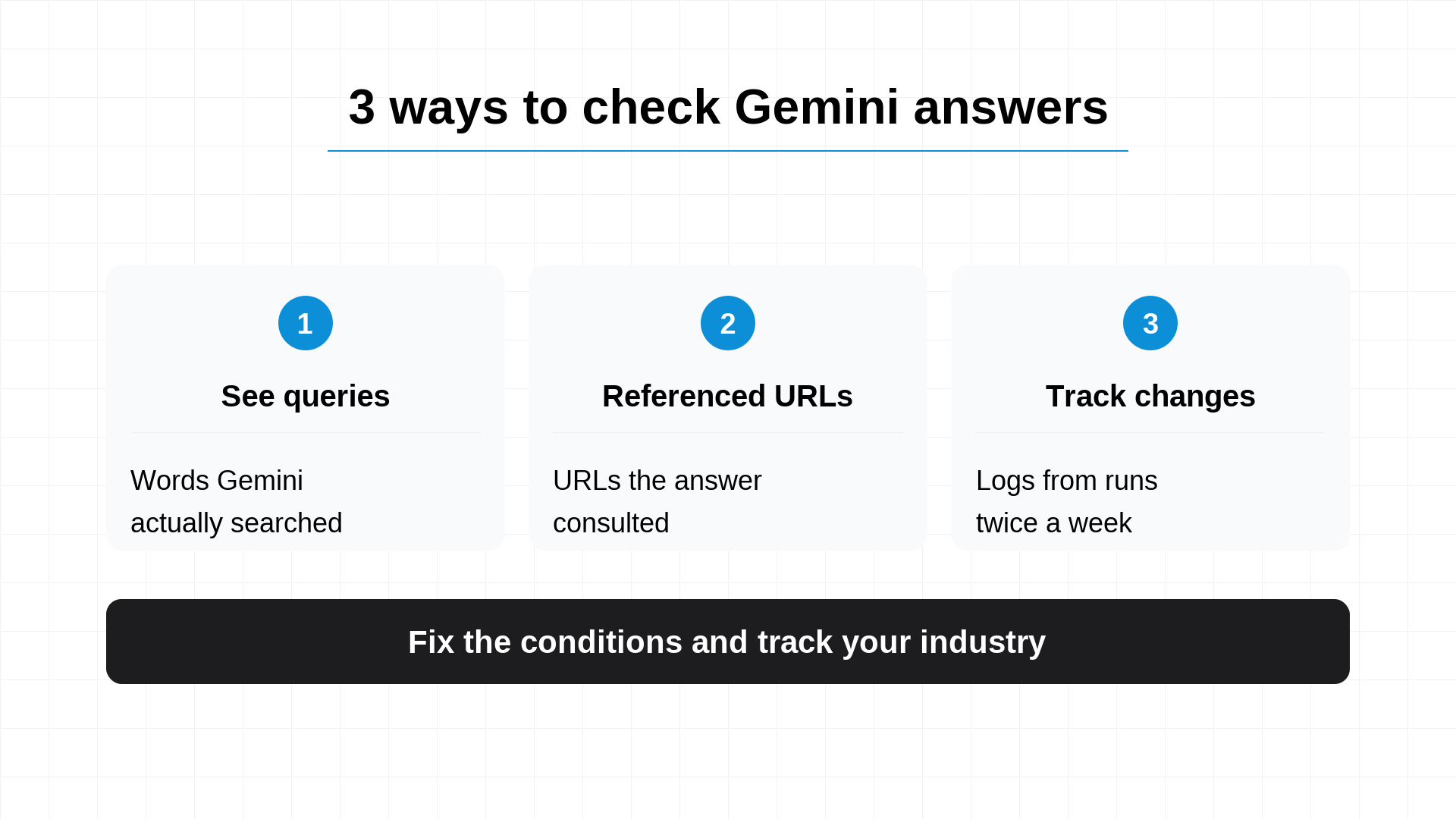
See the Words Gemini Actually Searched
For each registered prompt, Dr.AISEO shows the text of Gemini's answer and the queries Gemini ran behind the scenes (fan-out queries). Seeing whether words like a year, "pricing," or "comparison" were added tells you concretely what to add to which of your pages.
Check the Referenced URLs
For each answer, you can see the URLs Gemini consulted to write it. Seeing whether your site is among them, and if not, which comparison sites or media are, tells you where to send your information.
Fix the Conditions and Track Changes
Dr.AISEO measures Gemini through Google's API with grounding (answering after researching on Google Search) enabled. Because the model is fixed to gemini-2.5-flash, you can compare changes caused by your own work under the same conditions, unaffected by model swaps in the Gemini app (as of October 2026). The differences between collection methods are explained in "Should You Measure AI Search via the UI or the API? Why the Same ChatGPT Gives Non-Overlapping Results."
Registered prompts run automatically twice a week (Sundays and Thursdays), building up a log of answers (as of October 2026; once a week on the free plan). Past answers cannot be recovered later if they were not recorded.
Summary: Lead with Facts, and Know Where Gemini Looks
Gemini rewrites questions into keyword strings, adds years and proper nouns, searches Google, and cites about 30% of the pages it consults. What gets cited are short, factual passages that make sense on their own and sit in the first half of the page. Stating the conclusion and supporting facts at the top of the page, and spelling out years, company names, and figures, is the basic approach for Gemini.
In Japan, Gemini consults comparison and ranking articles far more often than ChatGPT does. The gap is especially large in finance, so beyond improving your own site, it is essential to check that the third-party sites Gemini consults carry accurate information about you.
You can check what Gemini searches for and which sites it consults in your industry with Dr.AISEO's free plan. Start by registering your key questions and building up a log of answers.