Home/Blog/What Gets Cited by ChatGPT? Its Own Index, Passage Extrac...
Technical Guides2026.10.21
What Gets Cited by ChatGPT? Its Own Index, Passage Extraction, and the Latest on Model Updates
To get your brand named by ChatGPT, you need to know where ChatGPT gets its information and in what units it uses it. External research published in 2026 has shown that ChatGPT uses its own search index in addition to external search engines, and that it builds answers not from whole pages but from short passages extracted from pages.
42%Share of answers with direct links after GPT-6 (Peec AI; 8–10% before the update)
30.4%Commercial pages' share of ChatGPT citations after GPT-5.6 (Profound; 22.6% before)
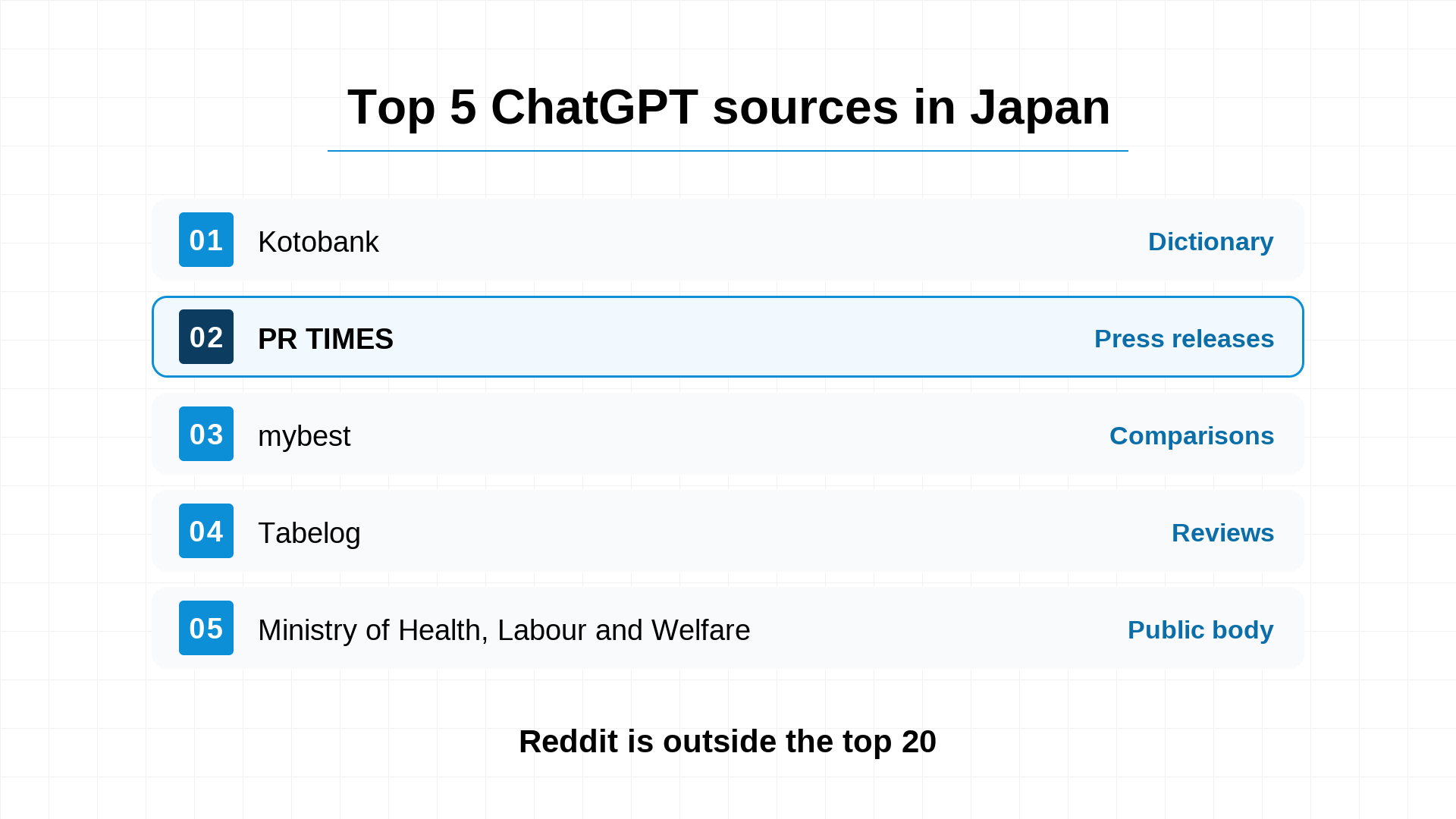
2ndPR TIMES' rank among ChatGPT citations in Japan (Ahrefs, September 2026)
ChatGPT's citation patterns change significantly with every model update. Measurements show that with GPT-5.6 in August 2026, sources shifted toward companies' official pages, and with GPT-6 in October, the share of answers with direct links more than quadrupled. Rather than chasing short-term trends, building a foundation that does not change is the shortcut, even if it looks like the long way round.
Question
What we now know
What to do
Where does it get information?
External search plus its own index
Make body text readable in the initial HTML
In what units does it use it?
Short passages extracted from pages
Write paragraphs that make sense without context
Will the trends last?
They change significantly with each model update
Track changes in your own answer logs
This article uses published research to explain how ChatGPT chooses its sources, which tactics work now and which need caution, and how to check how you are being chosen with Dr.AISEO.
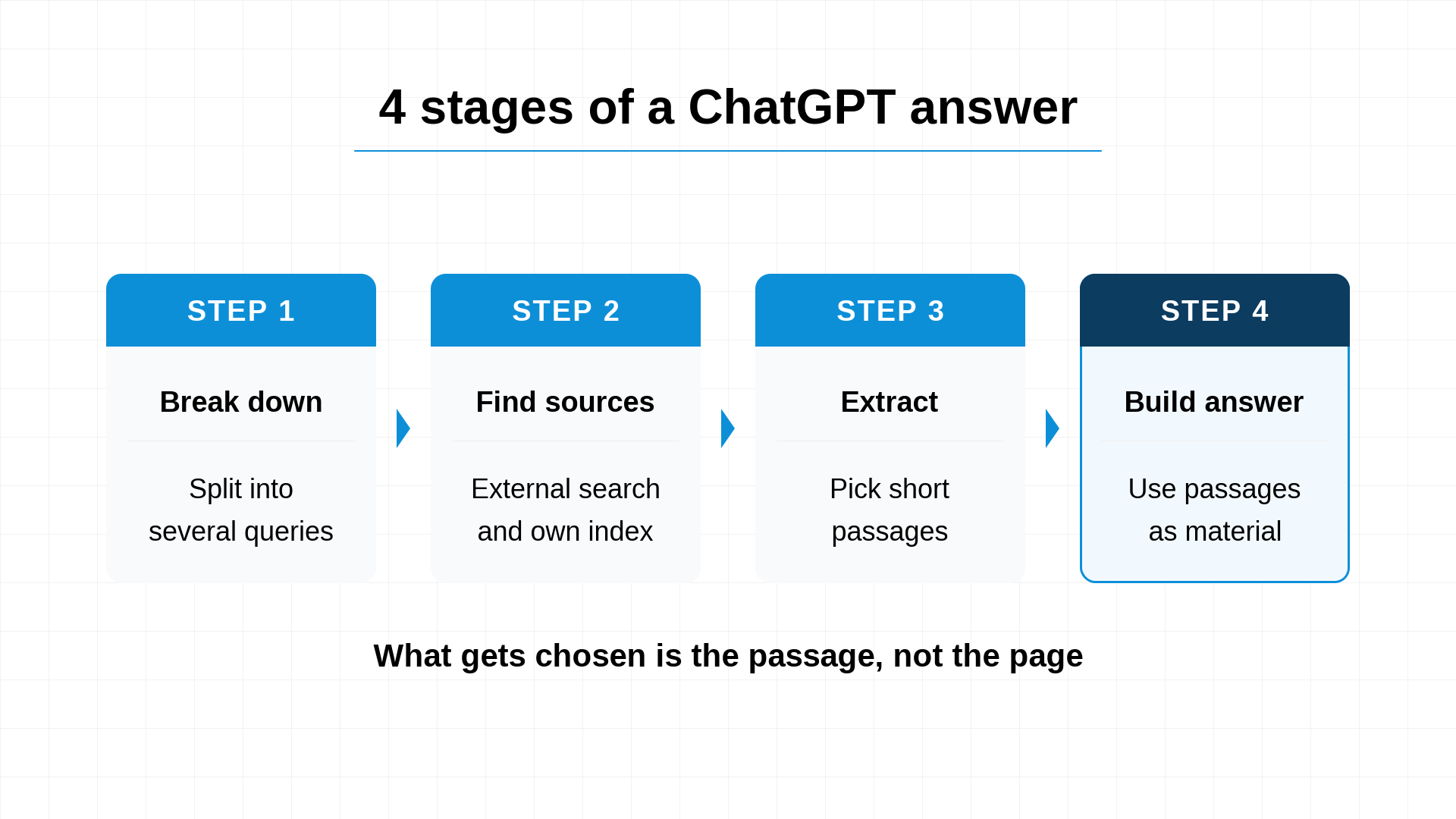
ChatGPT breaks a question into several search queries, gathers candidates from both external search engines and its own search index, and builds an answer. OpenAI has not officially explained this mechanism, but external research has revealed much of it.
Questions Are Broken Down into Multiple Queries
ChatGPT does not search the user's question as typed. It breaks it down into several queries internally before searching. These behind-the-scenes queries are called "fan-out queries." When Ahrefs analyzed 15 million ChatGPT fan-out queries from August to September 2026, 14.4% of answers involved a behind-the-scenes search, with an average of 1.6 queries per answer (Ahrefs).
Fan-out queries add words the user did not type. In the same analysis, the share of queries containing "official" rose from 10.1% to 13.1%, and the share containing "price" rose from 6.0% to 8.9%. In addition, 6.8% of queries were restricted to a specific site, and 75.9% of those targets were brand sites of companies or products.
External Search Engines and Its Own Index, "Labrador"
ChatGPT does not rely on a single source for search. Peec AI, which offers an AI search measurement tool, reported that from May 21 to July 21, 2026, the data sent to the ChatGPT interface included a field showing where search results came from. It had four values: in addition to vendors that fetch external search results, there was an in-house index named "Labrador" (Peec AI).
According to Peec AI, Labrador consists of 12 indexes split by domain: the general web, plus PDFs, YouTube, news, Wikipedia, local information, finance, law, health, shopping, images, and more. The company also confirmed that in mid-August 2026, an A/B test prioritizing the in-house index over search result pages was running in 8% of conversations. Note that this is external observation by a company that sells a measurement tool, and OpenAI has not confirmed it.
The pages in the in-house index are not the same as Google's search results. A page ranking high on Google will not necessarily be picked up by ChatGPT, and conversely, pages Google does not rate highly may be consulted. There is also analysis suggesting OpenAI's crawler does not execute JavaScript, so pages that render body text with JavaScript may not be read (Vercel).
Even for questions in Japanese, searches are not necessarily run only in Japanese. Ahrefs noted that English Wikipedia ranked above Japanese Wikipedia among ChatGPT's citations for Japanese questions, and inferred that ChatGPT likely expands Japanese questions into English queries (Ahrefs).
What Gets Cited Is the Extracted Passage: Three Traits That Make It Likely
Generative AI does not read whole pages gathered by search to answer. It splits them into short passages by heading or paragraph and uses the passages most relevant to the question as material. Splitting pages into short passages for search is a common method when generative AI uses external information.
Anthropic has described the problem of split passages losing their context, so that a sentence like "The company's revenue grew 3% over the previous quarter" no longer says which company it is about (Anthropic). However good a page is, a passage that does not make sense when extracted on its own is unlikely to become material for an answer.
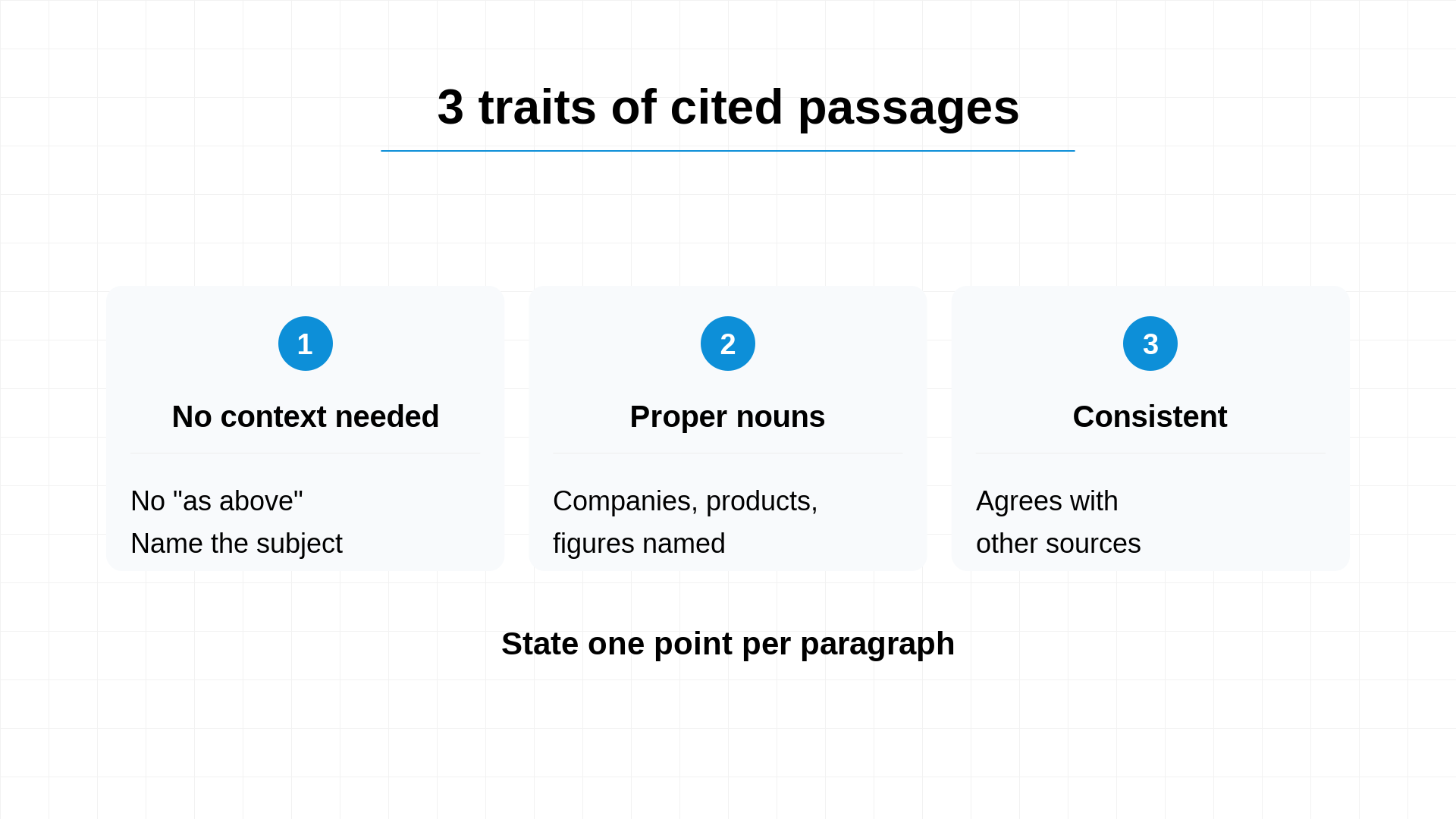
Passages that make sense even when extracted are more likely to be chosen as material. Based on published analyses and how extraction works, the traits come down to three.
Make sense without context: Sentences that rely on earlier paragraphs, such as "for the reasons above" or "the company," lose their meaning when extracted. State the subject and object every time.
Rich in proper nouns: Much information is a relationship between proper nouns: who did what. In Kevin Indig's analysis, proper nouns made up about 20.6% of words in passages cited by AI, far above the 5–8% in typical writing (SERPsecrets).
Consistent with established facts: AI tends to answer with what multiple sources agree on. In Ahrefs' analysis, 84.4% of answers to factual questions cited at least one official source (Ahrefs).
Here is an example rewrite. "For the reasons above, the tool can be said to be easy to adopt" carries no information when extracted. Writing "Dr.AISEO's free plan automatically records ChatGPT and AI Overviews answers once a week" keeps its meaning wherever it is cut.
There is no need to fine-tune passage length. How text is split varies by AI, and even inserting an image or table changes where splits fall. Prioritize stating one point per paragraph over adjusting length.
Citation Trends Change with Every Model Update
ChatGPT's citation trends change significantly with model updates. A realistic approach is to treat model updates like Google search algorithm updates, as events to check for what changed before and after.
GPT-5.6: More Citations of Companies' Official Information
With GPT-5.6, which became the default model in August 2026, the types of sources cited changed significantly. In measurements by Profound, which offers an AI search measurement tool, around August 8, 2026, between August 6 and 28, commercial pages (pages that introduce products and services and lead to sales) rose from 22.6% to 30.4% of ChatGPT's citations, and documentation such as product manuals and specification sheets rose from 6.3% to 11.6% (Profound).
What decreased were citations of user posts and encyclopedias. In Ahrefs' analysis, ChatGPT's citations of Reddit fell 88% and of Wikipedia 80% from March to September 2026 (Ahrefs).
GPT-6: Answers Now Include Direct Links
With GPT-6, rolled out gradually from October 7, 2026, the share of answers with direct links to web pages in the body text rose sharply. When Peec AI compared the same 1 million prompts, answers with direct links rose from 8–10% to 42%, and 54% of those links pointed to home pages (Search Engine Journal).
On the other hand, right after the switch, links in the body text did not pass referrer information, so visits from ChatGPT were counted as "direct" in GA4. A fix was reportedly rolled out from October 15, but when comparing ChatGPT traffic before and after GPT-6, be careful with figures from this period.
The Same Update Has Different Effects by Field
The impact of a model update depends on which field's questions you look at. When Nicolas Sitter compared hotel search questions before and after GPT-5.6, the number of searches per conversation had not changed, and some changes reported in other studies could not be confirmed (Nicolas Sitter). dejan.ai also countered reports of increased site-restricted searches, saying its own data shows no increase (dejan.ai).
All of these figures were compiled by measurement tool vendors and agencies from their own data, not announced by OpenAI. Shifting everything toward a format just because it increased in one update is risky, because the next update may swing the other way.
Tactics That Work Now, and Tactics That Need Caution
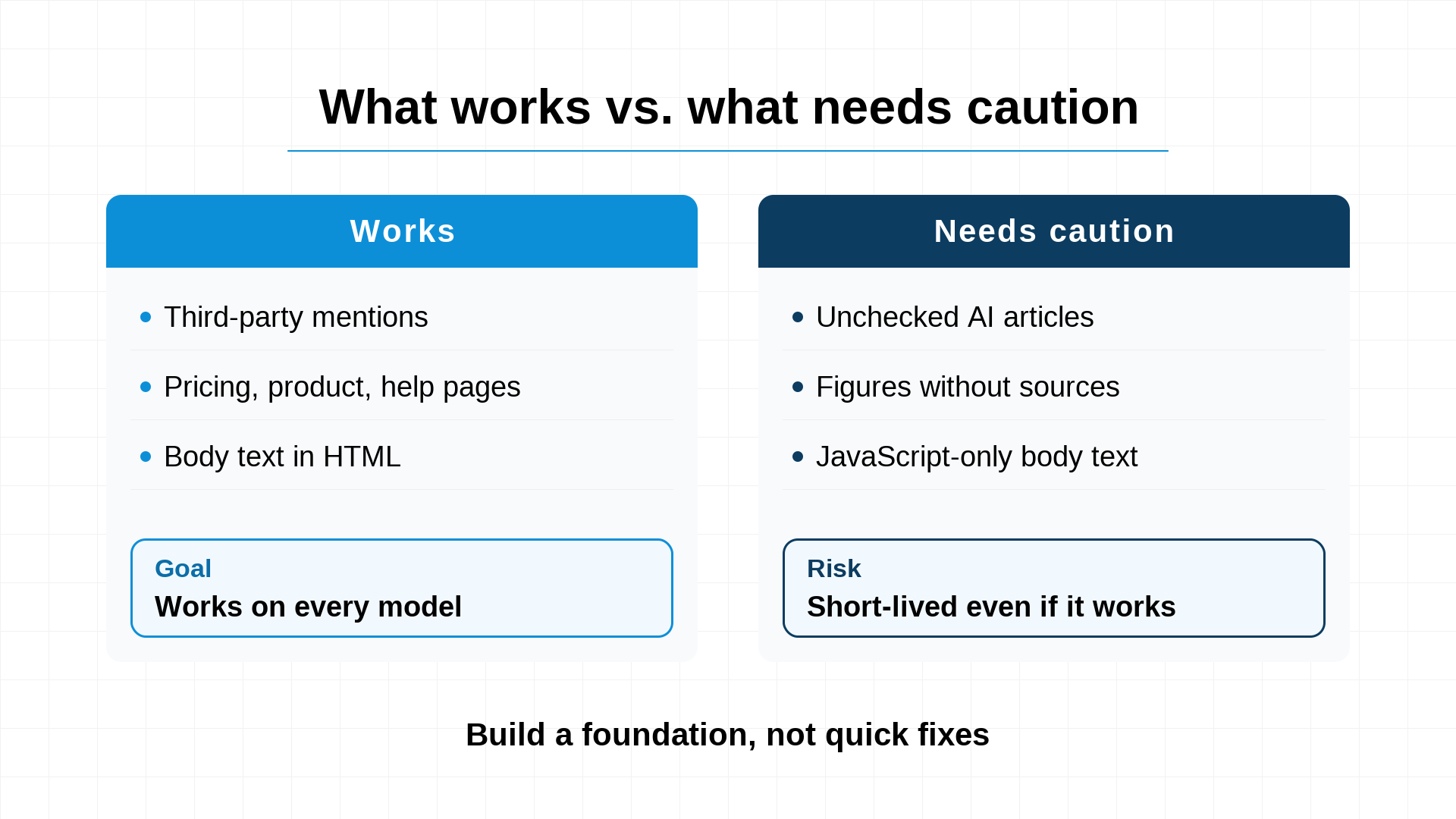
What keeps working regardless of model changes is creating a state in which your company is mentioned and recommended on the pages AI uses as sources. Conversely, quick-fix tactics aimed at AI search rarely last, even when they work.
Tactics That Work
Get mentioned and recommended on third-party sites: Getting listed, alongside the terms you want to rank for, on the media and comparison sites AI cites is the most impactful tactic. Because AI tends to answer with what multiple sources agree on, the more the same description is repeated outside your own site, the more likely it leads to recommendations.
Maintain pricing, product, and help pages: With "official" and "price" being added to fan-out queries, official pages that state prices and specifications in the body text are more likely to be consulted. State the target customers, what you offer, and price ranges in definitive sentences. A help center explaining how to use your product is also an asset that becomes a source, especially for specialized products.
Make body text readable in HTML: As noted above, ChatGPT's crawler may not execute JavaScript. Include important explanations and prices in the initial HTML.
That ChatGPT reads product and pricing pages has also been confirmed in the industry-by-industry "AIO / AISEO Domain Research" we conduct jointly with Bakuri Inc. In the banking loan edition measured in October 2026, 81% of ChatGPT's consultations were financial institutions' product pages such as "mortgages" and "car loans," reaching 89% when interest rate tables and Q&A pages are included. In the aesthetic medicine edition as well, 62% of the clinic pages ChatGPT read were basic pages such as treatment menus, doctor profiles, and pricing, while columns and explainer articles made up only 4%.
Mass-producing AI articles without quality control: Articles mass-produced with AI can lower your Google rankings and even cost you visibility in AI search. Prioritize articles with first-hand information only you can write over increasing volume.
Publishing figures without sources: When a Peec AI researcher tested a site publishing fictitious statistics, Google removed the site from search results, but ChatGPT kept citing the figures (Peec AI). Even if they get picked up temporarily, spreading errors damages your credibility. Attach the source and date of research to figures.
Body text shown only with JavaScript: Even if it reads fine on screen, it may look like an empty page to ChatGPT's crawler.
Sources ChatGPT Cites in Japanese
For questions in Japanese, the line-up of sources ChatGPT cites differs greatly from the U.S. Reddit, which ranks high in the U.S., is not near the top in Japan.
In Ahrefs' September 2026 ranking, compiled from about 30 million prompts in Japan, the domains ChatGPT cited most were 1 Kotobank, 2 PR TIMES, 3 mybest, 4 Tabelog, and 5 the Ministry of Health, Labour and Welfare. Reddit, which was first in the June edition, fell outside the top 20 (Ahrefs).
The clue for Japanese companies is that PR TIMES ranks second. Press releases are official information issued by companies themselves, yet they appear on a third-party site. Publishing new products, price changes, and research findings as releases with consistent proper nouns and figures is an accessible tactic for ChatGPT in Japan. That comparison sites, review sites, and public bodies rank high also shows the importance of placing accurate information outside your own site.
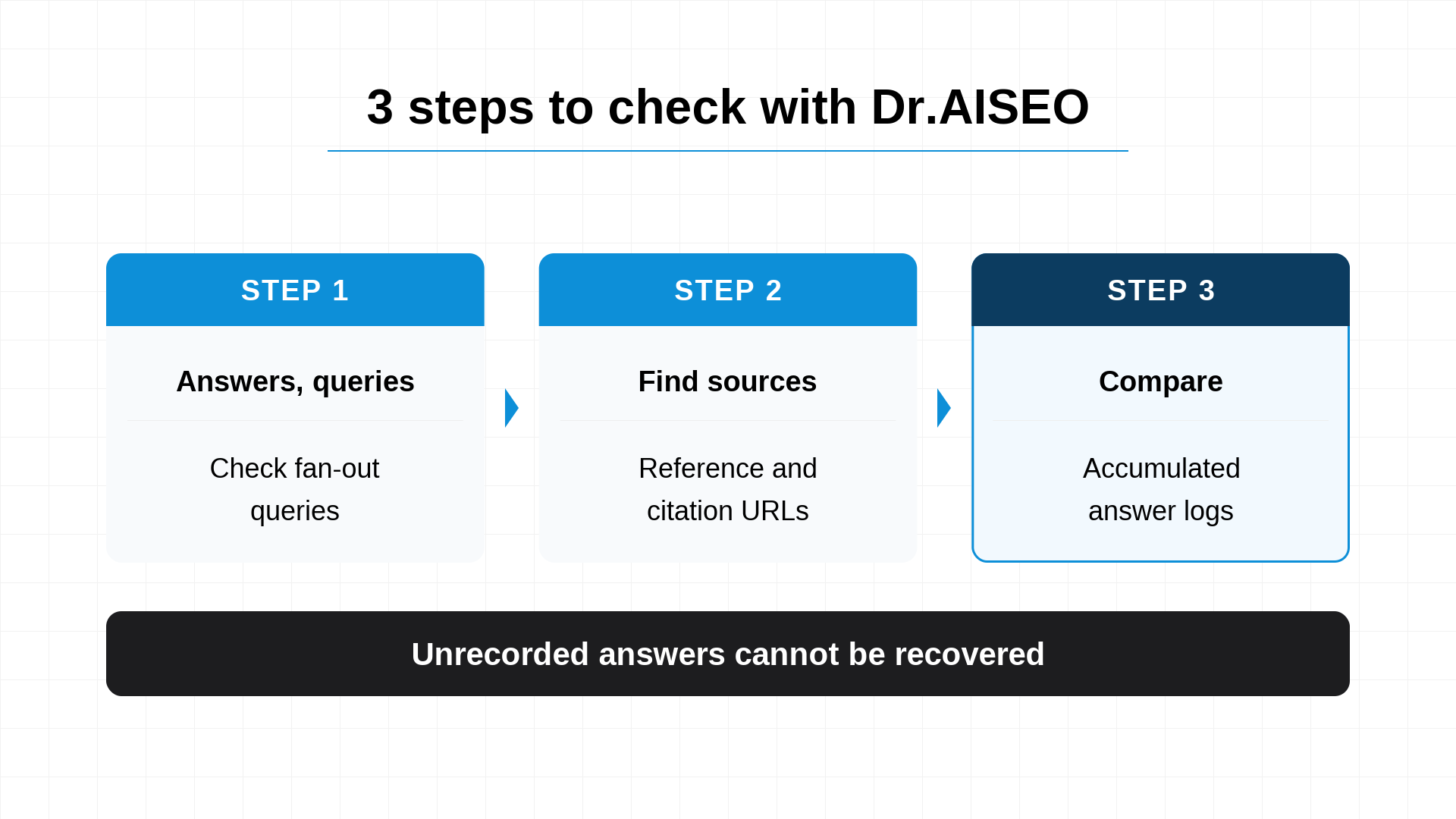
How ChatGPT chooses cannot be fully seen from outside, and it keeps changing with model updates. That is exactly why recording what ChatGPT actually searched for and which pages it cited, for questions related to your business, is the starting point.
See the Queries Behind the Answer
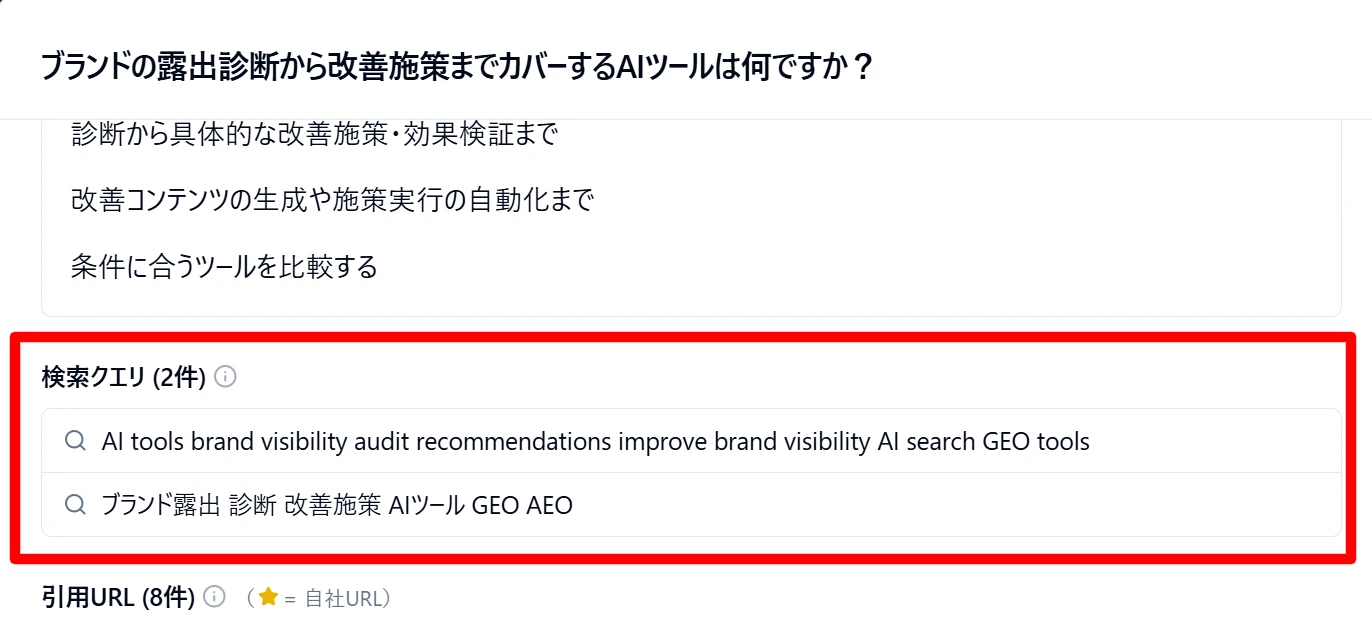
For each registered prompt, Dr.AISEO shows the AI's answer text and the queries ChatGPT ran behind the scenes (fan-out queries). Seeing whether words like "official" or "price" were added tells you concretely what pages to prepare.
Even when you ask in Japanese, ChatGPT's queries are not necessarily in Japanese. In the screen below, for the Japanese prompt "Which AI tools cover everything from brand visibility diagnosis to improvement measures?", ChatGPT searched with two queries, one in English and one in Japanese. English queries mainly pick up English pages, which opens the door for overseas sources to become material for the answer.
You can check the queries ChatGPT actually ran. Even for a Japanese prompt, searches may be run in English.
Identify the Pages That Were Consulted and Cited
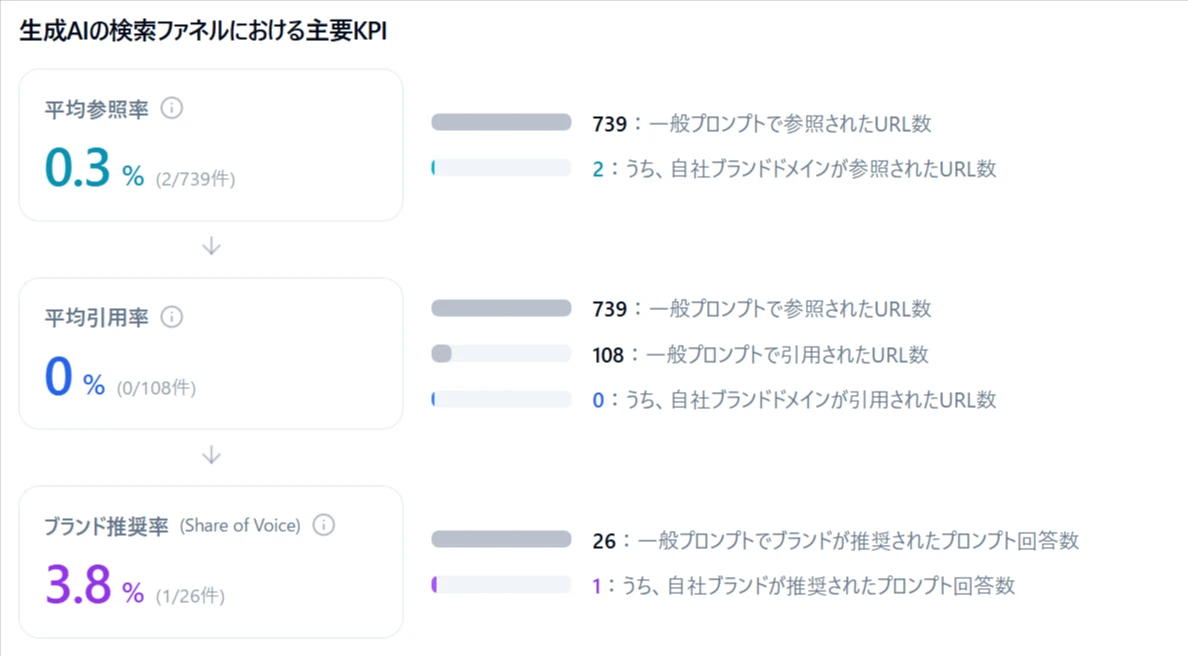
For each answer, you can see the URLs the AI consulted and the URLs it cited in the body text. How often your domain was consulted and cited is aggregated as a reference rate and citation rate. If pages you were not aware of are being picked up, or pages with outdated information are being cited, you can fix those pages or republish accurate information.
The Dr.AISEO dashboard shows the share of times your domain was consulted and cited, and the share of times your brand was recommended.
Compare Before and After Model Updates with Your Own Data
Dr.AISEO runs registered prompts automatically twice a week (Sundays and Thursdays) and builds up answer logs (as of October 2026; once a week on the free plan). When an update like GPT-6 arrives, you can compare what changed for your own industry's questions using before-and-after logs, rather than averages from external studies. Past answers cannot be recovered later if they were not recorded.
Summary: Build a Foundation That Does Not Change, Rather Than Chasing Trends
ChatGPT breaks questions down into queries, splits pages gathered from external search and its own index into short passages, and builds answers from the most relevant passages. The passages most likely to be cited make sense without context, are rich in proper nouns, and agree with other sources.
On the other hand, which types of pages are likely to be cited changes with every model update. Rather than chasing each trend, being mentioned accurately on third-party sites, maintaining official pages that state prices and specifications definitively, and making body text readable in HTML form a foundation that works on any model.
You can check what ChatGPT searches for in your industry and which pages it cites with Dr.AISEO's free plan. Start by registering your key questions and building up answer logs.