Home/Blog/How AI Describes You Isn't Decided by Your Own Site Alone...
AISEO Strategy2026.11.06
How AI Describes You Isn't Decided by Your Own Site Alone: Checking Its Sources and Aligning How You're Talked About Elsewhere
When you ask ChatGPT or Gemini "What's the best ○○?", which pages does the AI read to describe your company? Overseas, research claiming that "most of the basis for AI answers lies outside your own site" has drawn attention. Meanwhile, industry studies in Japan found that 68–89% of the pages ChatGPT cited were businesses' official sites. Both are true; they simply count differently.
68–89%Share of businesses' official sites among ChatGPT's sources for bank and aesthetic medicine questions in Japan (competitors included; Dr.AISEO × Bakuri, October 2026)
37–38%Share of media and other-industry articles Gemini read for bank questions (1–9% for ChatGPT)
Under 1%Chance of getting the same recommendation list when the same question is repeated (SparkToro, January 2026)
What is certain is that how AI describes you is not decided by your own site alone. "Official sites" include your competitors' sites, and some AIs also read many media articles. What the description is built from varies by AI, industry and question, and it also changes with model updates. That is why, rather than starting external work based on generalizations, you need to check the sources for the questions that matter to your company before you act.
What to check
What to look at
How AI talks about you
Whether it knows you, whether it says the same thing consistently, whether it speaks favorably
What it bases that on
Which pages on your site, which external sites
What causes any gap
Outdated information, incorrect information, dissatisfaction with the experience
This article uses research from Japan and overseas to lay out what AI builds its descriptions from, how to check the sources, how to align how you are talked about elsewhere, and how to identify the sources with Dr.AISEO.
The claim that "most of AI's basis is external" is correct by one way of counting and an overstatement by another. Whether "external" includes competitors' official sites changes the picture considerably. On top of that, which pages get read differs by AI and changes with every model update.
In Overseas Research, "External" Includes Competitors' Official Sites
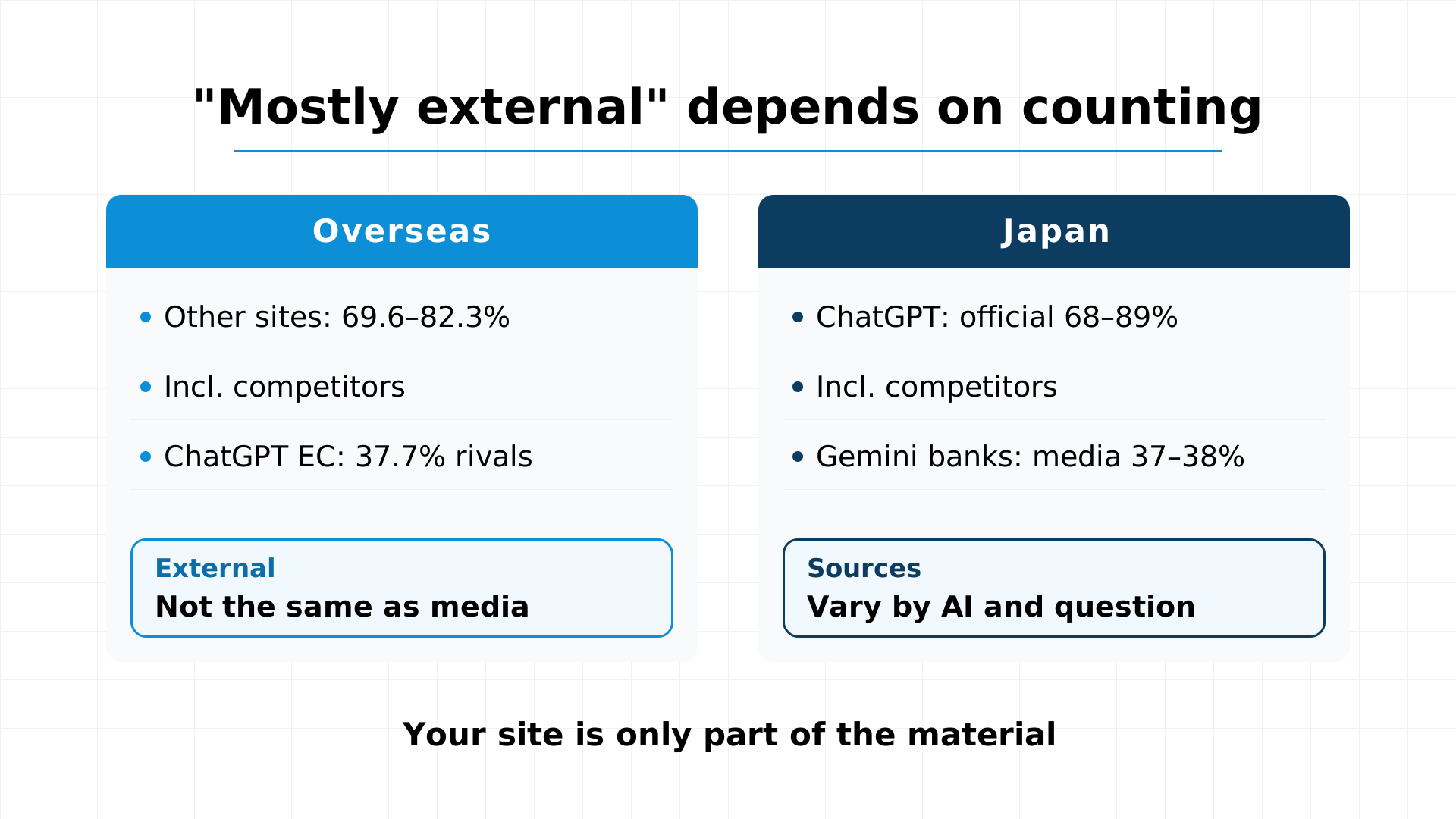
International SEO consultant Aleyda Solis analyzed the top 10 most-cited domains in ChatGPT, Gemini and Google's AI Mode for 15 brands across SaaS, ecommerce and finance (Aleyda Solis, August 2026). Domains other than the brand's own accounted for 82.3% in SaaS, 79.4% in finance and 69.6% in ecommerce.
However, "other than your own" includes not only media and review sites but also the sites of competitors and substitute products. In ecommerce, competitor and marketplace domains accounted for 36.6%, with 37.7% on the competitor side in ChatGPT and 44.7% in Gemini. "External" does not mean the same thing as "media."
In Japanese Research, Businesses' Official Sites Dominate, but It Varies Greatly by AI
In October 2026, Dr.AISEO and Bakuri Inc. repeatedly sent questions about banks and aesthetic medicine to ChatGPT and Gemini and tallied the sources. Of the sites ChatGPT cited or consulted, businesses' official sites accounted for 89% for bank loans, 82% for accounts and deposits, and 68% for aesthetic medicine (loan study, aesthetic medicine study). These official sites include not only your own company but also competing businesses.
In Gemini, by contrast, official sites made up only 47% for loans and 54% for accounts and deposits, and it read media and other-industry articles at 37–38% (Dr.AISEO). ChatGPT read such articles at 1–9%. In both AIs, personal blogs, social media and review posts made up less than 5% of references in all six industries (Dr.AISEO).
Putting the overseas and Japanese research together, what emerges is not "mostly external" but "from any one company's point of view, its own site is only part of the material." Whether the rest is competitors' official sites, media or public institutions changes by AI, industry and question.
Model Updates Change Which Sources Get Read
Which types of pages get read also changes with model updates. Today's trends will not necessarily continue after the next update.
According to Profound, which offers an AI search measurement tool, when ChatGPT's default model became GPT-5.6 in August 2026, commercial pages' share of citations rose from 22.6% to 30.4% (Profound). This figure was compiled by a measurement tool company from its own data and is not an OpenAI announcement. Even so, the fact that a single update can shift the makeup of sources this much shows that past research cannot simply be carried forward as future policy. For details on ChatGPT's model updates, see "What Gets Cited by ChatGPT? Its Own Index, Passage Extraction, and the Latest on Model Updates."
Types of External Work and How to Set Priorities
Prioritize external work starting from the places AI actually reads for questions that concern your company. Media coverage is not the only means. Aleyda Solis has published a framework that sorts the third-party information AI cites by type and prioritizes it (Aleyda Solis, October 2026). The types she lists include the following.
Independent reviews and testing: Articles and videos in which third parties actually use a product and show its strengths and weaknesses
Evidence-based comparisons and shortlists: Articles that lay out the differences between options for each user's conditions. She points to stated comparison criteria, up-to-date facts, and who each option suits
Demonstrations and how-to guides: Videos and articles showing setup or how to solve a problem
Community questions and answers: Places where users' experiences and pre-purchase questions gather
Industry media coverage and expert commentary: Coverage that presents your company's or staff's views within the industry context
Articles citing your own research data: Original research with a clearly stated method, picked up by other outlets
She recommends evaluating these on six criteria: "influence on AI answers," "whether the brand is tied to the problem," "whether it connects with existing marketing work," "business value," "whether the value remains if AI changes its sources," and "required effort." When using this framework, start with the sites AI actually cites repeatedly when answering questions that concern your company (such as "What's the best ○○?"). No matter how well known an outlet is, if AI does not read it for that question, it is not material for the answer. She, too, asks that influence on AI answers be judged not by an outlet's fame but by whether it is cited repeatedly for important questions. Beyond that, giving weight to whether a site remains a point of contact with customers even if the sources change makes you less vulnerable to model updates.
What gets published also matters. Citation Labs says that having your name and a link appear is not enough; what matters is that the text around the link explains who the service is for and what problem it solves (Search Engine Land, May 2026).
Aligning How You're Talked About Elsewhere with What You Want to Convey
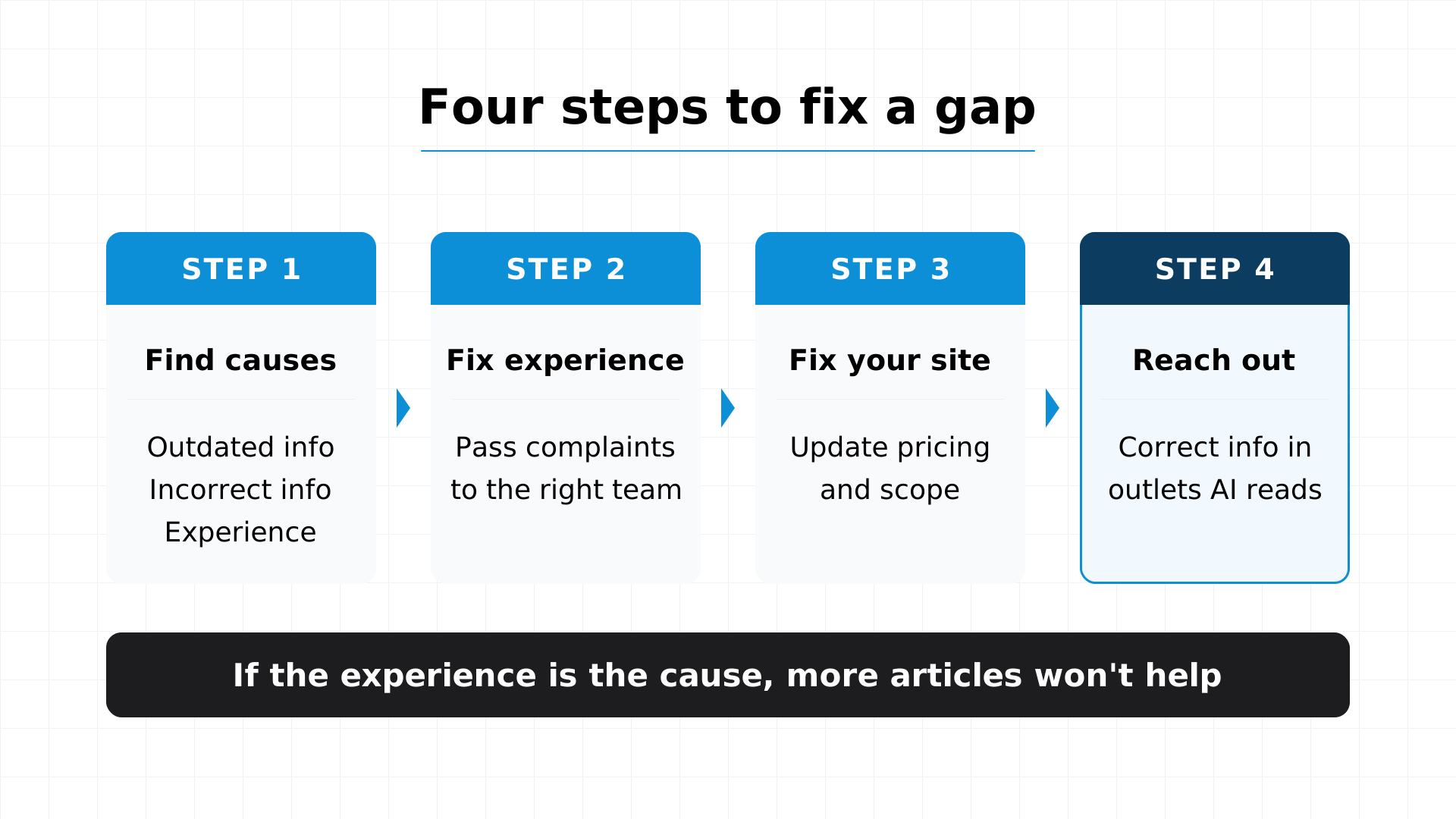
If AI's description and what you want to convey are out of line, first separate the causes. They fall into three: outdated information, incorrect information, and dissatisfaction with the experience. Fix them in this order: the experience, your own description, then external information.
Separate the Gap into Three Causes
Outdated information: Old pricing, discontinued services, a previous job title and the like remain on your site or on external pages.
Incorrect information: AI confuses you with another company or person with a similar name or attributes. In May 2026, the Munich Regional Court in Germany held Google liable in a case where AI Overviews linked two publishers to fraud (Search Engine Journal, October 2026).
Dissatisfaction with the experience: The same complaint, such as "slow replies to inquiries," appears again and again in reviews. Because the information is accurate, fixing pages will not make it go away.
Incorrect descriptions also affect trust in a company. In a February 2026 survey by Gaprize Inc., 71.4% of 800 people who had bought or signed up for SaaS, professional services, aesthetic medicine, insurance or cosmetics in the past year said that "if AI gives an incorrect answer, my trust in the company or product goes down" (PR TIMES, Japanese).
Fix the Experience, Fix Your Own Description, Then Reach Out Externally
Get the order wrong, and the description will not change no matter how much effort you put in. If dissatisfaction with the experience is the cause, adding articles or press releases will not change AI's description. First, the support or product team fixes the cause. Content marketing firm Siege Media recommends sharing complaints that recur in reviews with the team that can fix them (Siege Media, September 2026).
Next, bring the description on your own site up to date and correct. Writing pricing, scope, what you do not support, company history, and changes in officers in definitive sentences gives both AI and outside writers reliable material. Then ask the operators of external pages that still carry outdated information to update them, and create opportunities to appear with correct information in the outlets read for your questions.
Don't Buy Placements or Pose as Users
Even though external information matters, buying mentions in bulk can backfire. A contributed article in Search Engine Land reports that paid placements on loosely related sites and tactics of posting en masse on Reddit with aged accounts are being sold (Search Engine Land, June 2026). The contributor points out that there is no solid evidence that adding paid mentions makes your name more likely to appear in AI.
Google also explains that no special optimization is needed to appear in AI Overviews and that search fundamentals and policies apply as they are (Google). Posts that pose as users and placements that hide the fact that they are advertising damage your reputation itself if discovered.
Don't Judge from a Single Check
AI answers change every time, even for the same question. Rather than concluding from a single check that "we're not cited" or "the description is wrong," send the same question repeatedly and look at how often your name appears.
Lists and Order Change Every Time, but the Rate at Which Your Name Appears Holds Steady
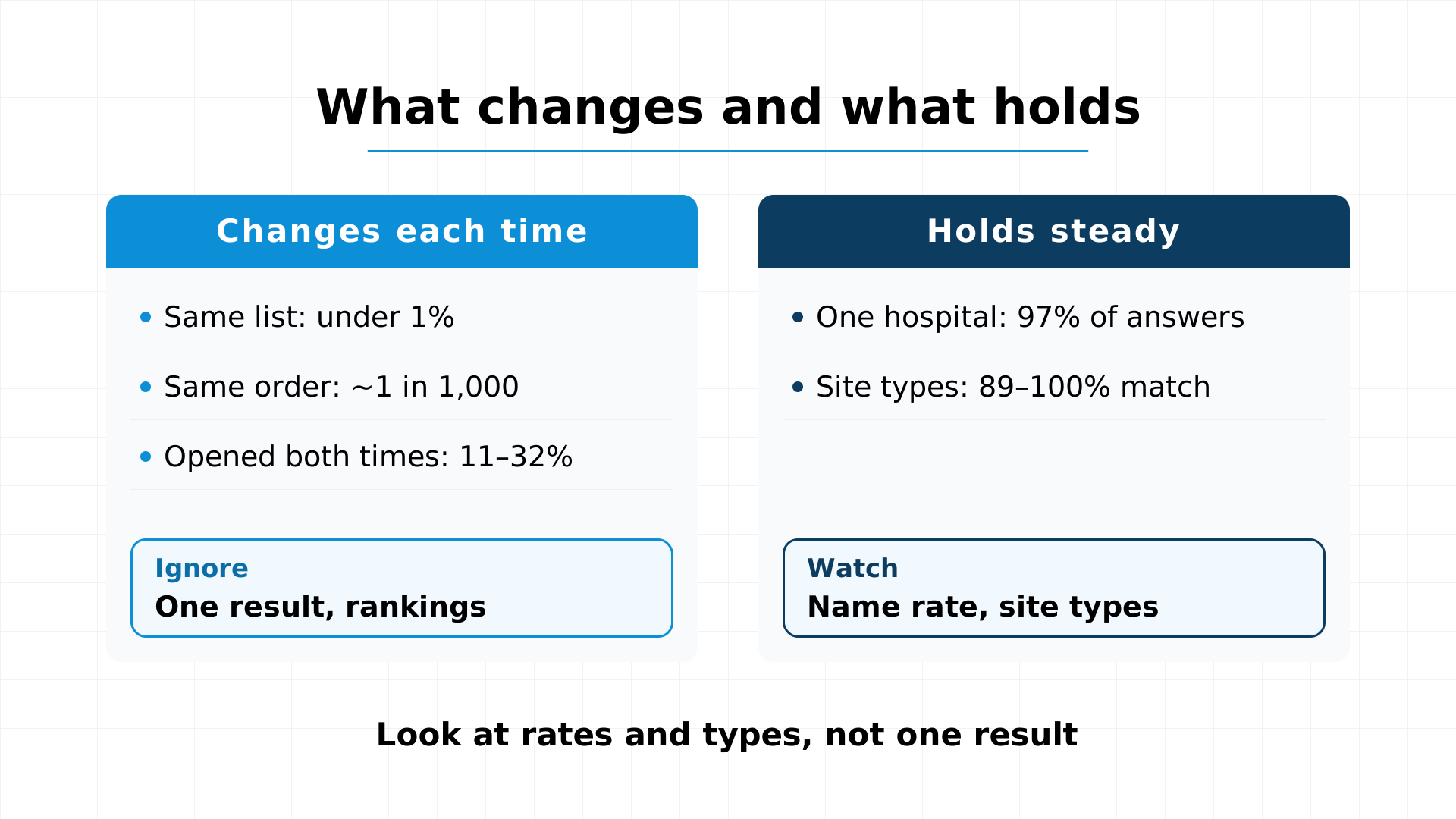
SparkToro's Rand Fishkin had about 600 volunteers send 12 questions to ChatGPT, Claude and Google's AI and collected 2,961 recommendation lists (SparkToro, January 2026). The chance that the same list of brands appeared twice in 100 runs was under 1%, and the same order came up about once in 1,000 runs.
On the other hand, the rate at which a name appeared was stable. For a question about West Coast cancer hospitals, one hospital appeared in 69 of ChatGPT's 71 answers (97%), but it was ranked first only 25 times. He concludes that "rankings" within AI are unreliable, while sending a question many times and looking at how often a name appears is meaningful. Note that his co-researcher works for a company that sells an AI answer measurement tool, and he discloses this.
Opened Pages Change, but the Types of Sites Read Rarely Do
In our joint research as well, when the same question was sent twice, pages opened both times were only 11–18% in ChatGPT and 23–32% in Gemini (loan study, accounts and deposits study). In the cross-industry study, pages opened in every run were 4–32% (Dr.AISEO).
The types of sites read, however, matched 89–100% (median per question) across all runs. Even as citations of individual pages rotate, tendencies such as "for this question, financial institutions' product pages and public institutions get read" rarely change. When checking sources, it is more reliable to look at which types of sites are read through repeated measurement than to fixate on a single URL.
Identifying the Sources AI Uses to Describe You with Dr.AISEO
Dr.AISEO is a tool that lets you check, for each registered category question, how AI described your company and what that description was based on, tracing back to the answer text and the URLs it consulted and cited. You can carry out the flow introduced in this article, "check, separate the causes, fix, and check again repeatedly," in one place.
See Side by Side Which Sites Are Read: Yours, Competitors' or Third Parties'
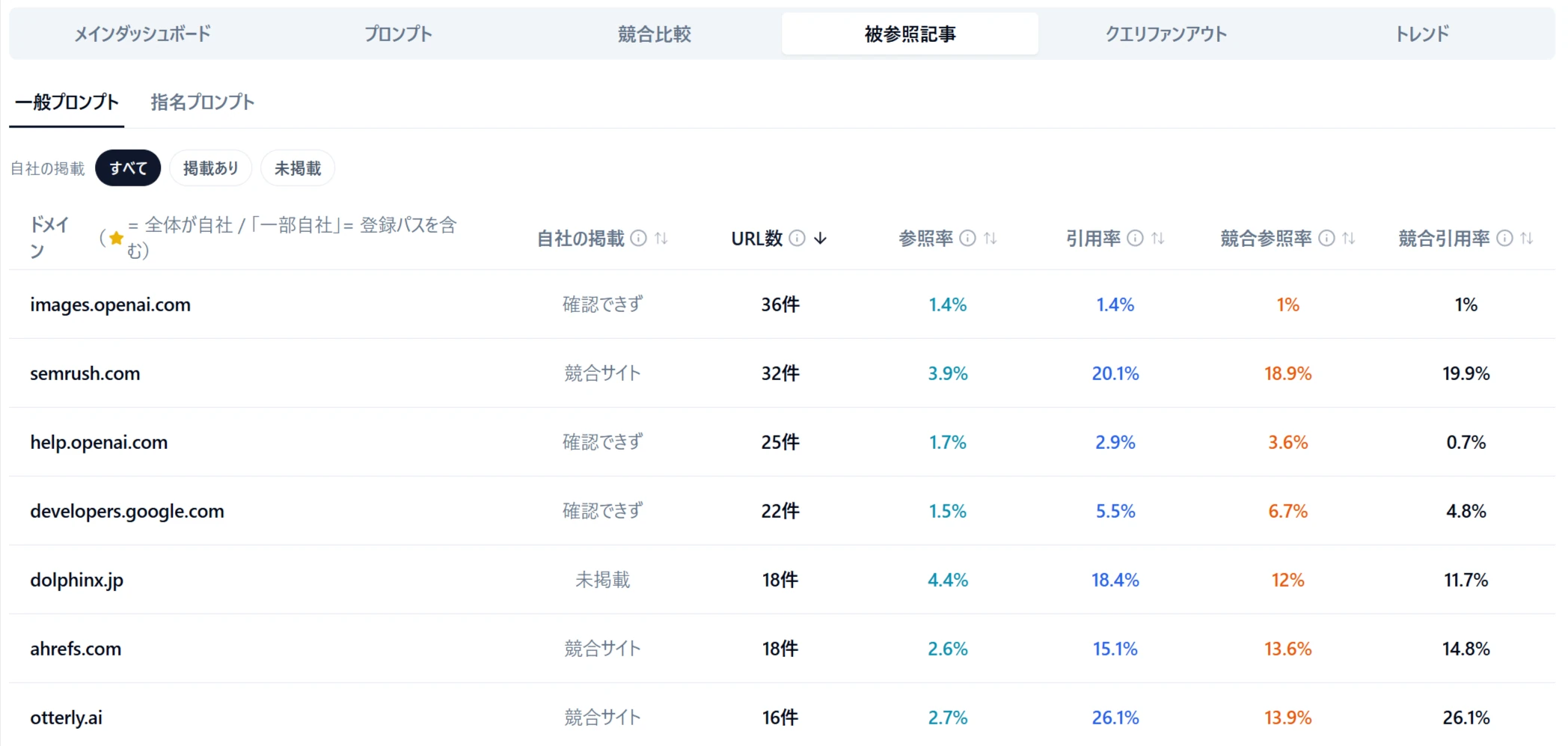
The Cited Articles Analysis screen lists the domains AI used as sources for its answers. For each domain, it shows whether your company is listed there, the number of cited URLs, the reference and citation rates, and the rates at which competitors were referenced and cited. Opening a domain shows the URLs of the cited articles and the list of questions that cited that domain.
The Cited Articles Analysis screen. Check side by side which domains AI reads often and whether your company appears on them.
Filter your listing status by "not listed" to find domains AI reads often for your questions but where your company does not appear. This gives you material for deciding where to start the external work introduced in the previous section. If pages you were not aware of, or pages with outdated information, are being picked up, you can also see where fixes are needed.
Check How You Are Described in the Answer Text
Not only the source URLs but the full text of AI's answers is recorded. You can check in the text whether your name appeared, what features you were described with, and how you were compared with competitors. Whether a brand appeared is judged by AI from context, and common nouns with the same spelling or different companies with the same name are not counted.
Send Questions Repeatedly and Compare Before and After Model Updates
Registered questions run automatically twice a week (Sundays and Thursdays), building up a log of answers (as of October 2026; once a week on the free plan). Instead of a single result, you can see changes in how often your name appears and in the types of sites read. When a model is updated, you can also compare the logs before and after to see what changed for questions in your industry. Past answers cannot be recovered later if they were not recorded.
Summary: Check the Sources for Your Questions, Then Fix
How AI describes you is not decided by your own site alone. But you cannot generalize that "most of it is external" either: some AIs center on businesses' official sites, while others read many media articles. Which pages get read differs by industry and question, and also changes with model updates.
That is why you check how AI talks about your company for category questions, and identify which pages on your site and which external sites that description is built from. If there is a gap, separate it into outdated information, incorrect information and dissatisfaction with the experience, and fix it in the order of the experience, your own description, then external information. Don't judge the results from one check; send the same questions repeatedly to confirm.
You can check what AI reads for questions in your industry with Dr.AISEO's free plan. Start by registering a few category questions and building up a log of sources.