Home/Blog/AIO Is Not an Extension of SEO. It Is Marketing That Buil...
Business Strategy2026.11.04
AIO Is Not an Extension of SEO. It Is Marketing That Builds the Reasons Customers Choose You
Ask ChatGPT or Gemini to "recommend a service that fits our company," and the AI will compare several companies, organize their features, and suggest candidates. In B2B purchasing in Japan, half of generative AI users already rely on AI to list candidates. What companies compete for at that moment is not search rankings but "how they are described," "whether they make the shortlist," and "whether the reason to choose them comes across."
50.3%Share of generative AI users in Japanese B2B purchasing who use AI to list candidates (HubSpot Japan, 2026)
24.9%Share who use AI information almost as-is for internal explanations and approvals (HubSpot Japan, 2026)
2ndPR TIMES' rank among domains cited by ChatGPT in Japan (Ahrefs, September 2026)
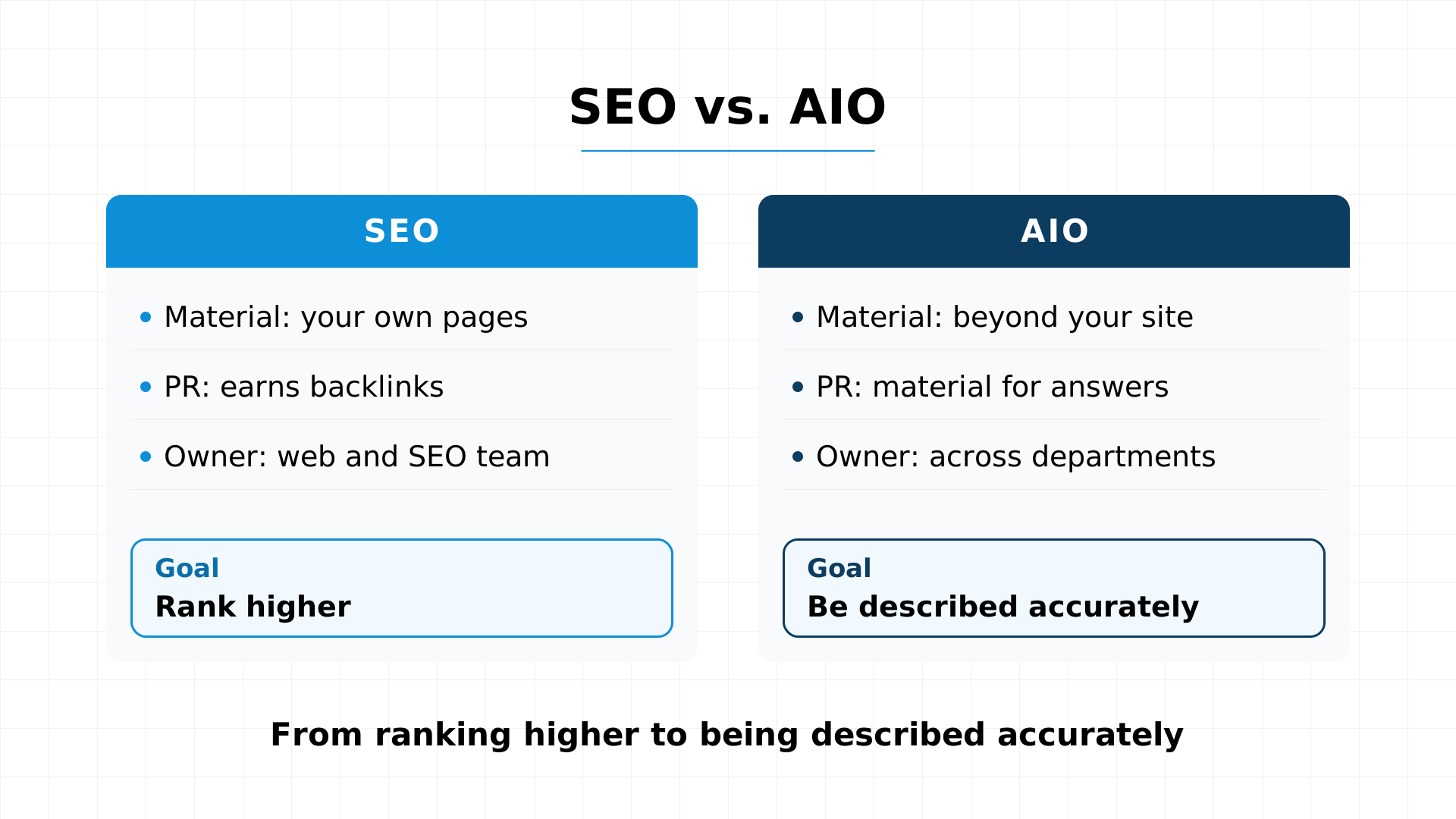
AI builds those descriptions not only from a company's own website but also from third-party sources such as media articles and comparison sites, and from information the company has published outside its own site, such as press releases. As a result, the work of AIO (AI search optimization) goes beyond the scope of SEO and extends into PR, sales, customer support, and product. AIO needs to be approached not as an extension of SEO, but as marketing itself.
SEO
AIO
Where you are evaluated
Rankings in search results
How you are described in AI answers
Main material
Pages on your own site
Your own site + third-party sources (media articles, comparison sites, etc.) + information you publish off your site (press releases, etc.)
Role of PR
A means of earning backlinks
Material for answers
Main owner
Web and SEO team
Cross-functional, including PR, sales, support, and product
Drawing on overseas commentary and research from Japan and abroad, this article explains why AIO becomes marketing itself, where companies should start, and what you can check with Dr.AISEO.
"SEO or GEO?" Is the Wrong Way to Frame the Question
Whether you call AI-era optimization "SEO" or "GEO (generative engine optimization)" is not the essential question. What matters is how you shape the way the market finds you, understands you, and what it believes about you.
Technical SEO consultant Jono Alderson called the debate over whether SEO or GEO is right "the wrong question" (Jono Alderson, July 2026). He defines the purpose of marketing as "shaping what the market discovers, understands, and believes," and says that SEO, GEO, and advertising are all merely means to that end.
From this perspective, treating AIO only as "a technique for getting cited by AI" is too narrow. Even if your name appears in an AI answer, you will not be chosen in a comparison unless your strengths come across correctly. Being cited is not the goal; it is the entry point to being chosen by customers.
That does not mean SEO becomes unnecessary. AI often gathers information using search engine indexes, so pages that search engines cannot read are also less likely to become material for AI. SEO remains the foundation, and AIO builds on top of it.
AI Has Entered the "Middle" of the Purchase Process
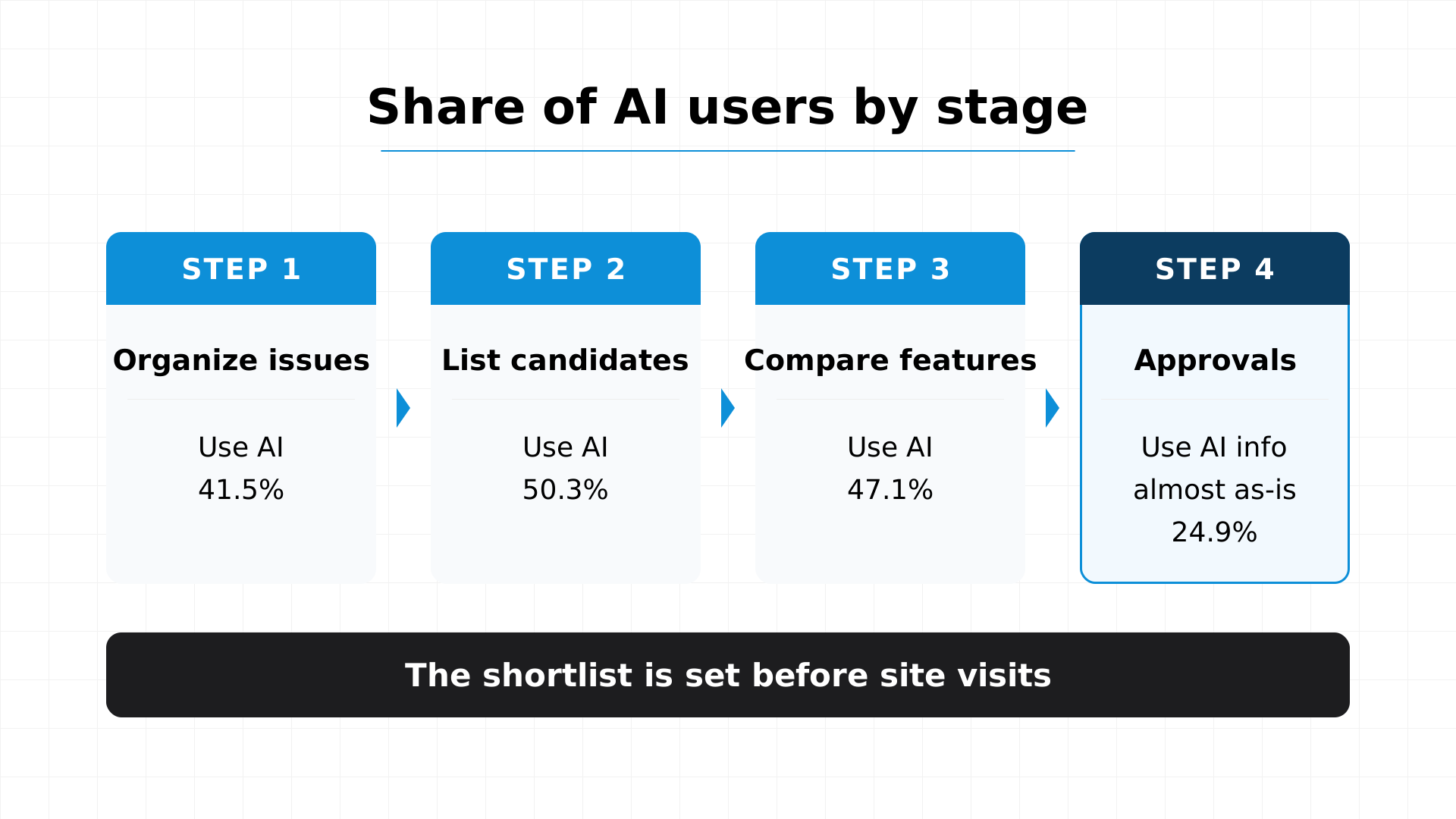
AI has entered not only the starting point of search but the middle of the purchase process, from listing candidates to comparing them and explaining the choice internally. For companies, whether they make the shortlist is increasingly decided before customers ever visit their site.
How AI Is Used in B2B Purchasing in Japan
In a survey HubSpot Japan conducted in June 2026, 1,573 people who had been involved in comparing, selecting, or approving B2B products in the past 12 months ranked "the influence of generative AI services and AI search on purchase decisions" (41.6%) first among the information-gathering behaviors they felt had increased (HubSpot Japan, Japanese). Respondents worked at companies with 50 or more employees.
In the same survey, generative AI and AI search users said they used AI in purchasing to "list candidates" (50.3%), "sort out features and differences" (47.1%), and "organize issues" (41.5%). All of these percentages are shares of generative AI and AI search users. The figure above arranges these items along the flow of the purchase process. AI is used less as a tool for finding information and more as a tool for lining up candidates and sorting out their differences.
When using AI information for internal explanations or approval requests, 48.3% checked the facts themselves and made edits. On the other hand, 24.9% used AI information "as-is or almost as-is." It is not unusual for an AI's description to become the internal comparison document itself.
Not Trusted, Yet Deciding Who Gets Compared
In the same survey, the share of respondents who rated "summaries from generative AI or AI search" as trustworthy was 37.8%, the lowest of the 10 items. The highest was "information with clear prices and contract terms" (60.6%), followed by "individual explanations from sales representatives" (59.8%) and "case studies" (57.0%).
These results show that AI is not making the final decision. But if your name does not come up when AI lists candidates, you lose the very opportunity to deliver your case studies and sales explanations. Whether you get compared at all is increasingly decided at the AI stage, which buyers trust the least.
SEO Centers on Your Own Site. In AIO, Third-Party Sources Also Become Material for Answers
In SEO, what was ultimately evaluated was the pages on your own site. In AIO, in addition to your own site, third-party sources such as media articles and comparison sites also become material for AI answers. The same applies to information you publish off your own site, such as press releases. Which sources are used, and how much, varies greatly by AI, industry, and question, but the fact that the scope of work extends beyond your own site is a major difference from SEO.
PR Shifts from "a Means of Earning Backlinks" to "Material for Answers"
SEO also had digital PR, but its main purpose was to get covered by the media and earn backlinks to your own site. What was evaluated was the page on your site that received the links.
In AIO, articles published in the media and the press releases a company issues can themselves become material for AI answers. In Ahrefs' September 2026 ranking, PR TIMES was the second most cited domain by ChatGPT in Japan, fourth in Gemini, and ninth in AI Overviews (Ahrefs, Japanese). No press release distribution site appears in the top 20 for any of the three AIs in the U.S. The differences between Japan and the U.S. are explained in detail in "Domains Cited by AI Differ Between Japan and the U.S.: A Breakdown for ChatGPT, Gemini, and AI Overviews."
Which media get read also depends on the question. In a joint study Dr.AISEO and Bakuri Inc. conducted in October 2026, 485 questions about bank accounts and deposits were each asked twice to ChatGPT and Gemini (Dr.AISEO). Among the media Gemini read outside financial institutions, personal finance media accounted for 73% for questions about time deposits, while law and tax offices and specialist sites on inheritance accounted for 87% for questions about inheritance procedures. The media your PR should target and what you publish change depending on the questions in which you want your company to be discussed.
AI Checks Company Claims Against Third-Party Evidence
When AI also reads third-party information, company claims get checked against it. Jono Alderson points out that AI has lowered the effort of comparison and verification, and that what customers and third parties report now influences recommendations more than what a company says (Jono Alderson).
For example, even if your site says "our support is attentive," if reviews repeatedly say "replies to inquiries are slow," AI picks up on that discrepancy too. What AIO asks is not only what your company says, but how the market talks about your company.
The Work Spans Departments. That Is Why AIO Becomes Marketing Itself
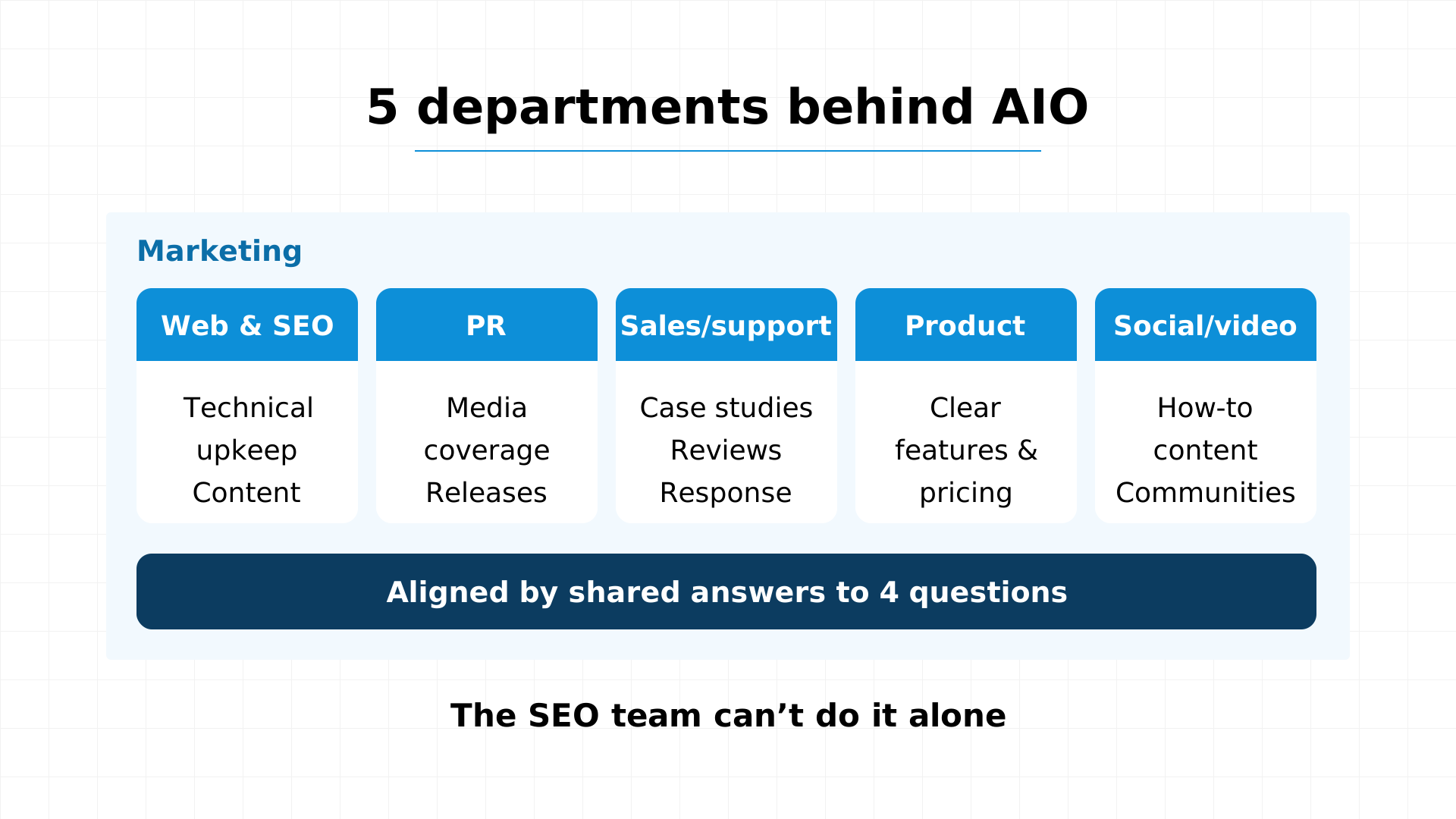
As the material for AI answers spreads beyond your own site, AIO work also leaves the hands of the web team and extends to PR, sales, support, and product. Designing work across multiple departments so it points in the same direction is marketing itself.
Each Department Has Its Own AIO Work
Dividing the work that affects AI answers by owner looks like this:
Web and SEO: technical upkeep so AI can read your pages, and content describing your strengths and specifications
PR: media coverage, and releasing research findings and press releases
Sales and support: case studies, requesting reviews, and the quality of responses to inquiries
Product: clarity of features, pricing, and contract terms
Social and video: how-to content and participation in communities
Of these, the SEO team can usually act directly only on the web and SEO area. For example, a review saying "replies are slow" will not be fixed no matter how many articles you write. You need to change your support setup and then update how you describe it.
Decide the Answers to Four Questions First, So Every Department Says the Same Thing
When running work across departments, first decide the answers to four questions: who you serve, what you offer, why your company, and why you can be trusted. If each department communicates on its own, how you are described outside will diverge, and AI's description of you will blur. These four questions are the same ones marketing has always faced.
Marketing question
What to consider for AIO
Who do we serve?
Which customers consult AI, and in what situations?
What do we offer?
Which problems do we solve, and how?
Why us?
How are we different from competitors, what are we best at, and why are we chosen?
Why should we be trusted?
Can we show track record, case studies, reviews, and expertise?
If you keep adding articles while these four remain vague, AI will be left with only a hazy image of "a company that can do anything." Before building a brand that AI understands, you first need to build a brand that people understand.
Results Can't Be Measured by Traffic Alone, Nor Proven by Visibility Alone
If comparisons happen inside AI answers, looking only at traffic to your site shows you just part of your customer touchpoints. On the other hand, an increase in how often AI mentions your name does not by itself prove a contribution to revenue.
HubSpot: Traffic Fell 80%, but Revenue Grew
HubSpot's blog lost about 80% of its search visits, from a peak of over 20 million a month, as AI answers spread (Search Engine Journal, October 2026). Even so, the company's revenue grew by about 20% in 2025, according to CMO Kipp Bodnar. Over several years, the company had built customer touchpoints beyond search, including newsletters, video, and podcasts.
However, Bodnar himself acknowledges that the relationship between AI visibility and business results is a correlation, and that causation has not been established. What this case shows is that "lost traffic" does not necessarily mean "lost," not that "AI visibility raises revenue."
Look at Three Layers
SEO consultant Gianluca Fiorelli points out that judging the value of AI search only by traffic and direct conversions overlooks the brand-building effects that accumulate before a purchase (iloveseo.net, October 2026). He also says that visibility in AI cannot by itself prove commercial value.
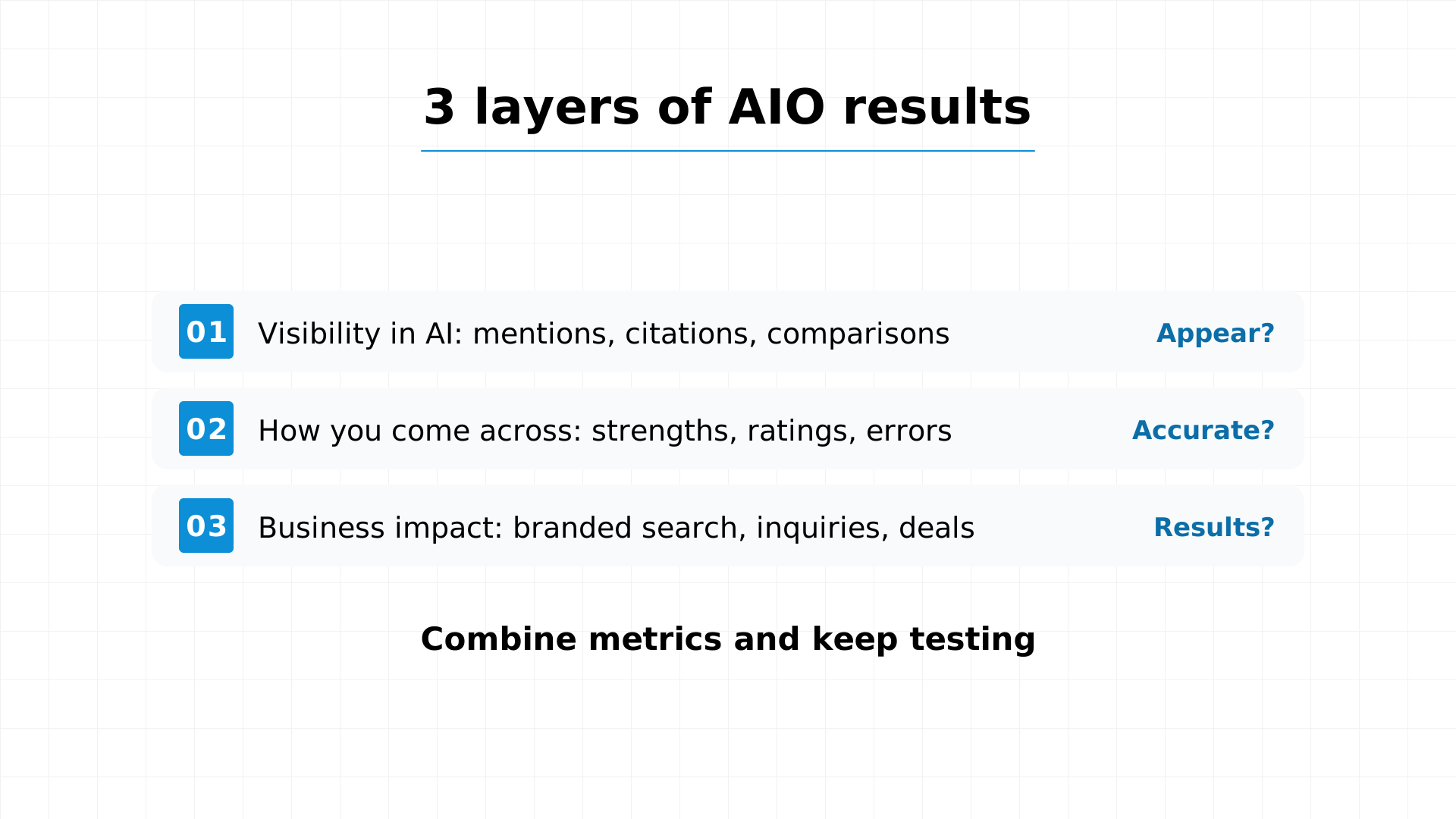
So look at results in three layers: visibility in AI, how you come across, and business impact.
Layer
What to look at
What to check
Visibility in AI
Brand mentions, citations, competitor comparisons
Does your name appear for important questions?
How you come across
Descriptions of strengths, evaluations in comparisons, inaccurate information
Is the value you want to convey expressed correctly?
What matters is combining multiple metrics with the voice of the customer, and continuing to test them as hypotheses.
Where to Start
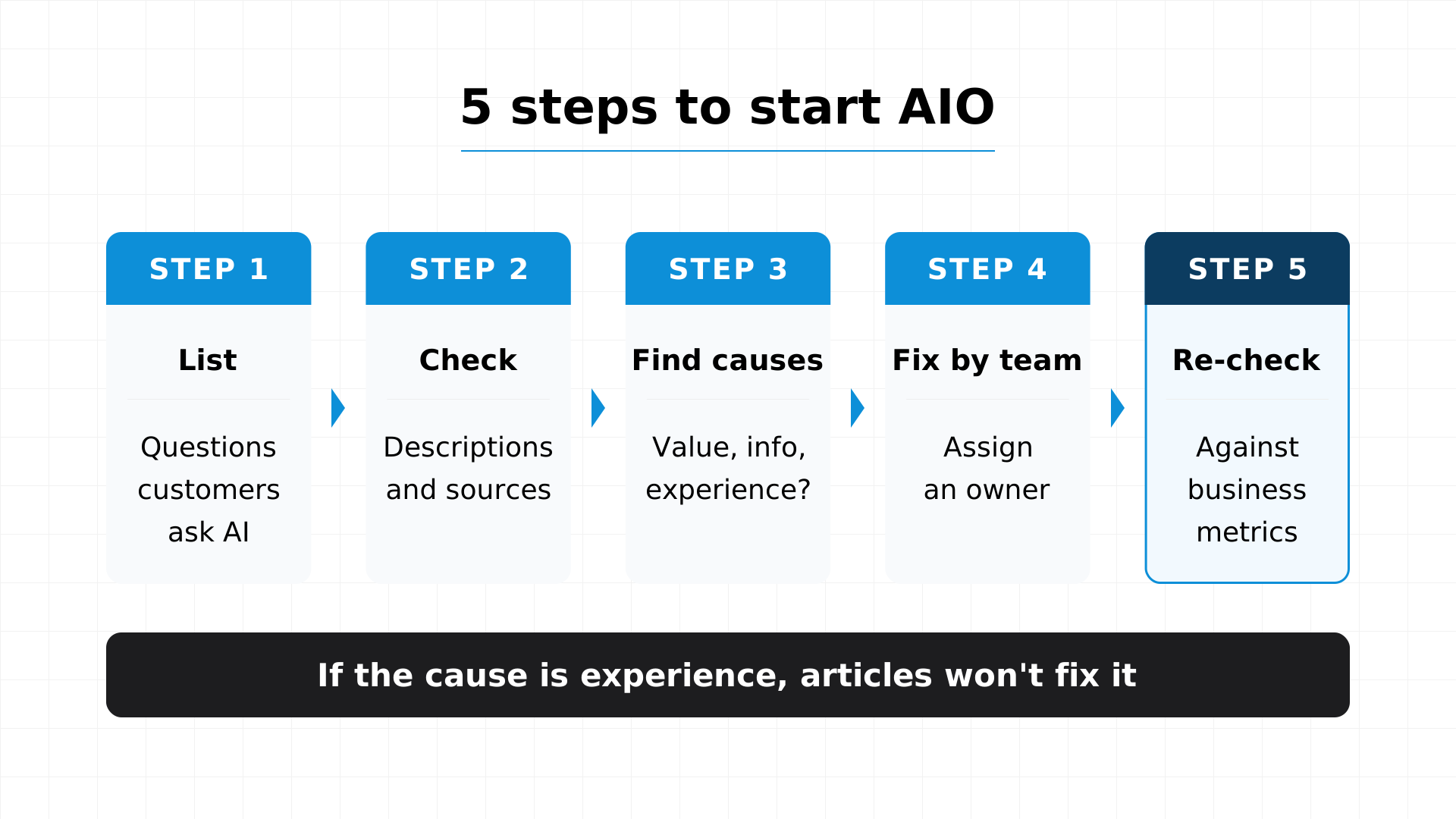
Start AIO by listing the questions your customers are likely to ask AI and checking how AI describes your company. Then separate the causes of any gap from the value you want to convey, decide which department owns each fix, and make the fixes.
List the questions customers are likely to ask AI: Write down not just search keywords but also customers' situations and comparison criteria.
Check how AI describes you and your competitors: Record not only whether your name appears, but also strengths, weaknesses, comparison criteria, and the sources of those descriptions.
Separate the causes of the gap from the value you want to convey: Determine whether the value itself is vague, information is lacking, or there is a problem with the actual experience.
Assign a department to each fix: If information is lacking, web or PR acts; if the experience has problems, support or product acts.
Keep checking, and compare against business metrics: AI answers change every time, so don't judge from a single result; keep checking the same questions.
The third step, separating the causes, is what turns AIO into a cross-functional effort. If the cause is "a problem with the experience," adding articles will not change how AI describes you.
What You Can Do with Dr.AISEO
Dr.AISEO is a tool for checking how AI describes you and your competitors, tracing back to the answer text and sources, and turning that into work across departments.
Check AI's Descriptions and Their Sources
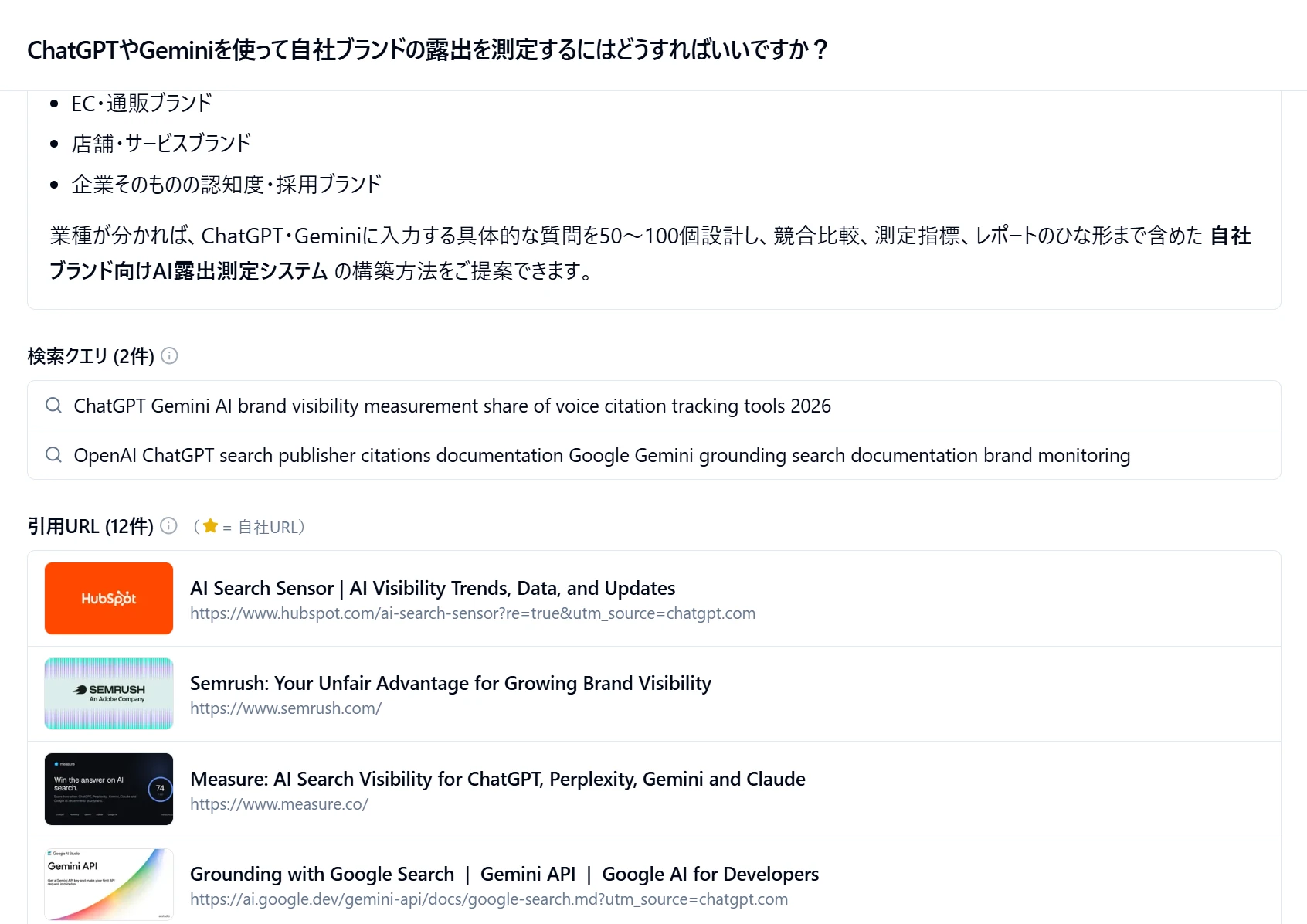
In Dr.AISEO, for each registered prompt (a question to AI), you can see the answer text from ChatGPT, Gemini, and AI Overviews, along with the URLs consulted and the URLs cited. Because AI judges from context whether your company appears, common nouns with the same spelling and different companies with the same name are not counted. You can compare against competitors to see how you are described and for which questions.
Answer log screen. You can see the words AI searched for to build its answer and the URLs it cited (a star marks your own URLs).
Looking at the consulted and cited URLs shows which sources AI built its description from. If you can identify media articles or reviews you were not aware of, or the source of an inaccurate description, you can take action such as correcting the information on that page or having PR republish accurate information.
Present What to Do, Across Departments
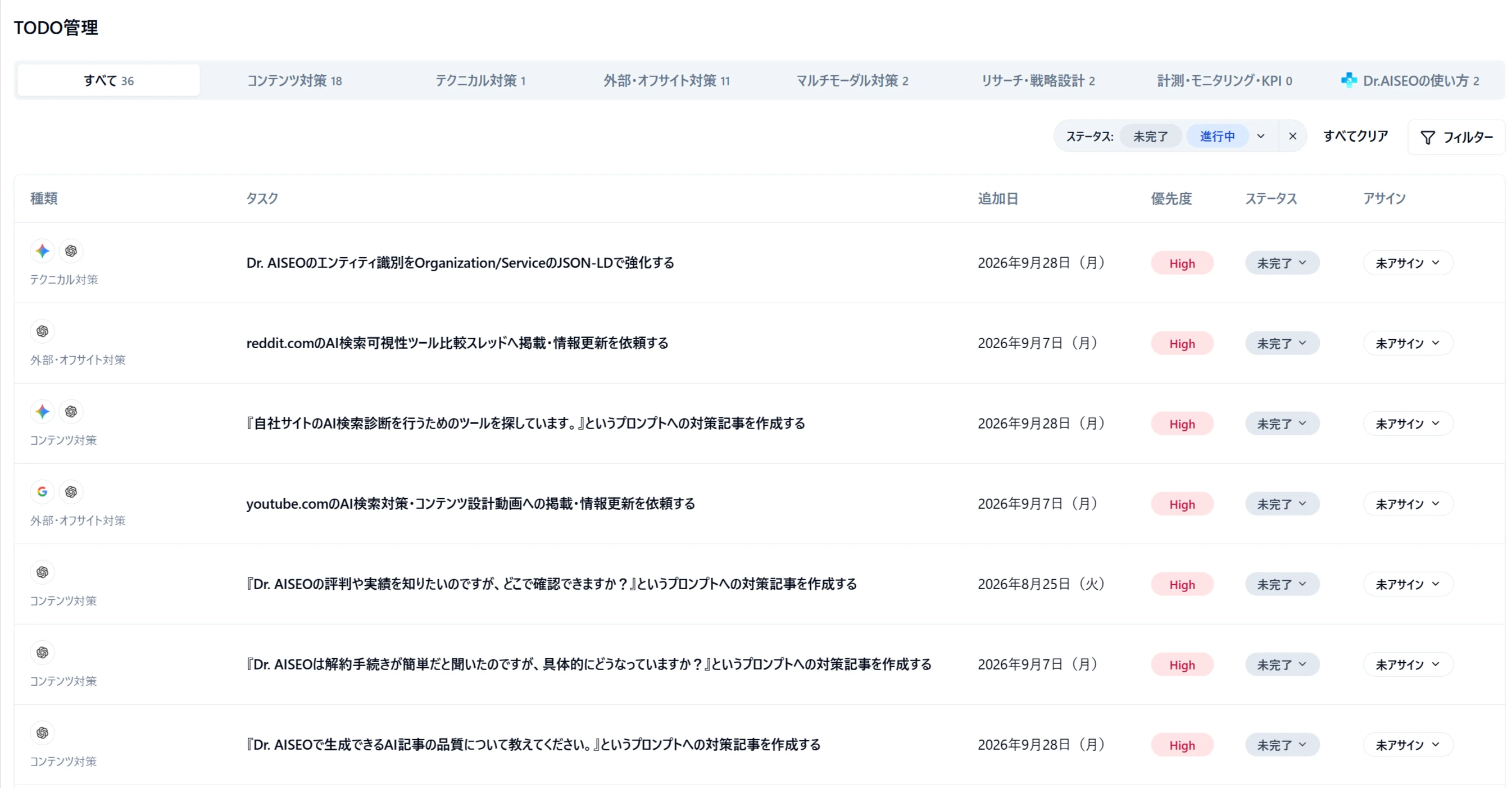
Based on the analysis, Dr.AISEO automatically creates a to-do list of actions once a week. For each action, it shows why it is needed along with the supporting evidence, and you can assign owners and track progress. The to-dos include not only content creation but also technical and off-site actions.
To-do management screen. Content, technical, and off-site actions are listed by type, and you can assign owners and track progress.
Measurements run automatically twice a week (Sundays and Thursdays), building up a history of answers (as of October 2026; once a week on the free plan). You can check over time how AI's descriptions changed before and after your actions.
Summary: AIO Rethinks Marketing as a Whole, Including SEO
AIO is not a technique for getting cited by AI. It is the work of conveying your value correctly and building reasons to be chosen, now that customers gather information, compare, and choose through AI.
The biggest difference from SEO is the scope of the work. AI builds its answers not only from your own site but also from third-party sources such as media articles and comparison sites, and from information you publish off your site, such as press releases. As a result, PR's role shifts from "a means of earning backlinks" to "material for answers," and even sales, support, and product teams become stakeholders in AIO.
This is not about abandoning SEO. AIO means rethinking marketing as a whole, including PR, customer experience, and product, on the foundation of SEO, to fit buying behavior that AI has entered.
You can check how AI currently describes your company with Dr.AISEO's free plan.