Home/Blog/ChatGPT Now Has Business Pages: 4 Changes Businesses in C...
Trends2026.11.12
ChatGPT Now Has Business Pages: 4 Changes Businesses in ChatGPT Brings, and the Work That Remains
On November 10, 2026, OpenAI launched "Businesses in ChatGPT" in beta. Inside ChatGPT, used by 1.2 billion people every week, businesses can now register and manage their own information and see how often ChatGPT mentions them and how many clicks to their website it generates. For the first time, ChatGPT itself has given businesses a way to provide information "officially" to AI and to measure the results.
1.2BWeekly ChatGPT users. Businesses can now manage their information inside ChatGPT (OpenAI, November 2026)
28 daysThe period covered by Business Hub's mentions and clicks. Only the last 28 days are aggregated
88.9%Share of official business sites among ChatGPT's references in bank loans. Official sites ranked first in all 6 industries (BAKURI & Dr.AISEO study, July–October 2026)
At the same time, OpenAI states clearly that claiming your business does not guarantee ChatGPT will recommend it more often. What ChatGPT recommends is still decided by ChatGPT. Claiming is a starting point for AI search optimization, but the work of tracking which questions you appear in, how you compare with competitors, and what to do to get chosen does not go away.
What changes
What doesn't change
You can hand official information directly to AI
AI still decides what to recommend
You can see mentions and clicks as official numbers
Official numbers don't show individual questions or gaps with competitors
Conversations with businesses and ads open new entry points outside the answer
Being chosen within the answer itself remains the main entry point
This article covers the essentials of Businesses in ChatGPT, lays out four changes the launch brings to AI search optimization, and explains why a measurement and improvement system like Dr.AISEO is still needed.
What Can Businesses Do with Businesses in ChatGPT?
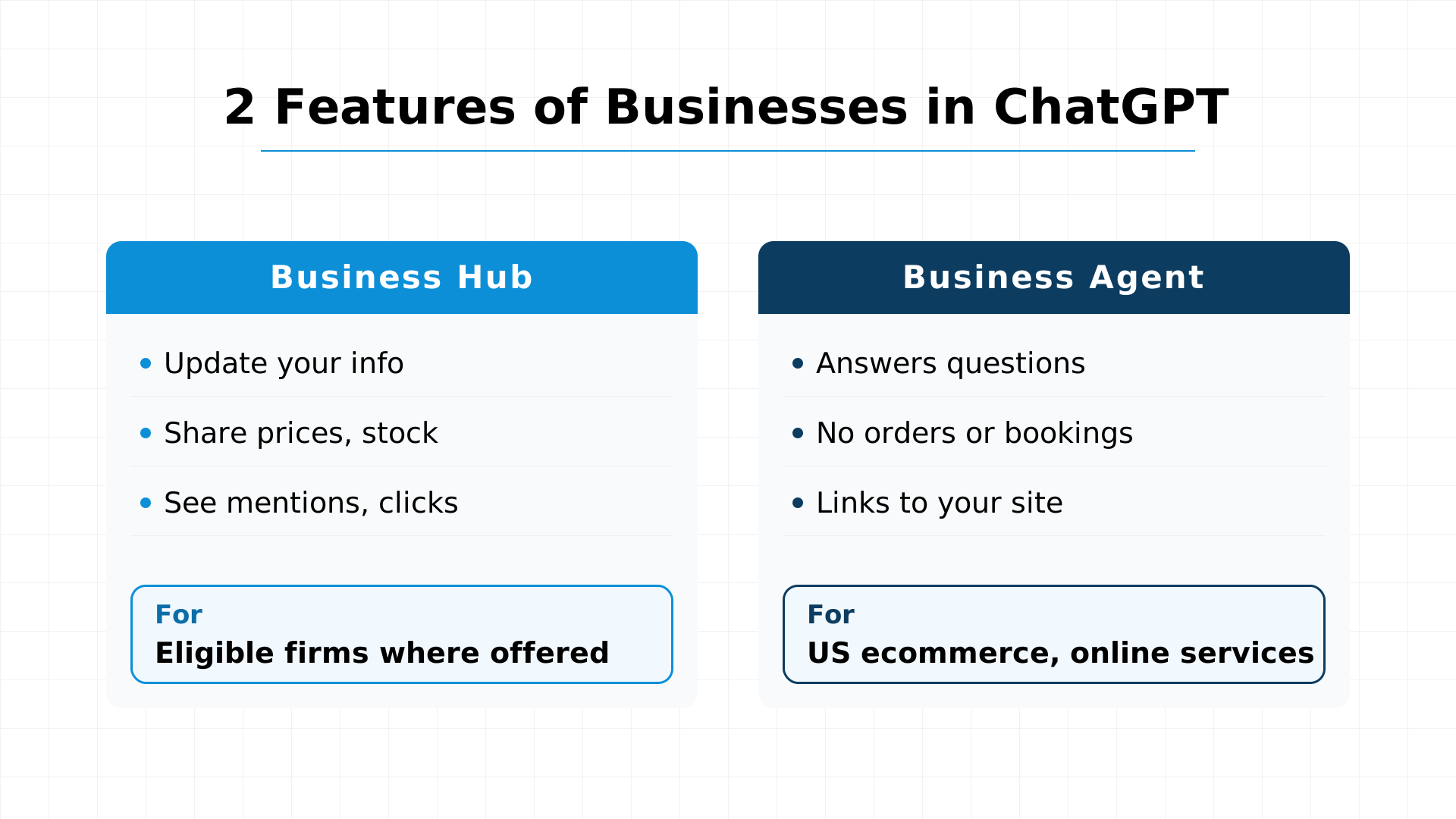
Businesses in ChatGPT consists of two parts: "Business Hub," where businesses manage their information, and "Business Agent," which answers users' questions based on that information. Business Hub is the foundation available to a broad range of eligible businesses, while Business Agent is an add-on only for businesses that meet additional requirements (OpenAI).
In Google terms, Business Hub is like combining the roles of Google Business Profile (GBP) and Google Search Console (GSC) into one tool inside ChatGPT. Feature by feature, the correspondence looks like this (OpenAI Help Center).
Business Hub feature
Closest Google equivalent
What it does and how it differs
Claiming and updating your profile
Google Business Profile
The business itself registers and updates its website URL, description, logo, delivery and return policies, and more. Like GBP, you manage it after claiming and verification
Connecting a product feed
Google Merchant Center
Provides product data including prices and availability. Connecting it does not guarantee ChatGPT will recommend your products
Mentions and website clicks
Impressions and clicks in Google Search Console
Shows how often ChatGPT's answers referenced your website and how often the link was clicked, aggregated over the past 28 days
Discovery topics
Queries in Google Search Console
Shows common themes across conversations that cited you. Individual prompts are not visible; you only see grouped themes
There is no equivalent of GA4. Business Hub's click count is the number of times a link was clicked inside ChatGPT; it does not confirm site visits or conversions. How many people actually came to your site from ChatGPT, and what they did there, still has to be measured with GA4 or another analytics tool. In other words, Business Hub covers "how you appear inside AI," and GA4 covers "what people do after arriving on your site."
To claim a business, you verify ownership by phone, business email, website domain (adding a DNS record), or Shopify, and OpenAI reviews the claim. Publishing information and viewing insights also require identity verification through a service called Persona; once approved, a blue check appears on the profile. Running ads or having a ChatGPT Enterprise agreement is not required to claim a business.
Business Agent is an AI point of contact for each business, where users can ask about its products and policies. As of November 2026, it is available only to US ecommerce and online service businesses with a website. It cannot complete purchases, make bookings, or check order status; its role ends at directing users to the business's website. OpenAI says it plans to expand eligible regions and business categories.
Note that the similarly named "ChatGPT Business" is a paid plan for organizations to use ChatGPT internally, and is unrelated to Businesses in ChatGPT. The former is a contract for "employees using ChatGPT," while the latter is a system for managing "how your business appears to ChatGPT users."
Change 1: AI Gets an "Official Information Channel"
The biggest change is that businesses can now hand their information directly to AI. Until now, the only way for a business to influence ChatGPT's answers was indirect: maintaining its own website and making sure it was described accurately in outside media and reviews.
We see this change as similar to how Google Business Profile transformed local search optimization. As Google Business Profile spread, stores and businesses began registering their own hours, locations, and photos and managing how they appeared in search results. Business Hub's profile brings the same idea to ChatGPT's answers.
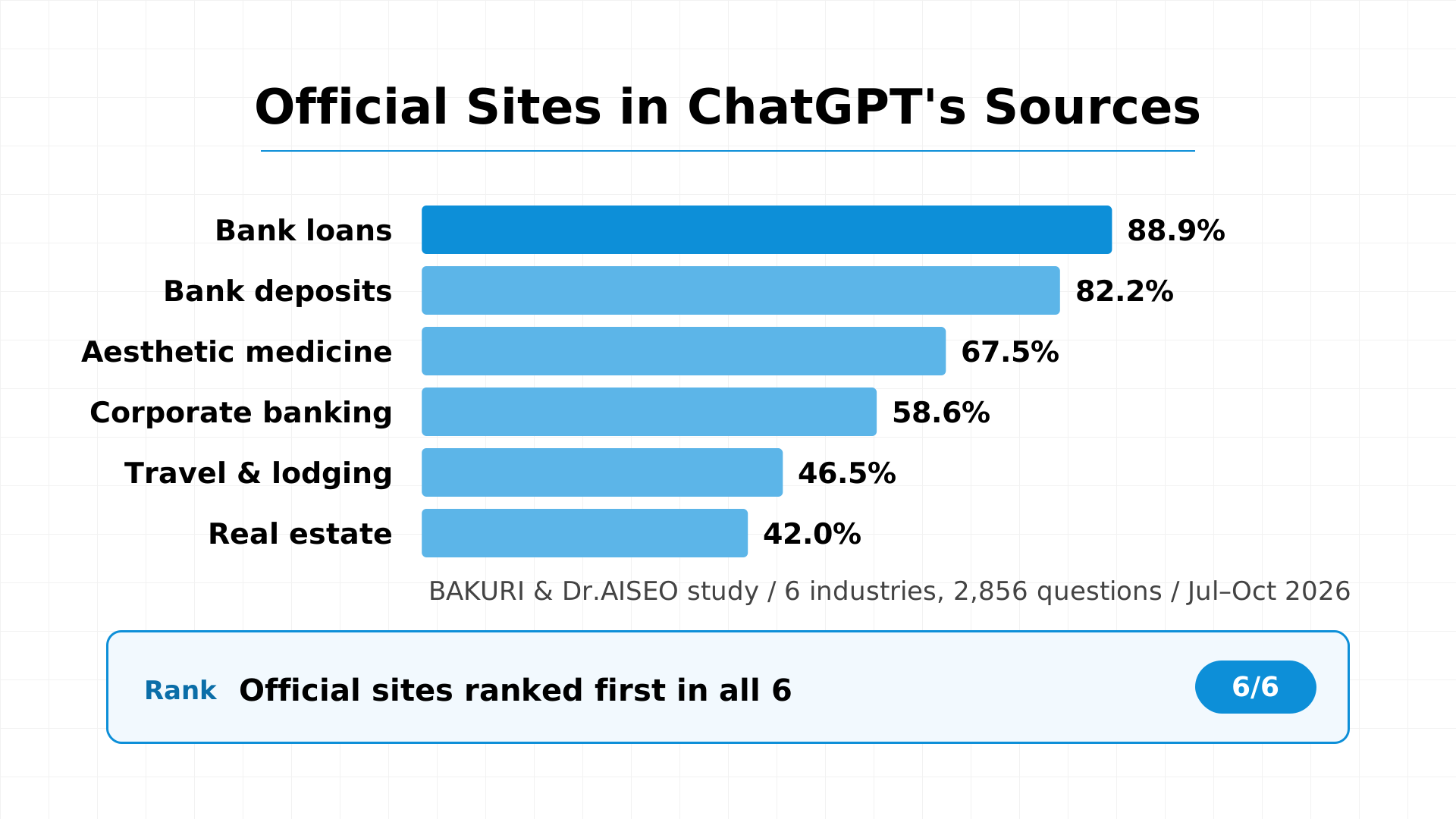
ChatGPT already relies heavily on businesses' own information. When BAKURI and Dr.AISEO examined ChatGPT and Gemini answers to 2,856 questions across six industries, official business websites were the top type of site ChatGPT read as the basis for its answers in all six. Official sites accounted for 88.9% of references in bank loans, 82.2% in bank deposits, and 67.5% in aesthetic medicine, and even in travel and lodging (46.5%) and real estate (42.0%), where major portals are strong, they narrowly outnumbered the portals (BAKURI Inc., Japanese; measured July–October 2026).
The foundation of ChatGPT's answers is already what businesses publish themselves. Business Hub adds another channel to that foundation, one that businesses can manage directly.
Now that ChatGPT also has an official channel, the importance of "publishing your information correctly, in a form AI can read" increases. Conversely, businesses that leave their profile unclaimed will continue to be described only through other sources.
Change 2: An "Official Yardstick" for Measuring Results in AI
The second change is that official numbers now exist for measuring results in AI. Because OpenAI itself defines "mentions" and "website clicks" and shows them to businesses, they become a common language for discussing AI-driven results internally.
Until now, measuring how AI treated your business meant either sending questions with an outside tool and collecting the answers, or looking at AI referral traffic in analytics. With the platform itself providing numbers, the question "Does AI optimization work?" can now be answered with official data, at least for ChatGPT.
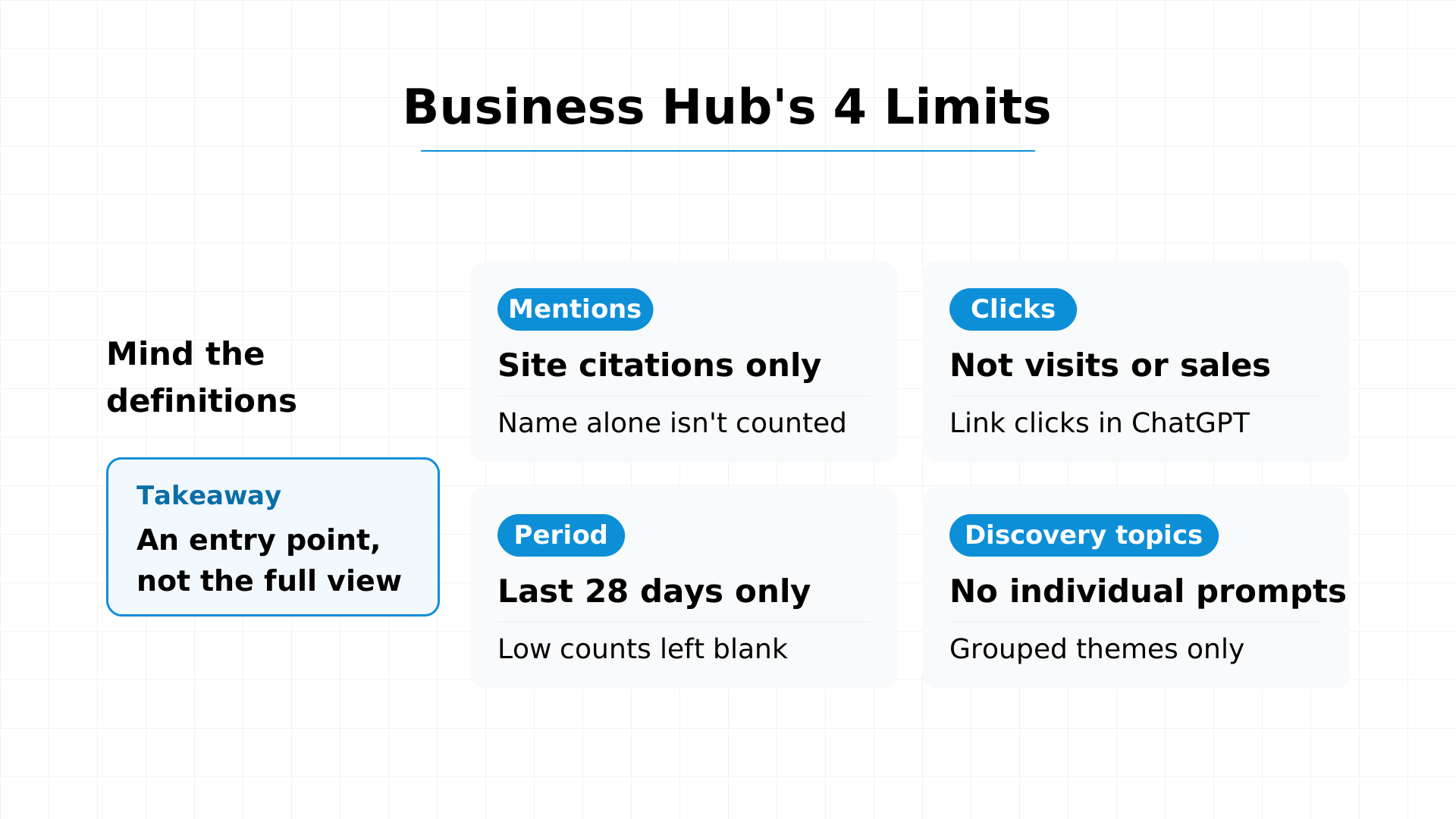
However, this yardstick is narrowly built. According to the Help Center's definitions, note the following (OpenAI Help Center).
How mentions are counted: For online businesses, a mention counts only when ChatGPT references the business's website. A brand name appearing in the answer alone does not count.
What clicks mean: The number of times a link to your website was clicked inside ChatGPT. It does not confirm site visits or conversions.
Period and thresholds: You see aggregated data for the past 28 days. Numbers that do not reach a certain volume are left blank, and a blank does not mean zero.
Content: Individual prompts and conversations are not shared with businesses. Discovery topics are also grouped themes and are said not to directly indicate user intent.
Because these constraints exist to protect user privacy, they are likely to remain for the foreseeable future. The official numbers are useful as an entry point for measuring results in AI, but on their own they do not give you the full picture of your situation.
Change 3: Touchpoints with Businesses Extend Beyond the Answer
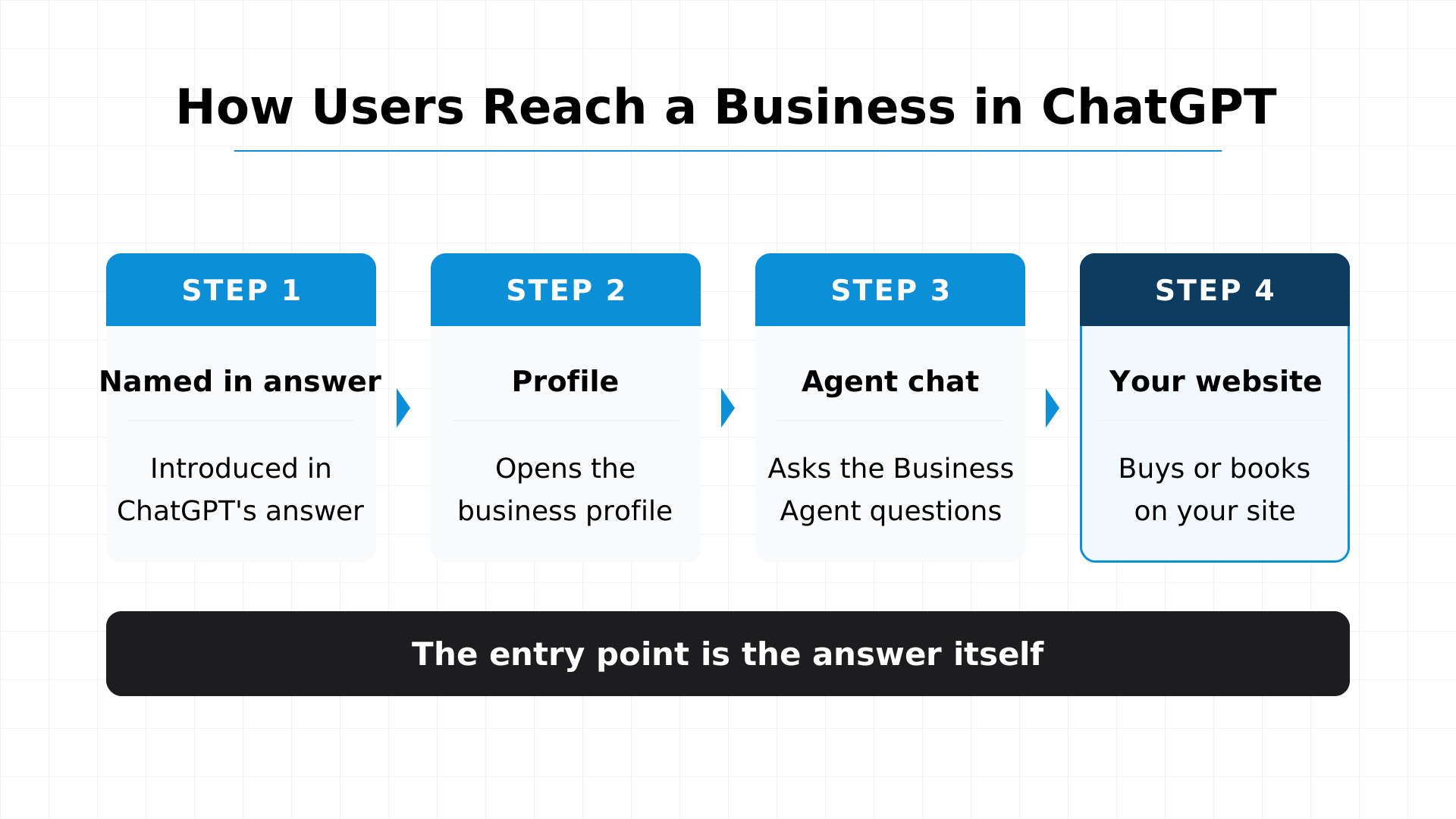
The third change is that there are more ways for businesses and users to meet inside ChatGPT. Until now, the touchpoint was a single path: "being introduced in an answer, then visiting the website." Profile views, conversations with a Business Agent, and ads are now added to it.
According to OpenAI, when a business appears in an answer, users can open its profile. If a Business Agent is available, they can ask about differences between products or whether something fits their needs based on the business's information, and complete purchases or bookings on the business's website.
However, as of November 2026, only US ecommerce and online service businesses with a website can create a Business Agent, and Japanese businesses cannot use it yet. For Japanese businesses, the touchpoints they can prepare now are the answer and the profile. Since OpenAI plans to expand eligible regions and categories, it makes sense to prepare the product information and return and delivery policies an agent would read on your own website now, ahead of availability in Japan. In that comparison and consideration progress within the flow of a conversation, the shift discussed in "The Rise of Conversational Commerce AI: Is the Shopping Cart on Its Way Out?" has taken a form businesses themselves can use.
A Business Agent can also be used as the destination for ChatGPT ads. However, OpenAI displays both Business Agent conversations and sponsored placements separately from ChatGPT's own answers, and states clearly that advertising does not influence ChatGPT's independent answers (OpenAI, OpenAI Help Center).
What this tells us is that the value of being chosen within the answer itself actually goes up. Both the profile and the Business Agent are opened only after a user first finds the business's name in an answer. Ads can buy an entry point, but they cannot buy the answer itself.
Business Agents also come with rules. OpenAI's policy requires agents to represent the business accurately and keep information current, and prohibits misrepresentation, high-pressure selling, collecting unnecessary sensitive information, and advice that requires professional credentials, among other things (OpenAI).
Change 4: A Race to "Align Your Information" Begins
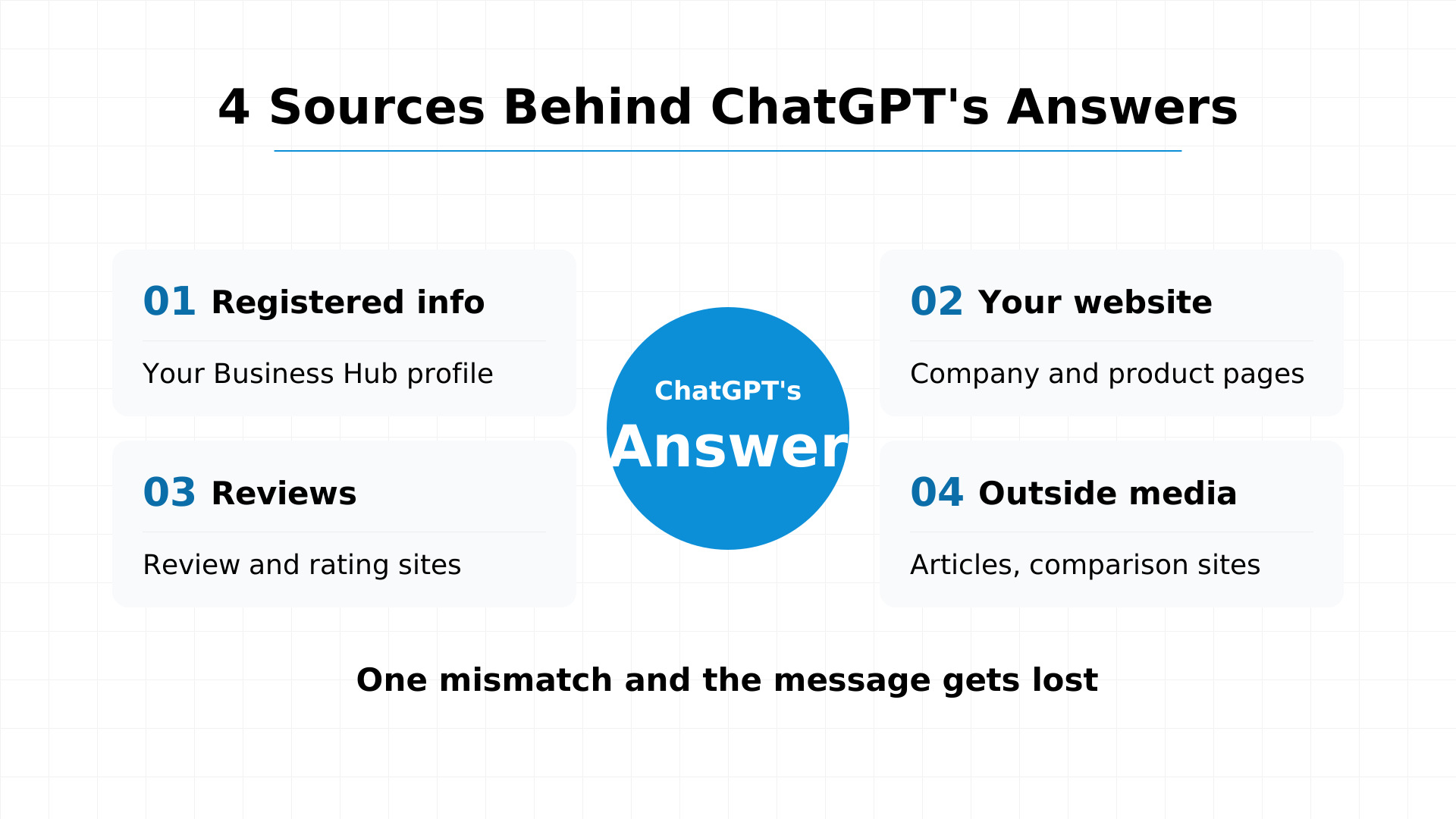
The fourth change is that keeping your information consistent across every source becomes more important. Even if you register correct information in Business Hub, ChatGPT also uses other sources to answer, so if what you registered conflicts with outside information, users will not get an accurate picture.
The Help Center states that updated information can take time to be reflected in answers and that ChatGPT also uses other sources (OpenAI Help Center). In other words, it is more accurate to think of Business Hub not as "a place to overwrite your information" but as one more source that AI consults.
The weight of outside sources is visible in other developments as well. In the US, the review site Yelp began providing local business data to OpenAI, and reviews, ratings, and photos are now used in ChatGPT's local search answers. An article by 97th Floor discussing the partnership presents the view that the focus of local optimization is shifting from "maintaining a single profile" to "making sure business information matches across multiple sources" (97th Floor, August 2026).
There is one more reason to claim early. In a Search Engine Roundtable article, the author expressed concern about third parties hijacking business profiles (Search Engine Roundtable). In the past, hijackings in which third parties gained owner access and changed store information did actually occur on Google My Business (now Google Business Profile) (Search Engine Roundtable, 2020). Business Hub can also be claimed by phone, email, or domain, which leaves room for someone to claim a business before its real owner does.
OpenAI provides a process for disputing ownership of a business that has already been claimed, but claiming your own business first is the safest approach.
Why Dr.AISEO Is Still Needed
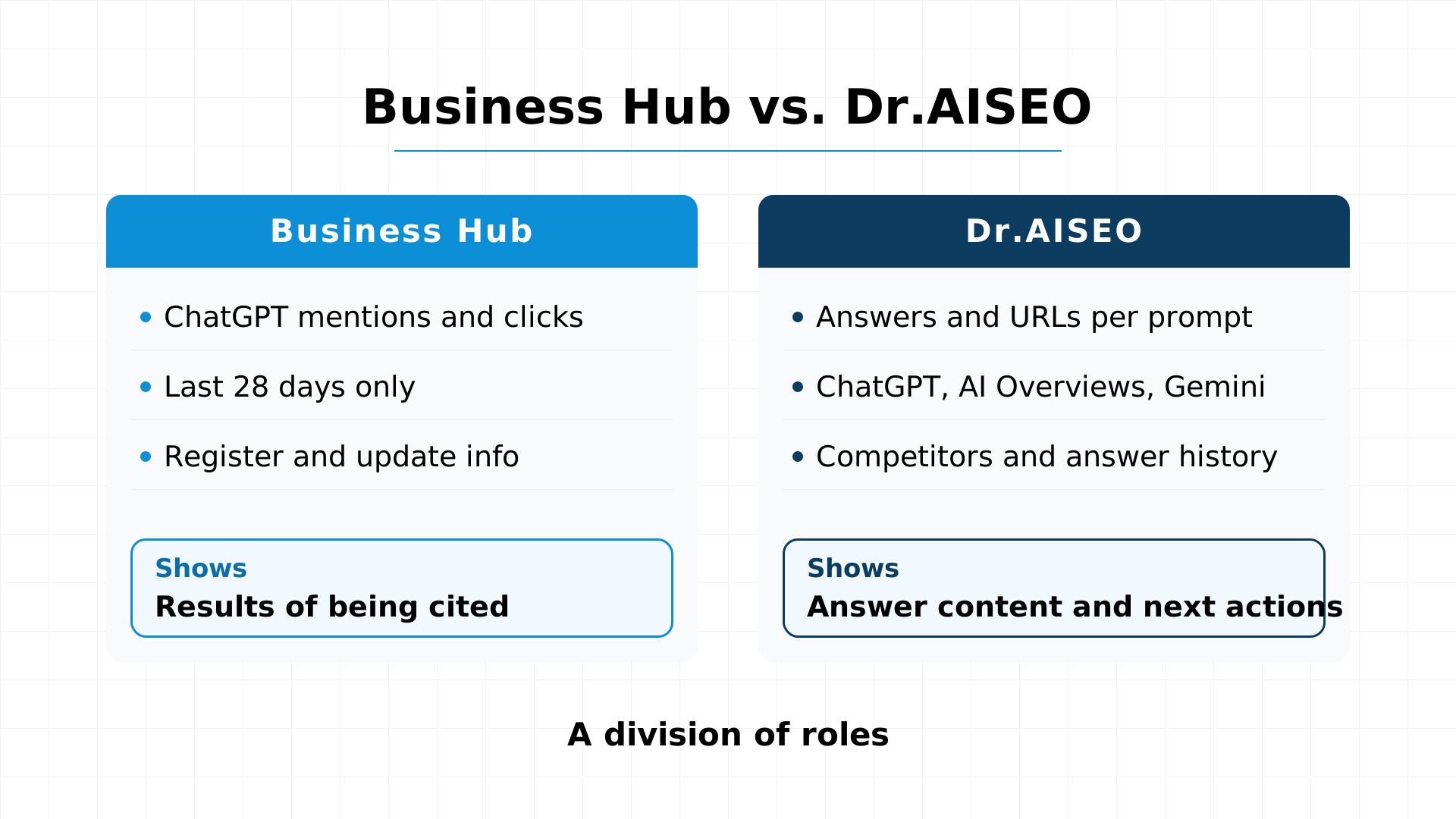
Business Hub shows the "results" of ChatGPT referencing your business, within the limits of protecting privacy. It does not tell you which questions you appeared in, how you compared with competitors, why you were not chosen, or what to do next. Dr.AISEO fills in that part.
First, you can see how AI actually answered, question by question. For each registered question (prompt), Dr.AISEO records the AI's full answer text and every referenced and cited URL. Because AI determines from context whether your brand appeared in an answer, cases where only your brand name appeared without your site being referenced are also counted. You can catch the state of "your name appears, but your website isn't referenced," which does not show up in Business Hub's mention count.
Second, you can compare AI services other than ChatGPT, and your competitors, side by side. Users do not rely on ChatGPT alone. In addition to ChatGPT, Dr.AISEO collects answers from Google AI Overviews and Gemini (Light plan and above) for the same questions, so you can compare differences in appearances and recommendations between you and your competitors (as of November 2026). Our collection methods and model, region, and language settings are disclosed in "Should You Measure AI Search via the UI or the API? Why the Same ChatGPT Gives Non-Overlapping Results."
Third, you can keep answers as a history. Business Hub shows only the past 28 days, and how AI answered in the past cannot be recovered later unless you recorded it. Dr.AISEO sends the same questions regularly and accumulates the answers, so you can compare how answers changed before and after claiming your business in Business Hub or improving your information. With GA4 integration, you can also view sessions from AI to your website on the same screen.
Fourth, it does not stop at measurement but shows what to do next. As OpenAI states, claiming your business does not guarantee more recommendations. Based on measurement results and your brand's situation, Dr.AISEO suggests actions from its tactics database once a week and explains why each is needed, with supporting evidence. You can also create articles that draw out first-hand information and create FAQs in the same tool.
Use Business Hub to maintain your official information, and Dr.AISEO to track and improve what AI actually says. The two are not replacements for each other but a division of roles.
What Businesses Should Do Now
Businesses in ChatGPT is in beta, and eligible regions and categories are expected to expand. What matters now is less the claim itself than being able to verify what changed before and after you claim.
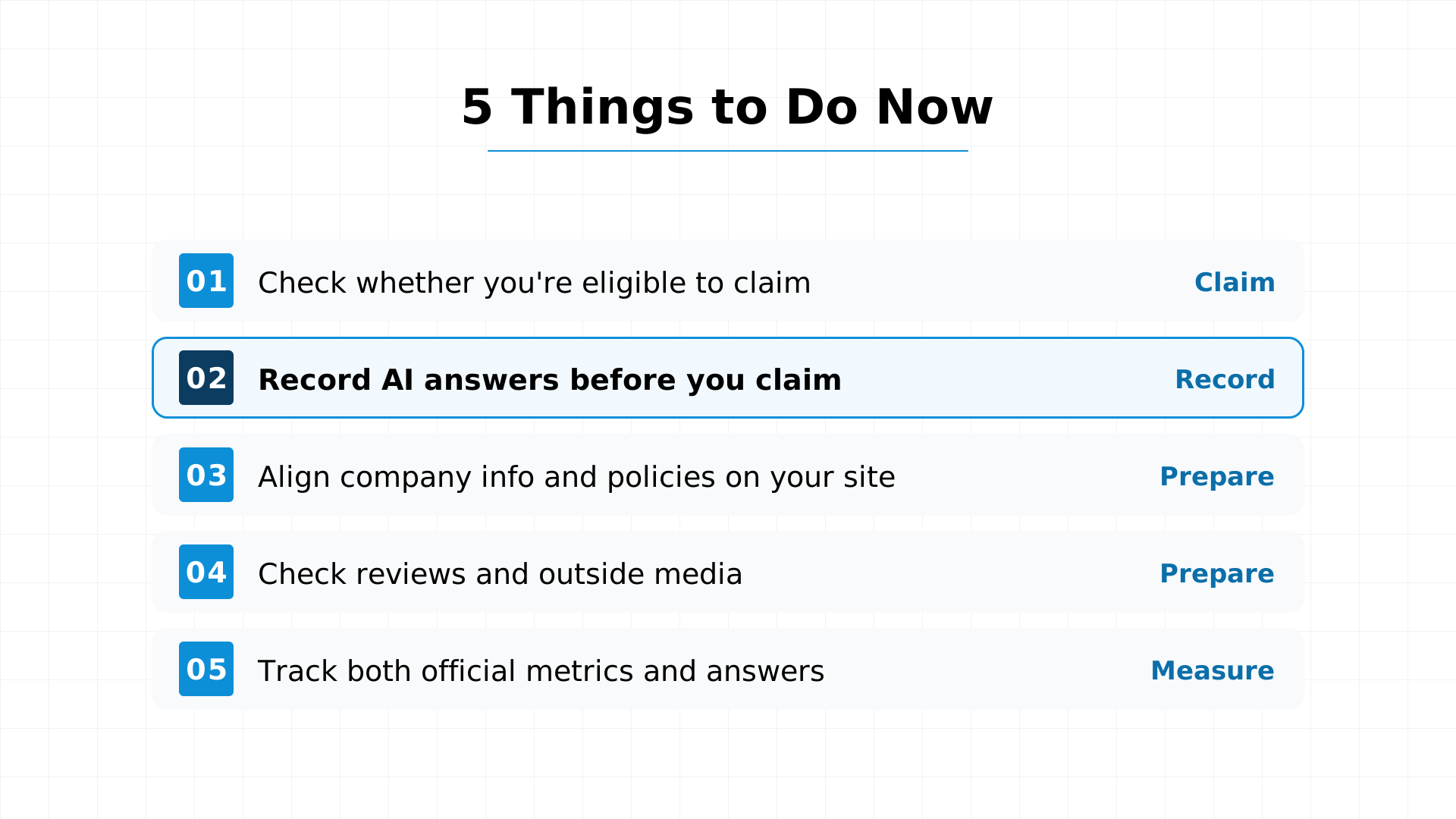
Check whether you're eligible to claim: Eligibility depends on your location and type of business. Search for your business in ChatGPT's Business Hub and, if eligible, claim it early.
Record AI answers before you claim: Save how ChatGPT and other AI currently answer questions related to your business. Without a "before" record, you cannot verify the effect of claiming or improving your information.
Align company info and policies on your site: Make sure the business description, delivery and return policies, and product information you register in Business Hub match your website.
Check reviews and outside media: Check whether outdated or incorrect information remains elsewhere, and fix what you can.
After claiming, track both official metrics and answers: Look at Business Hub's mentions and clicks together with changes in answers question by question.
Summary: Maintain the Official Channel, Keep Tracking What the Answers Say
With Businesses in ChatGPT, businesses now have an "official channel" for handing their information directly to ChatGPT and an "official yardstick" for measuring results. New touchpoints outside the answer are also emerging: profiles, Business Agents, and ads.
Even so, ChatGPT itself decides what it recommends. Ads do not influence answers, and claiming your business does not guarantee recommendations. To be chosen within the answer itself, you need to align your information from your website to outside sources, track how AI actually answers question by question, and keep improving.
With Dr.AISEO, you can check how ChatGPT and AI Overviews answer about your business, starting with the free plan. We recommend recording your current state first, before you claim your business in Business Hub.