Home/Blog/Is AI Search a Waste Because It Sends Little Traffic? How...
AISEO Strategy2026.11.10
Is AI Search a Waste Because It Sends Little Traffic? How to Measure It as a Brand Channel
In October 2026, a debate spread through the international SEO community claiming that "GEO (optimization for generative AI) is a distraction." Data from 100 sites showed that traffic from ChatGPT amounted to just 0.62% of Google organic search. The numbers themselves are accurate, but as long as you measure AI search as a channel that brings people to your site, you will miss most of its value. AI compares companies, names them and describes them inside its answers. AI search should be measured not as a demand-capture channel judged by traffic and conversions, but as a brand channel.
0.62%ChatGPT sessions as a share of Google organic search across 100 sites' GA4 data (Marie Haynes, October 2026)
8%Share of visits in which regular search results were clicked when AI Overviews appeared, versus 15% without them (Pew Research Center)
1.26xMedian ratio of AI traffic to organic conversion rates across 78 sites (Siege Media, June 2026)
That said, being a brand channel does not mean results can be written off as "invisible effects." Even if branded searches or direct traffic increase, you cannot conclude that AI caused it. What you need is to measure in stages—whether AI retrieves you, how you are treated inside answers, and what happened to business results—and to treat evidence according to its strength.
Stage
What to look at
Main data
Input
Whether AI gathers your pages as material
Your pages that were referenced, crawler visits
Channel
Whether your name appears in answers, whether you become a source, how you come across
Mentions, citations, answer text, comparison with competitors
Outcome
What happened to the business, weeks to months later
Traffic from AI, branded search, customer feedback, sales opportunities
This article lays out the substance of the "GEO is a distraction" debate and the rebuttal to it, explains how to measure AI search in three stages—input, channel and outcome—and shows what Dr.AISEO can and cannot measure.
The "GEO Is a Distraction" Debate: What Did the Traffic and Conversion Data Show?
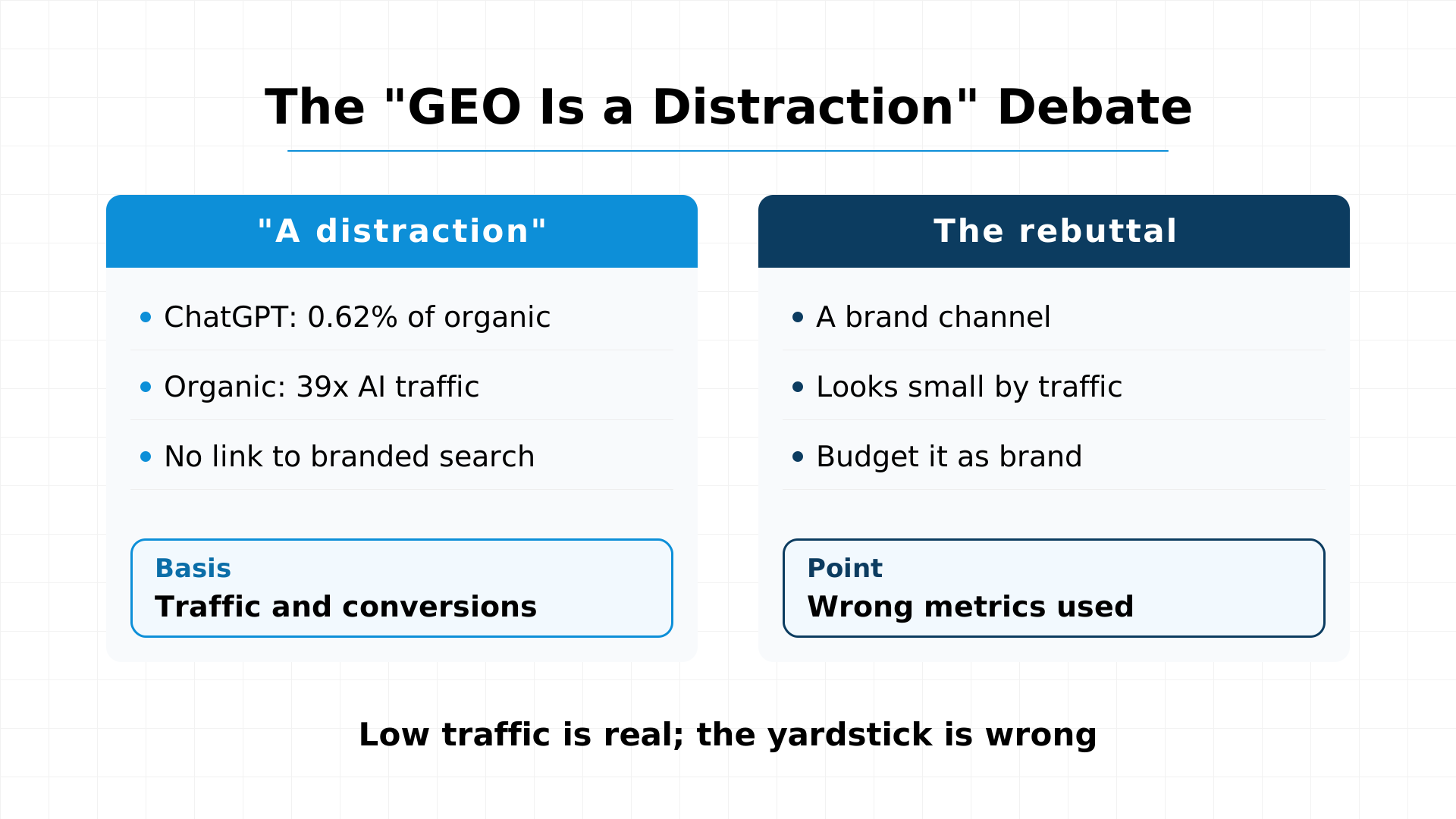
Those who call GEO a distraction base their case on data showing that the volume of traffic and conversions from AI falls far short of Google organic search. The data was collected carefully, and the fact that AI sends little traffic needs to be accepted as fact.
Three Studies That Showed "Low Traffic"
SEO consultant Marie Haynes analyzed 12 months of GA4 (Google Analytics 4) data from 100 sites (Marie Haynes, October 2026). Sessions from ChatGPT equaled 0.62% of Google organic search, roughly 1 to 160. In conversions as well, Google organic search drove about 27 times more than all AI services combined, including ChatGPT. She concludes that rather than chasing visibility in AI, businesses should prioritize restoring their performance in Google Search.
UK SEO agency SEO Works reported that, across 95 sites from September 2025 to August 2026, organic search delivered 39 times more traffic than AI assistants (SEO Works). In conversions, AI delivered 3.2 for every 100 from organic search.
Kevin Indig, who runs Growth Memo, tested the relationship between AI visibility and subsequent branded search and direct traffic for four brands across 632 combinations (Growth Memo, October 2026). He found no reliable relationship between the two.
The Rebuttal: A Brand Channel Was Measured With Performance Metrics
In response, Mike King, founder of SEO agency iPullRank, accepted all three sets of data but argued that the conclusion was a "category error" (iPullRank, October 2026). His point is that AI search is a brand channel, so of course its value looks small when measured with performance metrics such as traffic and conversions. He says both the budget and the measurement should treat it as brand work, not demand capture.
Note that iPullRank's business is supporting AI search, and Marie Haynes and SEO Works also offer diagnostic services and SEO support respectively. Each argument should be read with some discount for the business position it comes from.
What Do You Miss When You Measure Only Traffic?
Measuring AI search only by traffic misses at least three things: that AI Overviews reduce clicks in the first place, that some visits from AI are counted under other sources, and the effect of your name appearing in AI answers itself.
Clicks Fall When AI Overviews Appear
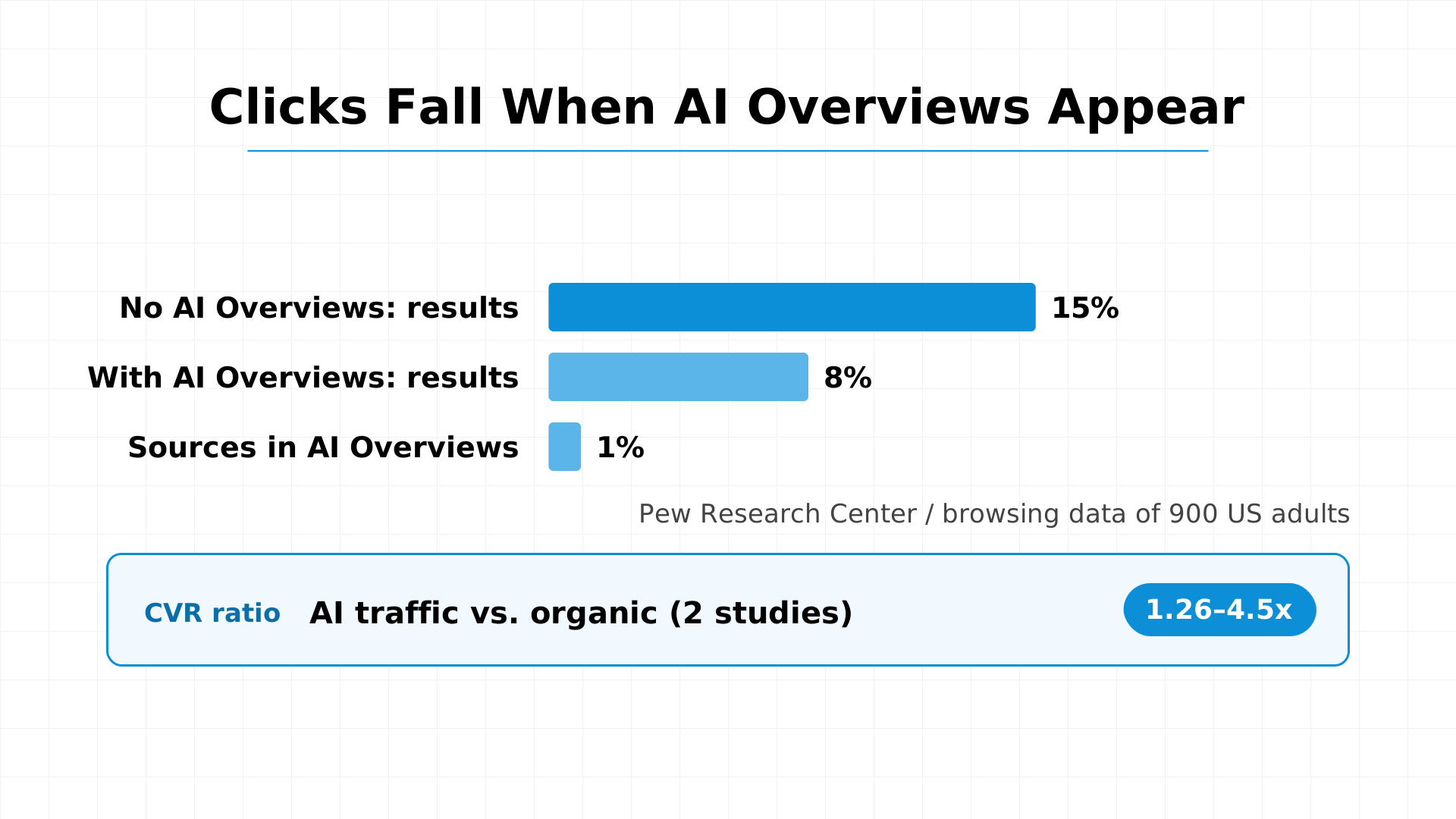
When the US research organization Pew Research Center analyzed Google search browsing data from 900 US adults, regular search results were clicked in 8% of visits when AI Overviews appeared, nearly half the 15% when they did not (Pew Research Center, July 2025). Sources inside AI Overviews were clicked in just 1% of visits where AI Overviews appeared. AI Overviews get read, but they generate almost no clicks.
Not Every Visit From AI Is Counted as "AI"
Analytics counts a visit as coming from AI only when the referrer still carries the AI service's name. The same SEO Works study notes that visits opened from in-app browsers, visits whose referrer information was stripped, and visits from people who learned about a company through AI and then searched for its name are not measured as AI. Clicks from AI Overviews are also counted as regular organic search sessions.
Opting Out of AI Search Features Lowered Regular Click-Through Rates Too
SEO expert Cyrus Shepard tried removing his own site from Google's AI search features (such as AI Overviews) for 28 days, then switched them back on for 28 days and compared (Zyppy, November 2026). AI search features accounted for about 21% of the site's clicks. He also reports that while the site appeared in AI answers, the click-through rate of regular search results was about 2.3% higher, meaning visibility in AI spilled over into regular search. However, this is a before-and-after comparison of a single site, and he himself positions it as a directional yardstick.
AI Traffic Converts Somewhat Better, but That Does Not Close the Volume Gap
Some data shows that AI traffic converts at a higher rate than organic search. In Marie Haynes's analysis, among the 55 sites that tracked conversions, traffic from ChatGPT converted at 13.8% versus 3.02% for Google organic, a gap of more than 4.5 times. Meanwhile, when SEO agency Siege Media analyzed GA4 data from 78 sites, the median ratio of AI to organic conversion rates was 1.26 times (Siege Media, June 2026). For ecommerce sites it was 1.01 times, almost no difference.
The conversion-rate gap ranges from just over 1x to over 4x depending on the study. Yet even 4.5 times, at the high end, comes nowhere near the gap in traffic volume (roughly 1 to 160). Explaining away low traffic with high conversion rates does not hold up.
Treating AI Search as a "Brand Channel"
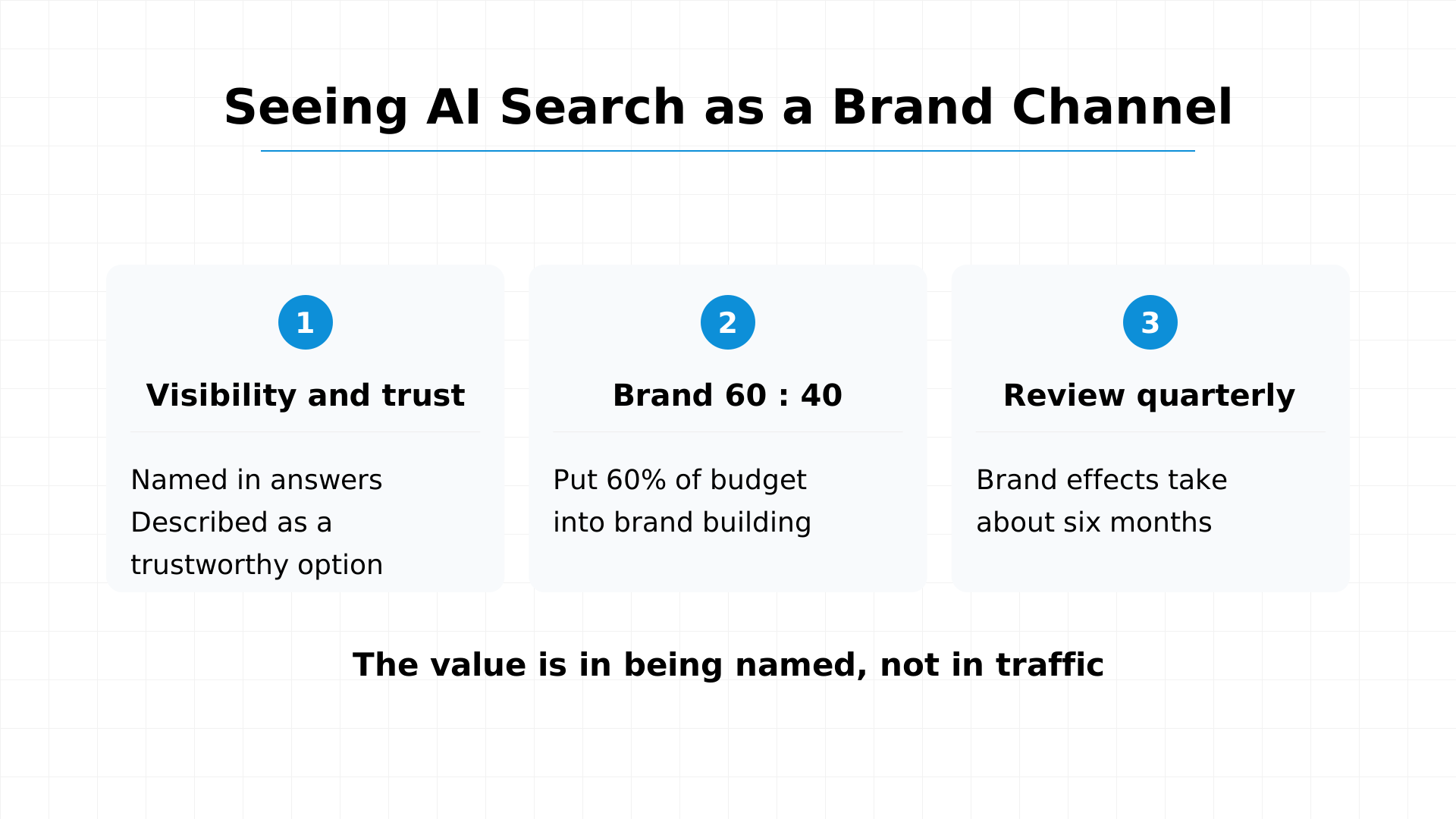
The value of AI search lies less in bringing people to your site than in having your name come up in answers and being described as a trustworthy option. Because AI assembles the answer, what a company can do is shape the material and the reputation it draws on. In this respect, AI search resembles a brand built through advertising and PR.
Brand Effects Show Up Late
Les Binet and Peter Field, known for their research on marketing effectiveness, concluded from analyzing cases collected by the UK's Institute of Practitioners in Advertising (IPA) that budgets work best split 60% to brand building and 40% to demand capture (summary of their talk by System1). They also say it takes about six months for the long-term effects of brand building to appear and overtake short-term effects. Citing this research, Mike King argues that AI search should be evaluated on the same timeline as brand building.
Measure in Three Stages: Input, Channel and Outcome
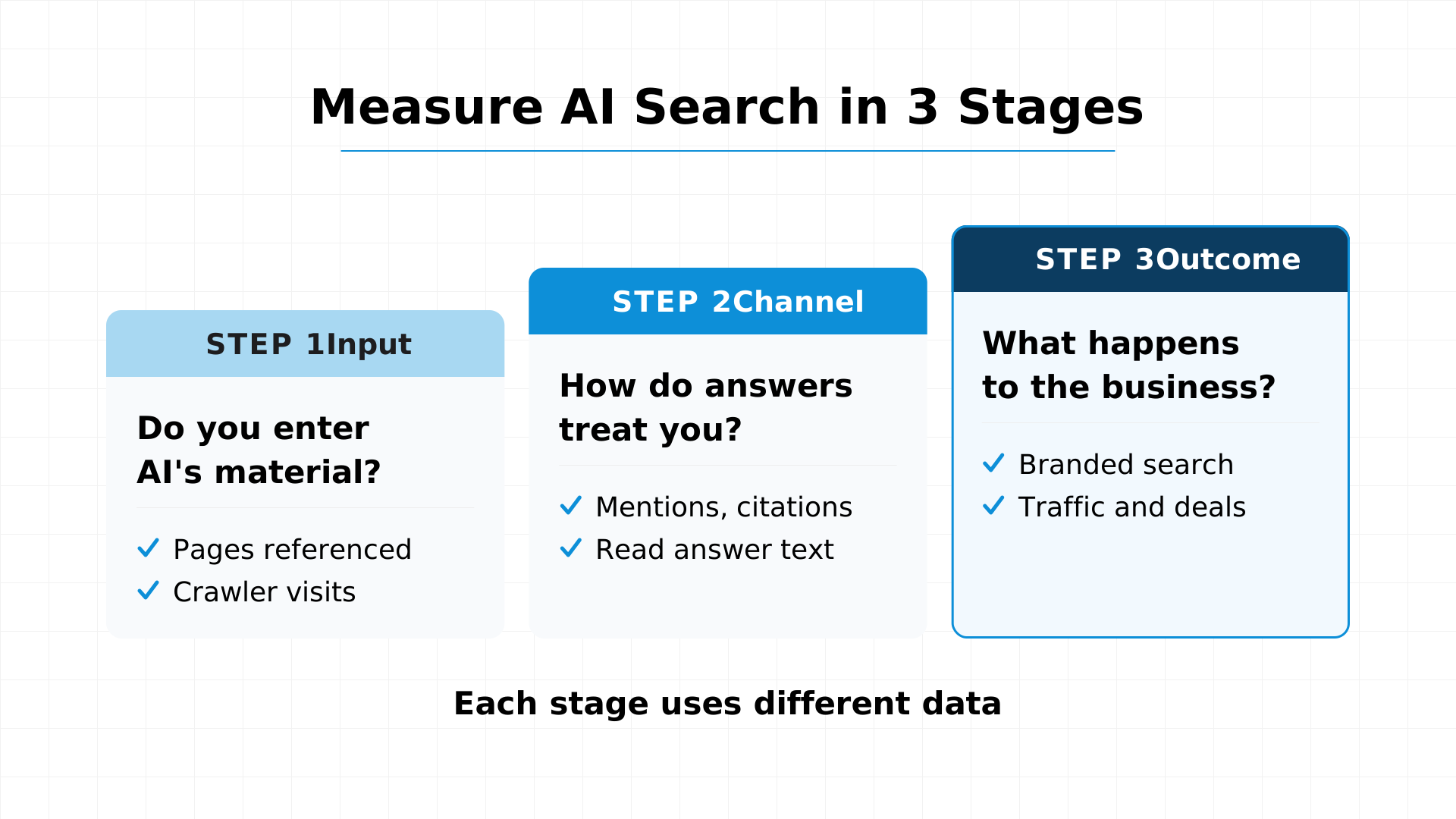
Measure AI search results in three stages: whether AI retrieves you (input), how you are treated inside answers (channel), and what happened to the business (outcome). This is the framework Mike King proposes, and each stage uses different data.
What to Look at in Each Stage, and With What Data
Here is what each stage looks at and the data it uses.
Stage
What to look at
What data to use
Input
Whether AI gathers your pages as material for its answers
Your pages referenced in AI answers, AI crawler visits recorded in server logs
Channel
Whether your name appears in answers (mentions), whether you become a source (citations), how you are described
Records of answers to questions sent repeatedly, comparison with competitors, answer text
Outcome
What happened to the business, weeks to months later
Branded search and the generative AI report in Search Console, AI traffic in GA4, inquiry forms, sales opportunity records
The generative AI report in Search Console was introduced in June 2026 and became available to all sites by the end of August (Google Search Central). It shows how often your URLs appeared in generative AI features such as AI Overviews, by page, country and date. Because it does not include clicks, it tells you that you were shown but not whether that led to visits.
In the Channel Stage, Measure Mentions and Citations Separately
The most important thing in the channel stage is to separate mentions from citations. A mention is whether your name came up in the answer, and it shows whether you were "chosen" as a candidate for comparison. A citation is whether your page was used as a source for the answer, and it shows whether you "became a source."
These two do not necessarily move in the same direction. Your page may be cited without your name appearing in the answer, and your name may appear based only on third-party articles. If you treat AI search as a brand channel, mentions should be at the center. Use citations as an indicator of whether the material supporting those mentions comes from your own site.
How This Relates to "Visibility in AI, How You Come Across and Business Impact"
"AIO Is Not an Extension of SEO. It Is Marketing That Builds the Reasons Customers Choose You" introduced looking at AIO results in three layers: visibility in AI, how you come across, and business impact. Visibility in AI and how you come across correspond to this article's channel stage, and business impact corresponds to the outcome stage. The three stages in this article add an input stage before them: whether AI retrieves you at all. When channel-stage numbers fail to grow, this lets you tell whether the cause lies in the input stage or in how you are treated inside answers.
Treat Outcome-Stage Evidence According to Its Strength
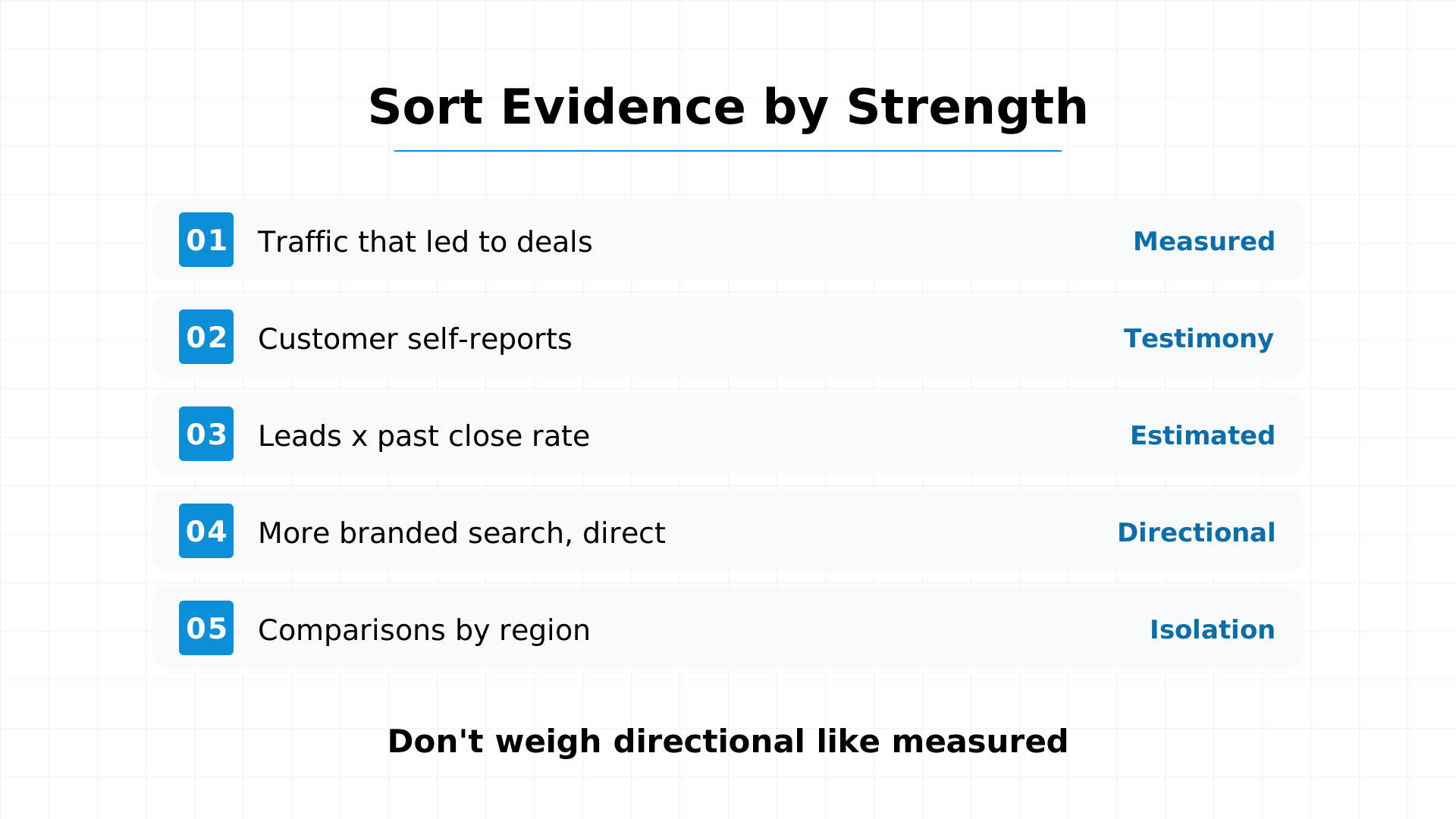
Not all evidence gathered in the outcome stage is equally strong. A record directly linked to a deal or revenue and a change such as rising branded searches support different conclusions. It is important to sort evidence by strength and not to report strong and weak evidence mixed together.
Distinguish Measured, Estimated and Directional
A Search Engine Land article proposes bringing the thinking of RevOps (revenue operations), which manages sales and marketing numbers in one place, into the evaluation of SEO and AI search (Search Engine Land, October 2026). The article recommends treating contribution to revenue at three levels of confidence.
Measured: analytics and customer records are connected, so you can trace the path from visit to deal and closed sale
Estimated: when you have leads but no closed sales yet, the revenue projected from past close rates and average customer value
Directional: signals such as AI citations or rising branded search that suggest business impact but cannot show a contribution to revenue on their own
Most AI search results remain at the directional level. Not reporting directional evidence with the same weight as measured evidence is the prerequisite for getting your organization to trust how AI search is evaluated.
Ask Customers: Trace AI's Influence Directly Through Self-Reports
The influence of AI that analytics cannot track can be traced by asking customers directly. When someone who learned about you through AI then searches for your name or types your URL directly, analytics cannot tell that the source was AI. Customers' own reports are one of the few ways to confirm these invisible paths and connect them to leads and deals.
In practice, add a "How did you hear about us?" field to your inquiry form and include AI options such as ChatGPT and Gemini. In sales conversations, ask whether prospects used AI when comparing options, and which AI described you and how. If you record the answers in your lead and deal records, you can track how far AI-originated deals led to closed sales and revenue.
Kevin Indig also recommends combining customer self-reports with visibility metrics, rather than relying on clicks alone, and tying them to closed sales and revenue in monthly reports. According to his article, US corporate card company Ramp estimated, using a method that included self-reported attribution, that 30–40% of its direct traffic was prompted by AI answers. If visibility is rising but customers rarely mention AI, that is also a cue to check whether the questions you are tracking have drifted away from how customers actually research.
Rising Branded Search and Direct Traffic Are Clues, Not Proof
It is quite possible that someone who learned your name through AI later searches for your company or types your URL directly. But you cannot count an increase in branded search or direct traffic as an AI result as is. In the same Kevin Indig analysis, direct traffic to the sites studied rose 140.9% from January to September 2026, while engaged direct traffic stayed nearly flat, and much of the increase was bot traffic. One site had 409,000 direct sessions but only 198 engaged sessions.
Also, even when he deliberately shifted the timing between rising AI visibility and rising branded search or direct traffic, relationships of similar strength sometimes appeared. In other words, overlapping timing alone cannot isolate AI's effect. That said, he also states, "An effect could still exist. I just couldn't isolate it." Not finding a relationship is not proof that there is no impact.
Create a Holdout Group Without the Initiative
When you want to isolate the effect of an initiative, create a comparison group where you do not run it (a holdout). Mike King recommends splitting targets by region, product line or business unit and comparing the side where you ran the initiative with the side where you did not. If you can make a comparison under matched conditions, you can raise directional evidence to a strength close to an estimate.
He also urges people not to treat imperfect measurement as a reason to do nothing. Rather than stopping because results cannot be traced directly, the realistic approach is to keep making decisions with the indicators available now, while stating the strength of the evidence.
What Dr.AISEO Can and Cannot Measure
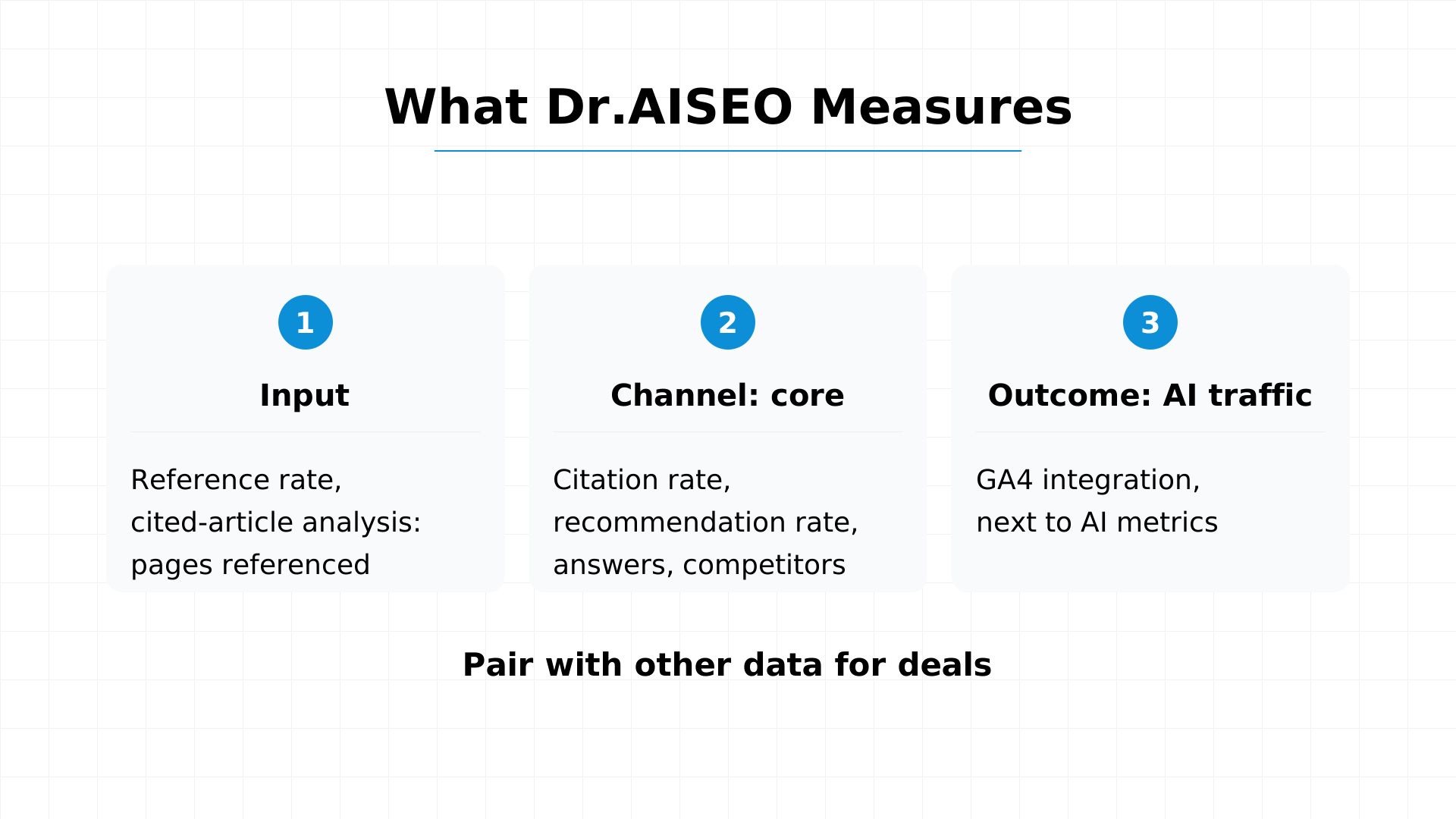
Dr.AISEO is a tool that measures mainly the channel stage of the three, along with the input stage and, within the outcome stage, traffic from AI. It does not measure branded search, customer feedback or deals, so use it together with Search Console, your inquiry forms and your customer records.
Channel Stage: View Mentions and Citations Separately
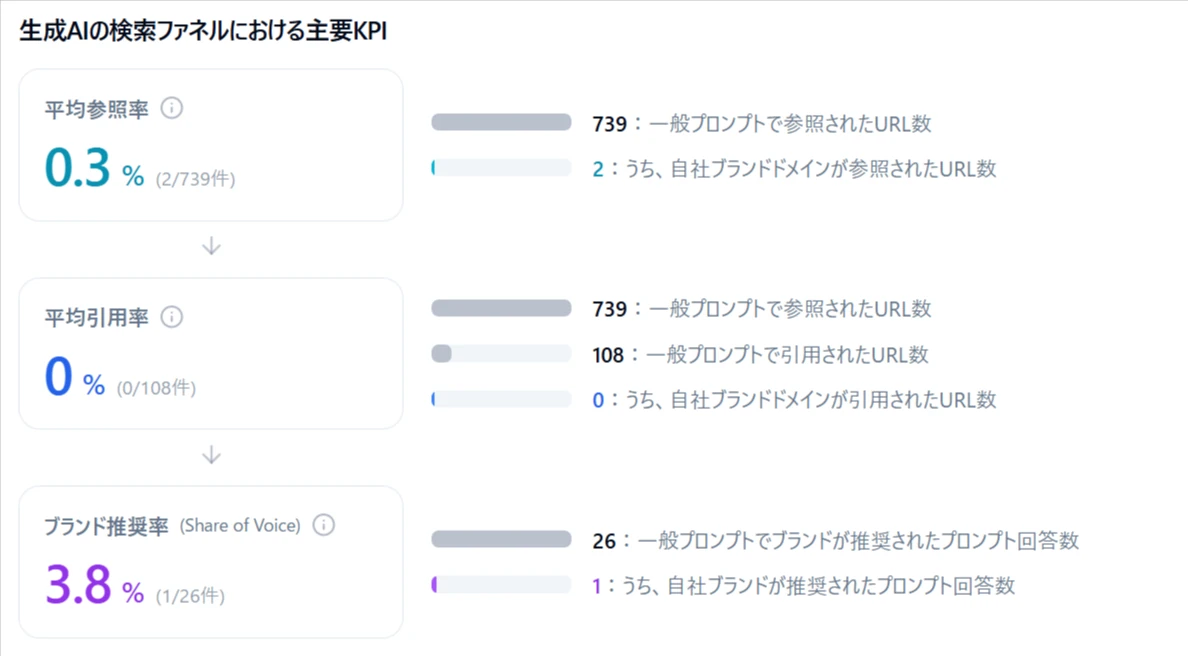
Dr.AISEO's dashboard shows the reference rate, citation rate and brand recommendation rate separately for general prompts (questions) that do not include your brand name. The citation rate is the share of URLs AI actually used as sources that include your site, which corresponds to "citations" in this article. The brand recommendation rate is the share of answers, among those including competitors, in which AI recommended or introduced your company, which corresponds to "mentions."
Visibility analysis screen. Viewing the reference rate, citation rate and brand recommendation rate separately shows at which stage you are stumbling.
For example, in the screen above the brand recommendation rate is 3.8% and the citation rate is 0%. In this case, you can read that while some answers name you, your own site is not being used as a source. Your name may be appearing based on third-party articles and similar sources, and adding information to your site that can serve as material for comparison is a possible next step. Viewing the numbers separately lets you see at which stage you are stumbling.
For branded prompts that state your brand name explicitly, you can see the share of answers in which AI described your company in a positive context (positive rate). For both types of questions, you can trace back to the answer text and the URLs that were referenced and cited. If you register competitors, you can compare yourself with them on the same metrics.
Send the Questions Customers Are Likely to Ask, Repeatedly, and Keep a History
When you register consultations customers are likely to bring to AI as questions, they run automatically on a regular schedule and a history of answers builds up. You can choose the frequency yourself, from 0 times a week (no scheduled runs) to 7 times a week (daily); the default is twice a week (once a week on the free plan) (as of November 2026). By continuing to send the same questions, you can compare before and after an initiative, and against competitors, on a quarterly basis. Past answers cannot be recovered later unless you recorded them.
Input Stage: See Which Pages AI Referenced
The reference rate is the share of URLs AI gathered as candidates for its answer that include your site. On the cited-article analysis screen, you can check which domains AI referenced and cited, and which articles on your own domain were cited. If your reference rate is low, you know the issue comes before how you are treated in answers: you are not getting into AI's material in the first place.
Outcome Stage: View AI Traffic Side by Side; Combine Other Data for Branded Search and Deals
GA4 integration is available on all plans, including the free plan (as of November 2026). Once connected, you can check the number of sessions from AI services such as ChatGPT, Claude and Gemini to your site over 7-, 14-, 30- and 90-day periods, side by side with your AI metrics.
Look at trends in branded search in Search Console, the number of times you appeared in AI Overviews in Search Console's generative AI report, and customer feedback in your inquiry forms and sales records. By reading channel-stage trends from Dr.AISEO side by side with this outcome-stage data in the same quarterly units, you can make decisions while keeping the strength of the evidence distinct.
Summary: Visibility Is a Leading Indicator; Deals and Revenue Are the Final Outcome
Traffic from AI search is tiny compared with Google organic search. Even so, having your name come up in AI answers and being described as an option for comparison has value that traffic cannot measure. AI search should be measured not as a demand-capture channel judged by traffic and conversions, but as a brand channel.
When you measure it, split it into the three stages of input, channel and outcome, and distinguish the strength of the evidence. Mentions and citations in AI are leading indicators, deals and revenue are the final outcome, and customer self-reports connect the two. Assuming there are effects you cannot see, while not conveniently counting what you cannot see as results, is the condition for keeping your organization's investment in AI search going.
With Dr.AISEO, you can check how AI mentions and cites you for your own questions, starting with the free plan. Start by recording where you stand in the channel stage, and line it up with your outcome-stage data every quarter.