Home/Blog/Which Tools Can Create Articles AI Will Choose?
AISEO Strategy2026.09.17
Which Tools Can Create Articles AI Will Choose? How to Write for Generative AI Search, and How to Compare Tools
No single tool can guarantee that AI will cite you just because you adopted it. What matters is building on standard SEO, creating articles that contain first-party information only your company can provide, and continuously checking your visibility in AI. This article explains how to think about article creation tools with AI interviewer and AIO/GEO features, what to check when comparing them, and how to run them after adoption.
3 functionsCollecting first-party information, reflecting it in the outline, and checking visibility after publishing
4 stagesCompare tools across research, material collection, outlining/generation, and improvement
5 itemsFields to record consistently every time you run fixed-point monitoring
Among companies investing in AI search optimization, more and more people are asking, "Which tools can create articles that AI will choose?" The short answer: no specific tool guarantees AI citations simply because you adopted it. Google itself explains that optimizing for generative AI search is an extension of basic SEO, and that original, genuinely useful content is what matters (developers.google.com).
What Is an Article That AI Chooses?
An article that AI chooses is one that answers searchers' questions while containing first-party information or original perspectives that other pages lack. AI search works by pulling information from multiple web pages and generating an answer to the question. That is why it matters to include your company's own experience and decision-making material rather than repeating generic explanations.
Google's View: Standard SEO Is the Foundation
Optimizing for generative AI search rests on the same foundation as standard SEO. Google explains that its generative AI features, such as AI Overviews and AI Mode, are built on its search index and its existing ranking and quality systems. So rather than special tactics aimed only at AI search, you should prioritize these basics:
Publish information that matches search intent
Make pages crawlable and indexable
Organize headings and paragraphs clearly
Make the content accurate and useful for readers
Add information and experience unique to your company
Labels such as AIO (AI Optimization) and GEO (Generative Engine Optimization) exist, but from Google's perspective they are treated as part of SEO for the search experience.
What AI Search Values: First-Party Information and Originality
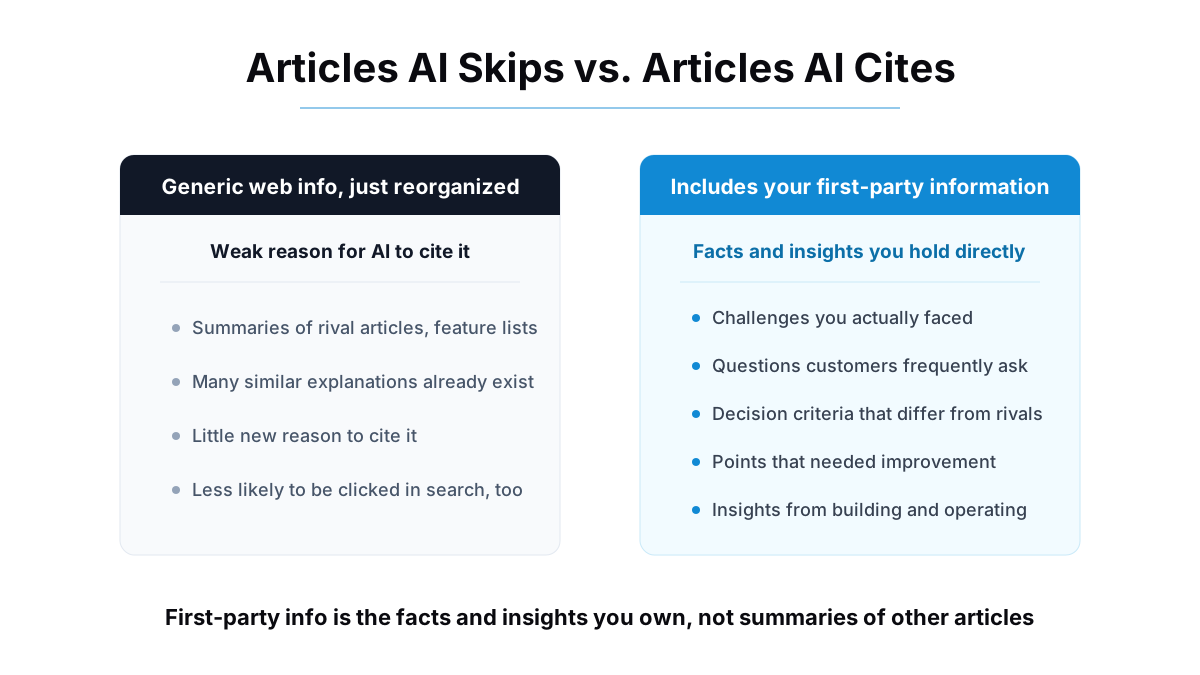
To create articles that AI search is likely to cite, it is effective to include first-party information such as your company's experience, customer case studies, research findings, and decision criteria. Articles that merely reorganize generic information from the web give AI a weak reason to cite them, because search results already contain many similar explanations.
To create articles that AI chooses, it is important to organize first-party information like the following before generating any text:
Challenges your company has actually faced
Questions customers frequently ask
Decision criteria that differ from other companies
Not only successes, but points that needed improvement
Insights gained from developing and operating your services
Three Functions an Article Creation Tool Needs to Get Chosen by AI
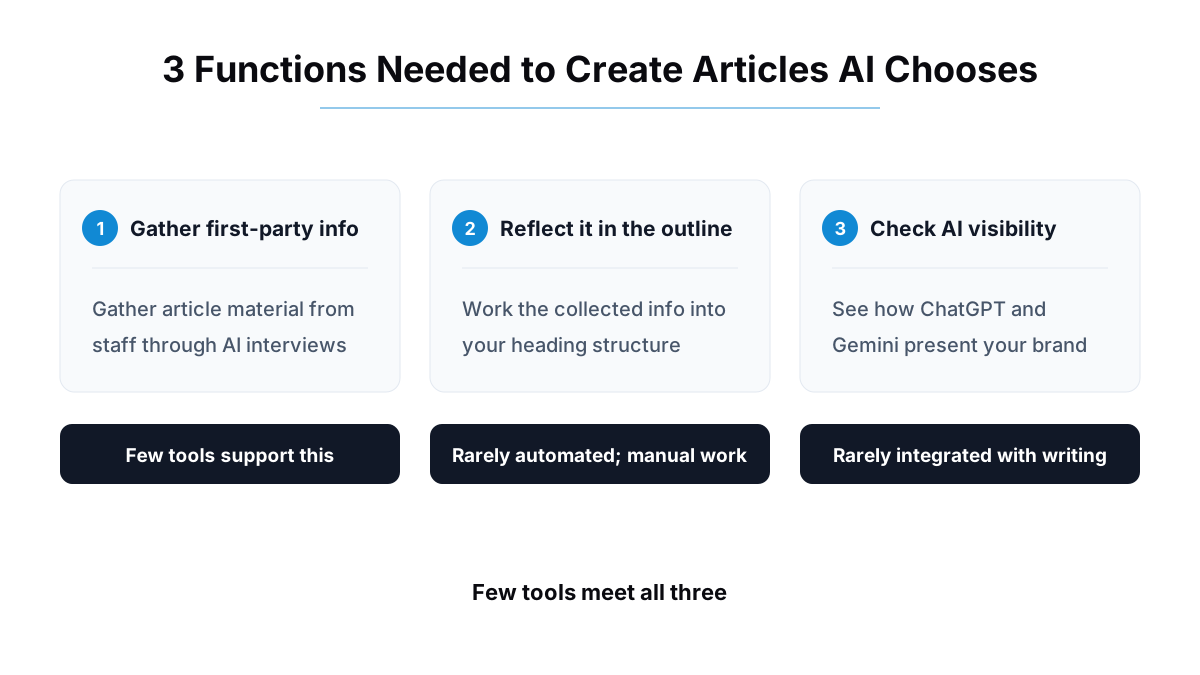
Creating articles that AI chooses requires three functions: (1) collecting your company's first-party information, (2) reflecting it in your article outline, and (3) checking how AI treats you after publishing.
Most products sold as article creation tools, however, are designed around generating text from keywords and competitor articles, and few currently meet all three requirements. When comparing tools, look at whether they cover all three rather than whether they can generate text; that makes the differences clear.
Collect Article Material Starting from AI-Generated Questions
The first is a function for collecting your company's first-party information before writing. Typical article creation tools generate an article from information on the web once you enter a keyword. With this approach, the output tends to stay within the range of what is already published, and originality is left for the writer to add afterward.
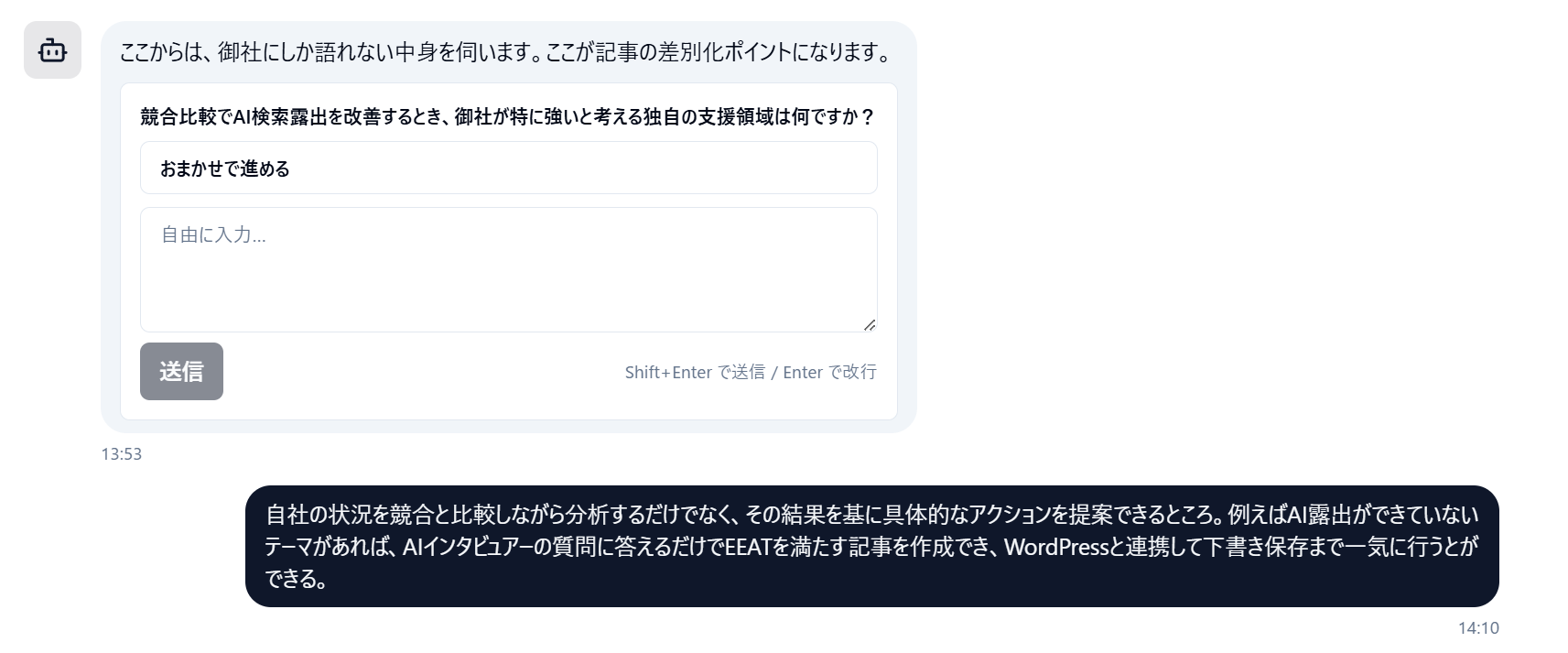
Dr.AISEO's AI Interviewer feature, by contrast, lets your team organize article material by answering questions from AI. The difference is that you can start from experience and facts unique to your company, but few tools are built this way.
Screenshot of the Dr.AISEO app (Japanese UI)
Example questions include:
What problems did customers face before adopting the service?
Under what conditions do you decide on a course of action?
How do you differ from other companies' services?
What tends to be overlooked in day-to-day practice?
With this method, your team does not have to write a finished draft from scratch. By answering the AI's questions, you can accumulate in-house knowledge as material for articles.
Turn Your First-Party Information into an Article Outline
The second is a function for reflecting the collected first-party information at the outlining stage. Many tools already generate heading structures automatically. However, most build the outline by referencing the headings of top-ranking competitor articles, so the output drifts toward the average competitor structure.
Incorporating your own collected first-party information into the outline, on the other hand, is rarely automated by tools, and in practice it often falls to the writer to insert it by hand. When turning it into an article outline, organizing it in the following order makes it easier to use in practice:
Define the conclusion readers want to know
Organize the general background information
Add your company's own experience and decision criteria
Spell out specific situations where the tool is used
Provide material that helps readers decide whether to contact you or request materials
Because Dr.AISEO lets you use the answers collected through AI interviews directly as outline material, it is easier to avoid "improvements" after publishing that amount to nothing more than adding generic content.
Support Everything from Generation to Improvement in One Flow
The third is a function for checking how you are treated in AI after publishing and feeding that into the next improvement. Today's tool market is split between products specialized in article creation and products specialized in checking AI search visibility, and few services handle both in one environment. As a result, many companies contract separately for a creation tool and a measurement tool and reconcile the data by hand.
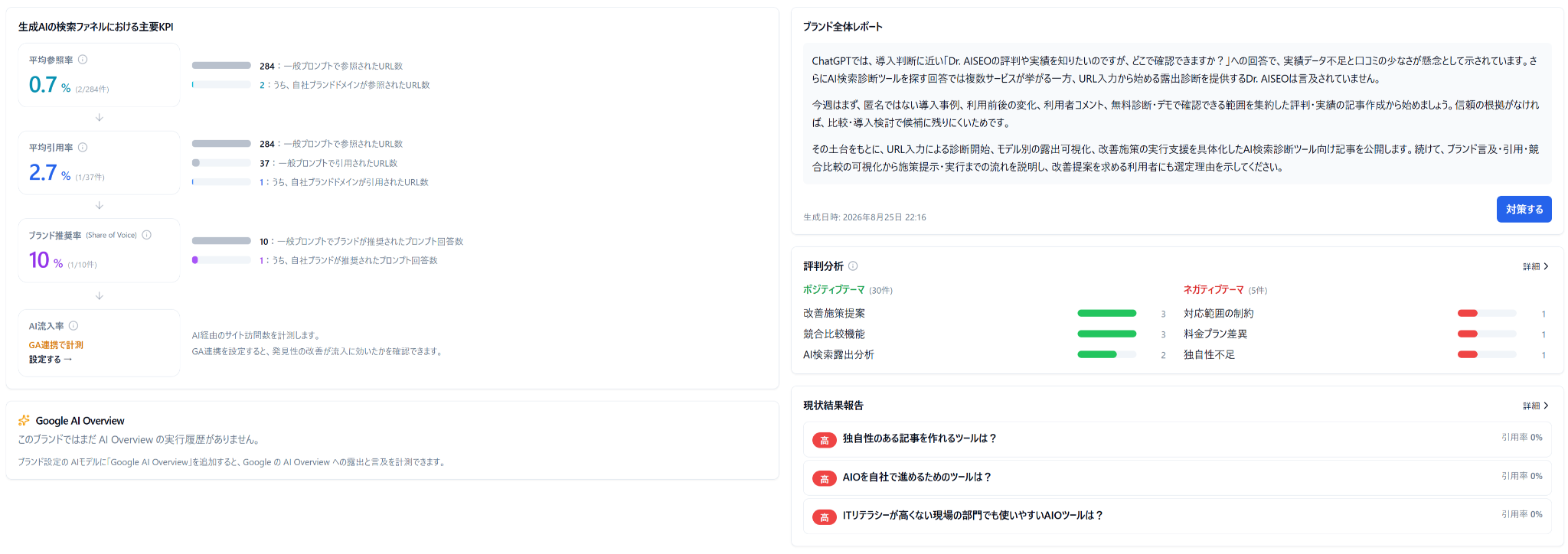
Dr.AISEO lets you check your visibility in ChatGPT and Gemini in addition to generating articles. You can monitor whether the articles you created are actually being used in AI answers and feed the results into your next article.
Screenshot of the Dr.AISEO app (Japanese UI)
Being able to manage research, AI interviews, article creation, visibility diagnosis, and improvement as one continuous flow is what sets it apart from standalone generative AI or typical SaaS tools.
What to Check When Comparing Tools
When comparing AI search optimization tools, the key is to check how much they streamline the work from research through improvement. Almost every tool handles research and generation, while only a limited number support collecting first-party information and checking AI visibility at all. The latter is where tools really differ.
Which Stages from Research to Improvement Does It Support?
When comparing tools, check the following four stages separately.
AI interviews, organizing in-house first-party information
Supported by few tools
Can it systematically collect your company's information?
3. Outlining and generation
Heading creation, draft generation, rewriting
Supported by many tools
Does it go beyond the average competitor structure?
4. Improvement
Visibility diagnosis, citation checks, monitoring
Mostly dedicated tools; rarely integrated with creation features
Can you run post-publication PDCA in one environment?
Research and outlining/generation rarely differ much between tools, so comparisons in these areas tend to come down to price and usability. The differences show up in stage 2, material collection, and stage 4, improvement. Material collection in particular is a stage many tools simply do not have, in which case interviewing staff and adding original information to drafts must be done manually.
Does It Track and Monitor AI Visibility?
AI search optimization requires checking how your company and services are treated after publishing. Visibility diagnosis is a function that asks AI such as ChatGPT and Gemini questions and checks whether your company name or articles appear in the answers. This function is mostly offered by dedicated visibility-measurement tools, and it is not often built into article creation tools.
Items to check include:
Does your service appear in the answer?
Which competing services are you compared with?
Is your site shown as a cited source?
How does the AI describe your company?
Are there misunderstandings or gaps in the answer?
Also, one-off checks cannot capture changes in results over time. Confirm whether the tool has a monitoring function that records results over time with consistent questions and check frequency. A tool that can run a diagnosis but keeps no records will not give you a basis for improvement decisions.
Judge Fit with Your Operations, Not Just Price
Choose a tool based on whether your team can keep using it, not only on how cheap it is. Even a feature-rich tool will struggle to deliver results if your team cannot handle the analysis and prompt management. In particular, running creation and measurement in separate tools adds not only contract costs but also the ongoing effort of switching between two screens and reconciling data.
When comparing, check the following:
Can the person in charge of articles operate it alone?
Can it store information from internal interviews?
Can multiple departments edit and review?
Is it easy to share reports with executives?
Can you manage the AI answer conditions and prompts?
To reduce the burden of managing creation and analysis in separate tools, we prioritize a design that handles article generation and AIO/GEO features in a single flow.
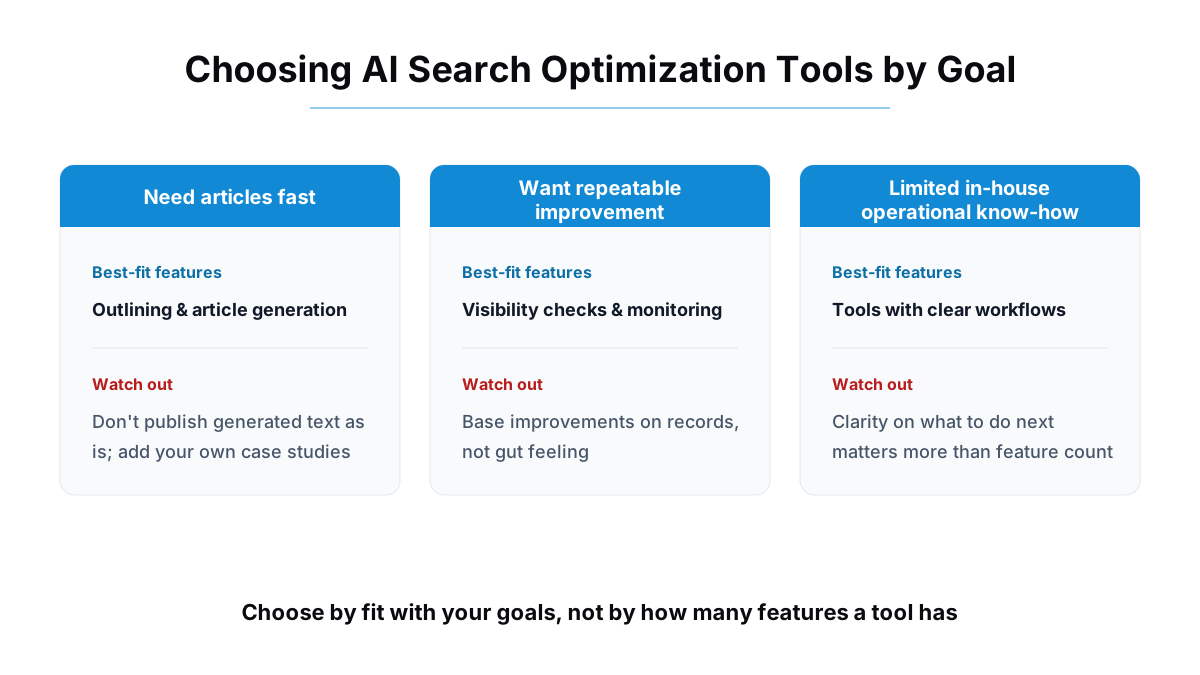
The right type of AI search optimization tool depends on your company's goals. A company that prioritizes the speed of article creation and one that prioritizes repeatable, ongoing improvement need different functions.
The Type That Suits Companies That Need Articles Fast
For companies that want to build up their article count in a short time, tools strong in outlining and article generation are a good fit. You can enter keywords and competitor information and get draft headings and copy, which shortens the time it takes to start writing.
However, you should avoid publishing generated text as is. Google explains that using generative AI to create large numbers of pages may violate its spam policies if they add no value for users. Even when you need articles fast, add at least the following information:
Your own case studies
The views of the person in charge
The criteria you use when delivering your service
Specific steps readers can take
The Type That Suits Companies That Want Repeatable Improvement
For companies that want to keep improving results after publishing, tools with visibility diagnosis and monitoring functions are a good fit, because they let you track how you appear in AI search at fixed points and use that to update existing articles or create new ones.
To make improvement repeatable, base decisions on records rather than gut feeling. For example, enter the same questions into ChatGPT and Gemini once a month and record the answers, the cited sources, and which competitors appear. Based on the results, make improvements such as:
Supplementing the information AI uses in its answers
Checking the gap between your page and the competitor pages being cited
Adding your own data and case studies
Reviewing how headings and body text correspond
How to Choose When You Have Little In-House Operational Know-How
If your company has limited SEO or AI search optimization know-how, it is important to choose a tool with a clear operating workflow rather than the most features. If you look at the analysis and still do not know what to do next, your initiatives will stall. For companies adopting a tool for the first time, the following functions make operation easier:
Information gathering through questions from AI
Automatic organization of headings and article structure
Visualization of visibility
Suggestions for themes to improve
Reports that can be shared across departments
Dr.AISEO's AI Interviewer feature organizes article material starting from your team members' answers. Another advantage for adoption is that it makes it easier for staff with specialist knowledge to pass information on to writers.
The Post-Adoption Workflow That Turns Into Results
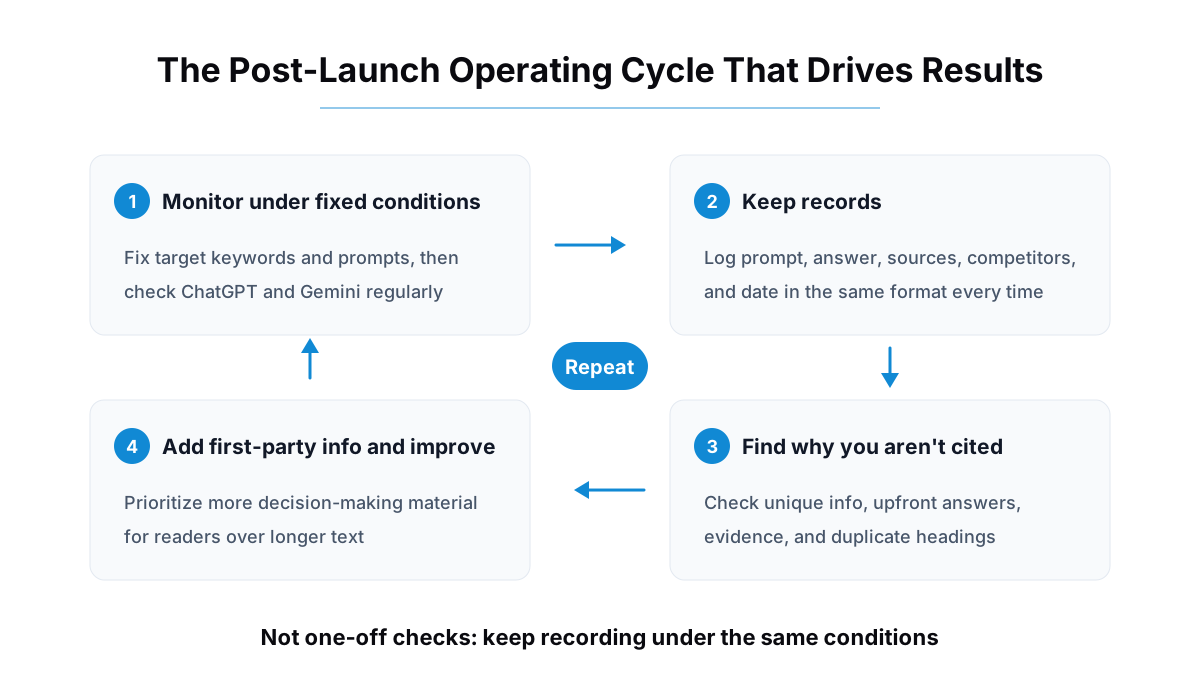
AI search optimization is not finished once you adopt a tool and publish articles. You need to keep checking visibility, identifying why you are not cited, and adding first-party information.
Monitor Whether AI Is Choosing You at Fixed Points
To check whether AI is choosing you, decide on target keywords and question wording, then survey regularly under consistent conditions. If the conditions change every time, you cannot accurately compare changes in visibility. In fixed-point monitoring, record the following items.
Item
What to record
Question
The question entered into the AI
Answer content
Whether your company and competitors appear
Cited sources
The pages and domains shown
Comparison set
Services introduced alongside yours
Date
The date of the survey
Checking multiple AIs such as ChatGPT and Gemini also reveals how answers differ by service. Dr.AISEO lets you check this kind of AI visibility and organize what to improve.
Review Why You Are Not Cited and Improve the Article
If AI does not cite you, it is not necessarily because of missing keywords. There can be several causes: too little original information, unclear answers to the question, insufficient evidence, and so on. Start by checking in the following order:
Does it answer the reader's question at the top?
Is generic information clearly separated from your own information?
Are numbers and case studies backed by evidence?
Do the sections under different headings overlap?
Are there concrete examples worth citing?
When improving, prioritize adding decision-making material over making the text longer. For example, instead of writing "we recommend it," show which companies it suits and under what conditions it does not; that makes the content far more practical.
Grow SEO and AI Search Optimization Together
SEO and AI search optimization are not initiatives that require separate articles. By improving alignment with search intent, technical readability, originality, and accuracy, you can serve both traditional search and AI search.
Google explains that to appear in generative AI search, a page must be indexed and eligible to be shown with a snippet. So pursue the following in parallel:
Choose topics that match search intent
Create articles that include first-party information
Connect related information with internal links
Check search performance in Search Console
Monitor visibility in AI search
Rather than chasing AI search results alone, it is important to also track business metrics such as search traffic, inquiries, and resource requests.
If you want to handle everything from collecting first-party information to checking visibility in one environment: Dr.AISEO handles first-party information collection with the AI Interviewer, article generation, visibility diagnosis in ChatGPT and Gemini, and post-publication monitoring in a single flow. It is designed to keep your improvement cycle going while cutting the effort of switching between creation and measurement tools.
Summary: Creating Articles AI Chooses Takes Both the Right Tool and the Right Operations
Creating articles that AI chooses requires not just generation features but also first-party information collection and post-publication improvement. Google's official guidance likewise centers optimization for generative AI search on basic SEO and highly original, useful content (developers.google.com).
Increasing Your First-Party Information Comes First
The top priority in creating articles that AI chooses is increasing your company's first-party information. Summaries of competitor articles and generic know-how alone make it hard to show new value to AI or to readers.
With the AI Interviewer feature, you can organize your team's experience and decision criteria into article material by answering questions. Clarifying "what only we can say" before writing is the starting point for making an article more original.
Organize What You Need to Decide on Requesting Materials or Contacting Us
When considering a tool, judge it against your own operational challenges, not just its feature list. Organizing the following points in particular makes comparison easier:
Do you need a system for collecting first-party information?
Is making article generation more efficient your priority?
Do you want to check your visibility in ChatGPT and Gemini?
Do you want article creation and visibility diagnosis in one place?
Can your team keep running the PDCA cycle internally?
Dr.AISEO supports first-party information collection with the AI Interviewer, article generation, visibility diagnosis in ChatGPT and Gemini, and post-publication monitoring. If you would like to see how it could work for your company, consider requesting our materials or contacting us.